
Fed Chair Kevin Warsh Signals Possible Rate Hike Amid Persistent Inflation
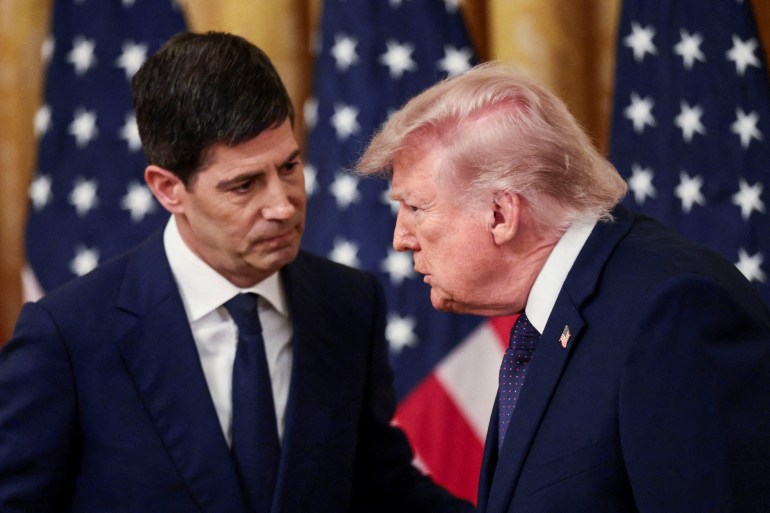
Federal Reserve Chair Kevin Warsh used his first Jackson Hole speech to warn about stubbornly high inflation, pushing markets to expect a rate increase as soon as September and affecting global financial assets.
By Hushread Stories, from 48 outlets · First published 18 Aug 2026
In brief
- Federal Reserve Chair Kevin Warsh signaled a possible interest rate hike due to persistent inflation during his Jackson Hole speech.
- Markets now expect a rate increase as soon as September, with odds rising from 30% to 57% after Warsh's remarks.
- Warsh emphasized the need to bring inflation back to the 2 percent target, making it a top priority for the Fed.
- The upcoming mid-September Federal Reserve policy meeting will be crucial for determining the next steps on interest rates.
- Political implications arise as Warsh's hawkish stance may conflict with President Trump's push for lower rates ahead of midterm elections.
Timeline · 8 moments
Trump says Fed's Warsh 'will do what he has to do'
Breaking News on Seeking Alpha Business & Economy ↗Investors wary after Warsh speech fuels rate-hike bets
Bloomberg ↗US Fed rate hike bets soar to 57% after Warsh's speech
Economic Times Business & Economy ↗Fed chair Warsh warns inflation too high at Jackson Hole
Time.news ↗Dollar rallies after Fed chief lifts rate expectations
World News CNA ↗Investors expect higher rates after Fed chairman's pledge
The New York Times ↗Fed chair warns inflation is still too high
NPR News ↗Gold prices fall ahead of Warsh's Jackson Hole speech
Time.news ↗How it started
Kevin Warsh took over as Chair of the Federal Reserve with inflation already running above the central bank's 2 percent target. The U.S. economy was facing persistent price increases, even as job growth slowed and market volatility eased.
Warsh's debut on the global stage came at the Jackson Hole Symposium, an annual gathering of central bankers and economists. Investors and analysts were eager to hear whether the new Fed chief would chart a new course or stick with previous policies.
How it unfolded
On August 28, 2026, Kevin Warsh addressed the Jackson Hole Symposium, making inflation control his main theme. According to Time.news and DIE ZEIT, he emphasized that inflation remained too high for comfort and signaled a willingness to raise interest rates if prices did not start falling soon. The Guardian and NPR News reported that Warsh told the audience there was still 'work to do' to bring inflation down, setting expectations for tighter monetary policy.
His remarks quickly rippled through financial markets. The New York Times and CNBC noted that investors began betting on a rate hike as early as September, with the odds jumping from around 30% to 57% after Warsh's speech, according to the Economic Times. Gold prices dropped sharply, while the dollar strengthened, as reported by ISNA and World News CNA.
Several outlets, including Bloomberg and Japan Times, highlighted that Warsh's stance set up a critical decision at the Fed's mid-September policy meeting. While some analysts predicted a 25 basis point rate hike, others cautioned that Warsh did not provide specific guidance on the timing, as noted by ARD Tagesschau and Bloomberg Economics.
The political implications were also clear. The New York Times and Seeking Alpha pointed out that Warsh's hawkish tone could put him at odds with President Trump, who has been pushing for lower rates ahead of the midterm elections. Trump later acknowledged that Warsh might 'do what he has to do,' but gave no details about possible White House responses.
Where it stands
By the start of September, the expectation of an interest rate hike at the Fed's next meeting has become the dominant market view. Warsh has maintained a firm focus on inflation, stating that bringing consumer prices back to the 2 percent target is a top priority.
While markets are bracing for higher rates, some investors remain cautious, noting that Warsh left the door open to changing course if economic data shifts before the September meeting. The central bank's next moves are likely to have wide-reaching effects on global markets and U.S. politics.
What to watch
All eyes are now on the upcoming Federal Reserve policy meeting in mid-September, where a rate hike is widely anticipated but not guaranteed. Analysts are also watching for further signals from Warsh and the Fed as new economic data comes in, particularly on inflation and employment.
More in Business
All →
Volkswagen salary freeze plan deepens tensions ahead of German labour talks
Reports of a worldwide pay freeze through 2030 have sharpened Volkswagen's dispute with employee representatives, as IG Metall threatens strikes ahead of another round of crisis talks.
15 sources · over 5 days
Musk backs $3.5 trillion Tesla and SpaceX merger as insiders raise concerns
Special committees are studying a combination of Musk's two companies, but his public backing has raised concerns about shareholder scrutiny, delays and the difficulty of valuing the business.
17 sources · over 2 days
SBI Says 3,897 Customer Records Exposed Among 3.75 Lakh Dark-Web Records
SBI's preliminary analysis found personal information in 3,897 records among around 3.75 lakh records available on the dark web, while the bank reported no material impact on its IT systems or financial performance.
14 sources · over 3 days