Astronomers Discover S301, Fastest Star Orbiting Milky Way's Black Hole
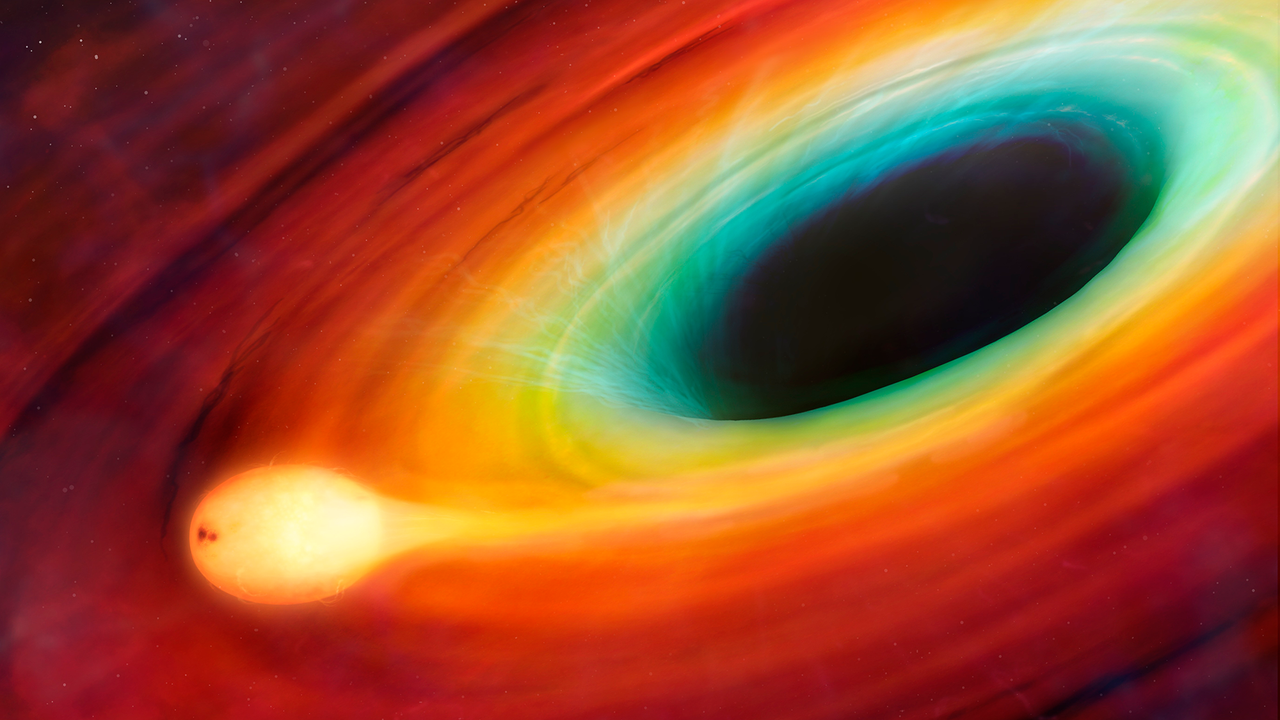
The discovery of star S301, racing around Sagittarius A* at 25,000 kilometers per second, gives scientists a unique chance to study the black hole's spin and put Einstein's relativity to the test.
By Daniel Okafor · First published 19 Aug 2026
In brief
- Astronomers discovered S301, the fastest known star, orbiting Sagittarius A* at 25,000 kilometers per second.
- S301 completes its orbit every 8.7 years, providing unique data on the black hole's properties.
- The star's orbit allows scientists to potentially measure Sagittarius A*'s spin within the next decade.
- S301 is about 1.5 times the mass of the Sun and five times brighter than typical stars in its vicinity.
- Future observations will test general relativity and look for deviations from Einstein's predictions.
Timeline · 4 moments
Fastest known star found orbiting Milky Way's black hole
Science Magazine ↗Scientists find closest star to the Milky Way's central black hole
Ars Technica Tech ↗Scoperta la stella più veloce della Via Lattea, sfreccia a 25mila km al secondo
RSS di - ANSA.it ↗Fastest star ever spotted at the centre of our galaxy
New Scientist ↗How it started
Astronomers have long tracked stars near the center of the Milky Way, searching for clues about the massive black hole, Sagittarius A*, lurking there. These stars, known as S-stars, move in tight, fast orbits, providing a natural laboratory for extreme physics.
The hunt for even faster and closer stars continued as telescopes and instruments improved. Researchers hoped to find a star whose speed and proximity could reveal more about the black hole's properties and the nature of gravity itself.
How it unfolded
In August 2026, several research teams announced the discovery of S301, a star orbiting Sagittarius A* at a record-breaking speed. According to Science Magazine and Live Science, S301 moves at about 25,000 kilometers per second, or more than 8 percent the speed of light. Live Science reported that the star completes an orbit every 8.7 years, making it both the fastest and closest known star to the black hole.
Phys.org and World News CNA highlighted that S301's orbit is so tight and fast that it offers a rare opportunity to study the effects of the black hole's spin on nearby objects. Scientists believe this could allow them to directly measure Sagittarius A*'s rotation for the first time within the next decade.
Coverage from outlets like Scientific American and Universe Today noted that the discovery also provides a new way to test Einstein's theory of general relativity under extreme conditions. The Gravity collaboration, whose findings appeared in Nature, played a key role in pinpointing S301's speed and orbit, according to ANSA.it.
Further details emerged in follow-up reports. For instance, Ars Technica pointed out that S301's nearly escape-velocity orbit (with an eccentricity of 0.9832) makes it especially useful for probing the black hole's gravitational field. In.gr added that S301 is about 1.5 times as massive as the Sun and five times brighter, making it stand out among stars near the galactic center.
Where it stands
S301 is now recognized as the fastest known star in the Milky Way, moving at incredible speeds around the supermassive black hole Sagittarius A*. Its orbit and behavior are already providing astronomers with new data on how gravity and black holes work in the most extreme environments.
The discovery has been widely reported and discussed in the scientific community, with researchers now focused on monitoring S301's future orbits and interactions with the black hole.
What to watch
Scientists plan to use S301's future movements to attempt the first direct measurement of Sagittarius A*'s spin. Continued observation will also allow researchers to test general relativity and look for any deviations from Einstein's predictions. The next few years are expected to bring more precise data as S301 completes its tight, high-speed loop around the black hole.
More in Science
All →
NASA Launches Nancy Grace Roman Telescope to Unravel Dark Universe
NASA successfully launched the $4.3 billion Nancy Grace Roman Space Telescope on August 30, 2026, with the goal of exploring dark energy, dark matter, and distant planets, promising major advances in cosmic research.
80 sources · over 16 days
Trump Launches US Space Academy and Honors Artemis II Crew in Houston
President Trump has signed an executive order creating the US Space Academy, coinciding with awarding the Artemis II crew the Congressional Space Medal of Honor after their record-setting lunar mission.
27 sources · over 10 days
Scientists Discover Double Spiral Structure Inside Narwhal Tusks Using X-Rays
Canadian-led research has revealed that narwhal tusks contain two opposing spiral layers, providing new insight into their strength and the biology of these mysterious Arctic whales.
11 sources · over 6 days