Supreme Court Temporarily Lets Trump Continue $400 Million White House Ballroom
The US Supreme Court has allowed President Trump to keep building a controversial, privately funded White House ballroom after lower courts tried to halt the project, triggering a fierce legal and political fight.
By Samuel Adeyemi · First published 17 Aug 2026
In brief
- The Supreme Court has temporarily allowed President Trump to continue construction on a $400 million White House ballroom.
- Construction is currently about 65 percent complete and funded entirely by private donors and corporations.
- The Supreme Court's order pauses a lower court's ruling that halted the project amid legal challenges.
- Key legal questions include presidential authority, Congressional approval, and the use of private funds for federal property.
- A final ruling from the Supreme Court could determine the project's fate as construction progresses.
Timeline · 7 moments
Congress has already approved White House ballroom project
The Hill ↗Preservationist group urges Supreme Court to keep White House ballroom paused
The Hill ↗How the Supreme Court could use Trump's ballroom to gut environmental law
VOX ↗Supreme Court temporarily allows Trump ballroom construction to continue
NBC News ↗Chief Justice Roberts briefly allows White House ballroom construction
The Hill ↗White House ballroom will cost nearly $400m as Supreme Court allows work to continue
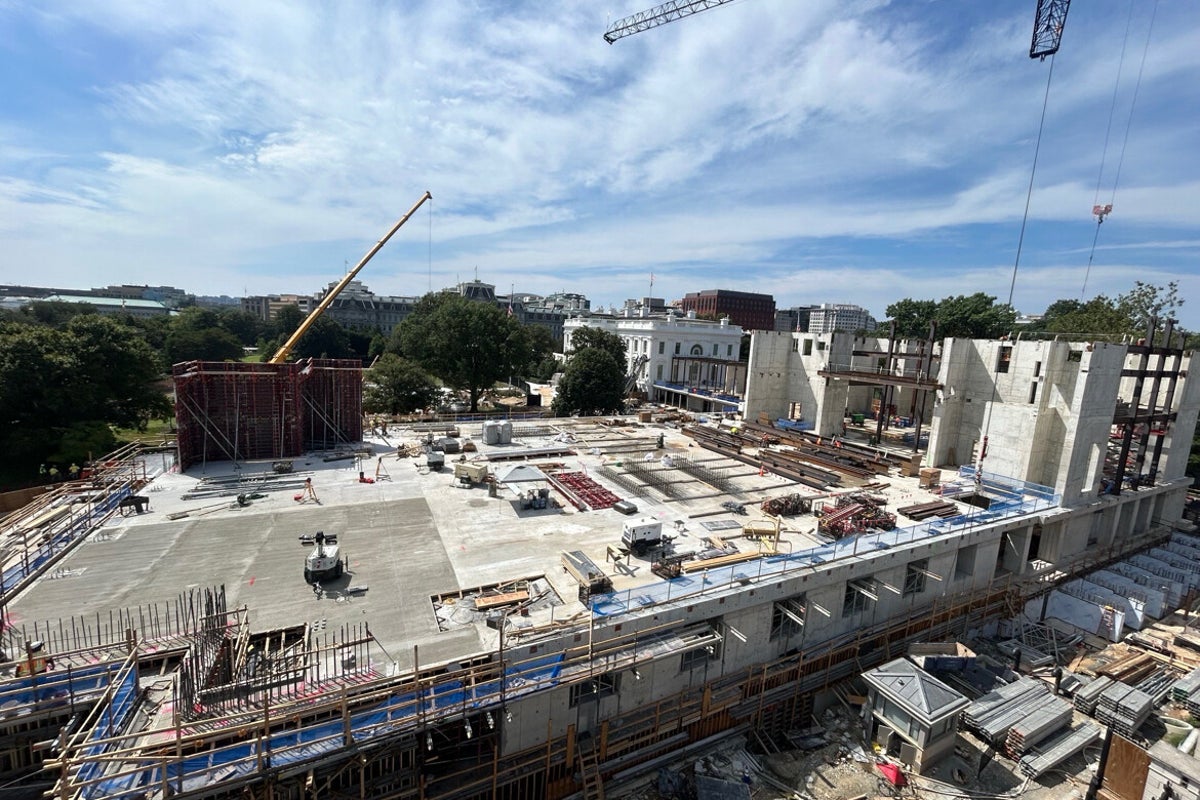
Euronews ↗Trump gloats over ballroom construction with new photo after Supreme Court allows him to keep building, for now
The Independent ↗How it started
Plans for a new White House ballroom first gained attention in 2026, with President Trump proposing a $400 million project to replace the East Wing. According to The Hill, the Department of Justice argued that Trump had the authority to proceed, claiming Congress had already approved the project.
However, critics, including preservationist groups, quickly challenged the plan. They argued that such a large-scale alteration to the White House required further Congressional approval and raised concerns about historic preservation and environmental law.
How it unfolded
By mid-August 2026, demolition of the East Wing had been approved and work on the ballroom was moving quickly, as reported by The New York Times. The Trump administration insisted the project was too advanced to pause, with construction running 20 hours a day.
Legal challenges mounted, with a federal court ordering a halt to the project on August 7, according to Franceinfo. Opponents argued that the president lacked the authority to move forward and questioned the legality of using private donations for the construction, as covered by The Conversation and The Independent.
The Trump administration appealed to the Supreme Court for emergency relief. On August 21, Chief Justice John Roberts issued a temporary stay, pausing the lower court's order and allowing construction to continue while the Supreme Court considers the case, according to NBC News and The Hill.
The pause was described by multiple outlets as an administrative stay, meaning the project can proceed for now but remains under judicial review. Trump celebrated the decision, sharing photos of the construction and calling it under budget and ahead of schedule, as noted by The Independent and Euronews.
Where it stands
At present, construction on the White House ballroom is ongoing. The Supreme Court's temporary order allows the Trump administration to continue work while the legal battle continues. The project is reportedly about 65 percent complete and funded entirely by private donors and corporations, according to Euronews.
The Supreme Court has not yet ruled on the underlying legal issues, which include questions about presidential authority, Congressional approval, and the use of private funds for federal property. The outcome could set a significant precedent for future presidential building projects.
What to watch
The Supreme Court is still considering the emergency appeal from the Trump administration. A final ruling could either allow the project to finish or force it to stop, even as construction nears completion. Key legal questions remain over the president's authority and the role of Congress in approving major changes to the White House.
Observers are also watching how the Court will address concerns about historic preservation and the legality of accepting private donations for such a project. The decision could have lasting effects on both the executive branch and the future of the White House itself.
More in Politics
All →
One Dead, Six Injured Including Police in Minneapolis Downtown Shooting
A shooting at a downtown Minneapolis apartment building left one person dead and six injured, including two police officers, prompting an ongoing investigation and heightened security in the area.
8 sources · today
Jury in Lindsay Clancy Triple-Murder Trial Deadlocked Over Mental Health Defense
After days of deliberations, jurors remain unable to reach a verdict on whether Lindsay Clancy is criminally responsible for killing her three children, highlighting deep divisions over mental illness and justice.
39 sources · over 19 days
Trump Says He's 'Happy' About Harry and Meghan Leaving the US
Former President Donald Trump publicly welcomed Prince Harry and Meghan Markle's departure from the United States, reigniting debate over the couple's relationship with the UK and the US.
10 sources · today