SpaceX Falcon 9 Rocket Crash Leaves 60-Foot Crater on the Moon
NASA has released detailed images showing the aftermath of a SpaceX Falcon 9 upper stage crashing into the Moon, a rare event that offers new insights into lunar science and space debris risks.
By Fatima Al-Rashid · First published 18 Aug 2026
In brief
- On August 5, 2026, a SpaceX Falcon 9 upper stage crashed into the Moon, creating an 18-meter-wide crater.
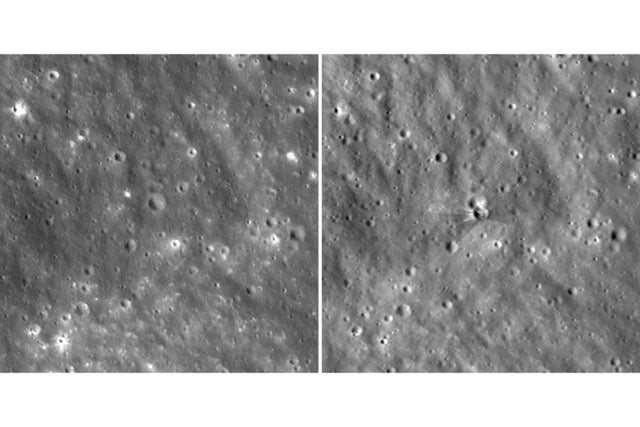
- NASA's Lunar Reconnaissance Orbiter captured images of the impact site, revealing significant disruption around the crater.
- The crash occurred in the Moon's southern polar region, an area of interest for future exploration missions.
- The incident highlights concerns about space debris as more private companies launch lunar missions.
- Researchers plan to analyze the crater to understand lunar geology and the implications for future lunar exploration.
Timeline · 8 moments
SpaceX Falcon 9 launches lunar landers and experiments
vc.ru: Популярное за все время ↗Falcon 9 rocket upper stage crashes into the Moon
Proto Thema ↗NASA LRO captures images of fresh lunar crater
Новости Молдовы - Point.md ↗NASA releases before-and-after photos of impact site
NASA Breaking News Space ↗NASA confirms 60-foot-wide crater from SpaceX crash
CBS Top Stories ↗Scientists measure crater depth using shadow analysis
NDTV News - World-news News ↗BBC details force and background of the crash
BBC - Home ↗NASA confirms size and significance of the crater
Universe Today ↗How it started
The story began with the launch of a SpaceX Falcon 9 rocket in January 2025. The rocket was tasked with delivering lunar landers and scientific instruments, including payloads from Firefly Aerospace and Ispace, according to vc.ru. After completing its main mission and separating from its payload, the Falcon 9 upper stage was left in a highly elliptical orbit around Earth and the Moon.
Over time, the rocket stage drifted further due to gravitational forces and solar radiation pressure. With no fuel or control systems left to guide it, it became a piece of space debris. Predictions indicated that its trajectory would eventually intersect with the Moon, but the exact impact location and timing remained uncertain until closer to the event.
How it unfolded
On August 5, 2026, the Falcon 9 upper stage crashed into the Moon at a speed of roughly 8,700 kilometers per hour, as reported by Mehr News and Proto Thema. The impact occurred in the Moon's southern polar region, an area of interest for future exploration.
NASA's Lunar Reconnaissance Orbiter (LRO) began searching for the impact site shortly after the predicted crash. Six days later, the LRO captured clear before-and-after images of a fresh crater, measuring about 18 meters (60 feet) wide and less than 10 feet deep, according to NASA and CBS. Scientists used the length of the crater's shadow to estimate its depth, as noted by NDTV.
The images showed rocky streaks and significant disruption around the impact site, indicating a high-speed collision. According to the BBC, the rocket had spent over a year drifting through space before hitting the lunar surface with the force of three tonnes of dynamite.
NASA released these images publicly on August 18 and 19, 2026. The event quickly drew attention from scientists and the media. Outlets like Sky News, Scientific American, and Popular Science highlighted both the scientific value of the new crater and the concerns about space debris from commercial launches.
Where it stands
NASA's detailed images of the impact site have provided researchers with new data about how artificial objects interact with the Moon's surface. The 60-foot-wide crater is now a permanent feature and a marker of human activity beyond Earth.
The incident underscores the growing conversation about the risks of unmanaged space debris, especially as more private companies conduct lunar missions. Scientists are studying the crater to learn more about lunar geology and the effects of high-velocity impacts.
What to watch
Researchers are expected to analyze the crater to better understand the Moon's subsurface materials and how future impacts might affect planned lunar exploration. The event may also prompt new discussions about tracking and managing spent rocket stages, as space traffic around the Moon increases.
More in Science
All →
NASA Launches Nancy Grace Roman Telescope to Unravel Dark Universe
NASA successfully launched the $4.3 billion Nancy Grace Roman Space Telescope on August 30, 2026, with the goal of exploring dark energy, dark matter, and distant planets, promising major advances in cosmic research.
80 sources · over 16 days
Trump Launches US Space Academy and Honors Artemis II Crew in Houston
President Trump has signed an executive order creating the US Space Academy, coinciding with awarding the Artemis II crew the Congressional Space Medal of Honor after their record-setting lunar mission.
27 sources · over 10 days
Astronomers Discover S301, Fastest Star Orbiting Milky Way's Black Hole
The discovery of star S301, racing around Sagittarius A* at 25,000 kilometers per second, gives scientists a unique chance to study the black hole's spin and put Einstein's relativity to the test.
22 sources · over 10 days