Trump Pushes Forward With Controversial 250-Foot Triumphal Arch Project in D.C.
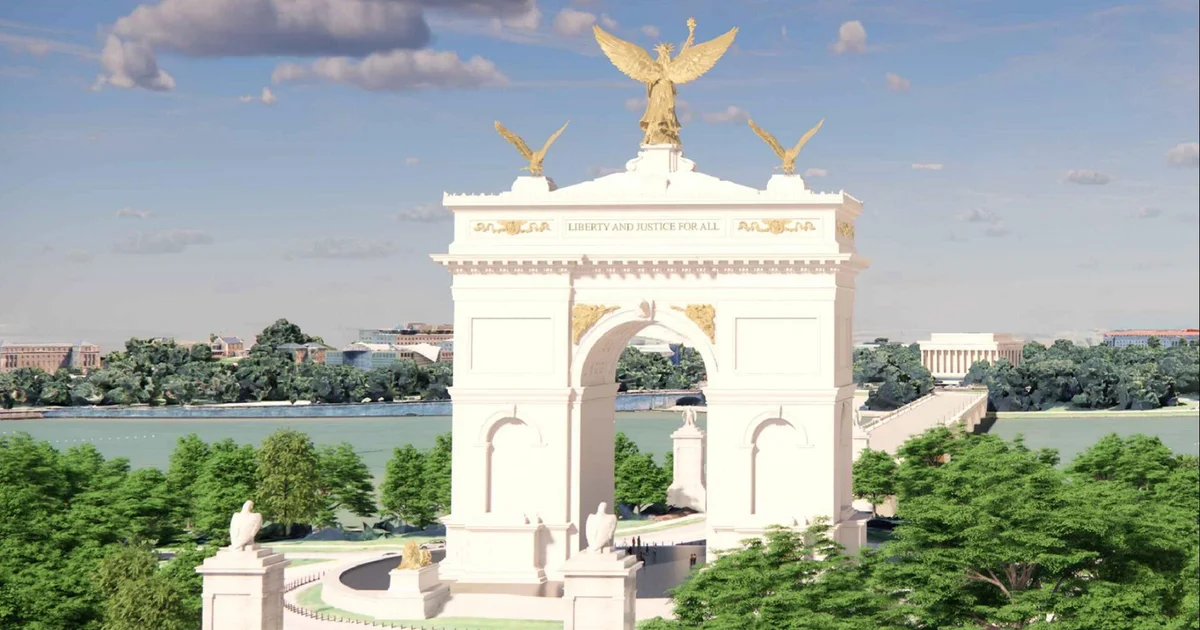
President Trump's proposed triumphal arch near Arlington National Cemetery is moving ahead despite historic preservation concerns and a dramatic new plan to make it a military complex.
By Ravi Menon · First published 20 Sept 2026 · Chapter 2 of 2
Earlier: Trump Advances Triumphal Arch Project Near Arlington Amid Historic Site Concerns
In brief
- President Trump has advanced plans for a 250-foot triumphal arch near Arlington National Cemetery in Washington, D.C.
- The National Park Service and administration officials have admitted the project will have adverse effects on historic sites nearby.
- The Federal Aviation Administration approved the project with adjustments to address flight safety due to its proximity to Reagan Airport.
- Trump recently announced the arch will also serve as a military complex, housing drones, snipers, and ammunition storage.
- Critics and veterans groups are pushing back, and a federal court is currently considering the legality of the project.
Timeline · 7 moments
Trump announces plan for triumphal arch near Arlington
The Daily Beast Latest Articles ↗Officials admit arch will harm historic sites
The Independent ↗National Park Service details adverse effects in planning document
Latest news, sport and opinion from the Guardian ↗Administration acknowledges arch could obstruct river views
ABCNews.com ↗FAA approves arch with flight safety adjustment
The Independent ↗Trump announces arch will serve as military complex
CBS Top Stories ↗Legal challenge heads to federal court
NPR News ↗How it started
President Trump first announced his intention to build a massive triumphal arch near Arlington National Cemetery in June 2026. The proposed structure would stand 250 feet tall and occupy a prominent position close to key Washington, D.C. monuments. From the outset, the plan drew immediate criticism from preservationists, veterans groups, and local officials, who worried about the impact on the area's historic character and views.
Despite the controversy, the Trump administration argued that Congressional approval was not needed for the project. The National Park Service acknowledged that the monument would affect historic sites, but suggested mitigation measures rather than cancellation.
How it unfolded
On September 1, 2026, President Trump announced that work would soon begin on the arch. The National Park Service released a planning document noting that the structure would contribute to adverse effects on historic properties around Memorial Circle and the National Mall.
Later in September, the Federal Aviation Administration approved the project, but required an adjustment to address concerns about its proximity to Reagan National Airport's flight path. The planned site is just 3,000 feet from the airport and directly in the approach and departure corridor.
As opposition grew, some critics proposed an alternative design using slender columns instead of a full arch, but the administration did not adopt these suggestions. Instead, on September 20, President Trump dramatically shifted the project's framing. He announced that the arch would double as a "top grade Military Complex," equipped with sniper positions, drone storage, and ammunition facilities. He claimed this change was made at the request of the U.S. military for national security purposes.
This militarization of the project sparked further backlash, with multiple outlets reporting veterans' concerns and renewed legal scrutiny. A federal court is now weighing the legality of the arch's construction.
Where it stands
As of late September 2026, the triumphal arch project has cleared key regulatory hurdles, including FAA approval, but faces ongoing legal and public opposition. President Trump has reframed the arch as a dual-use monument and military complex, arguing it is necessary for national security.
Veterans groups, preservationists, and critics continue to press for alternative designs or the cancellation of the project. The matter is now before a federal court, which will determine whether construction can legally proceed.
What to watch
The next major development will be the federal court's decision on the legality of building the arch. If the court rules in favor of the administration, construction could begin as planned. However, if the court sides with opponents, the project may be halted or forced to undergo significant changes.
More in World
All →
Meloni Proposes Cap on Foreign Students and Ban on Face Coverings in Italian Schools
Italy's Prime Minister Giorgia Meloni has announced plans to limit the number of foreign students per class and ban face-covering garments in schools, sparking debate over education and integration.
17 sources · today
South African Police Find Ninth Woman Dead Near Johannesburg
Authorities have discovered a ninth woman's body near Johannesburg, intensifying fears of a serial killer or group of killers.
16 sources · over 6 days
Ukraine Hits Moscow With Over 1,600 Drones During Russian Elections
Ukraine carried out a record drone attack on Moscow, killing at least two and damaging a major oil refinery as Russians voted.
44 sources · over 5 days