
EU and China Prepare for Beijing Talks as Trade Tensions Rise
Talks on October 8 and 9 come as France and Germany demand stronger trade defences, China warns against protectionism, and European industries face growing pressure from Chinese imports.
By Hushread Stories, written with AI from 15 outlets · First published 7 Oct 2026
In brief
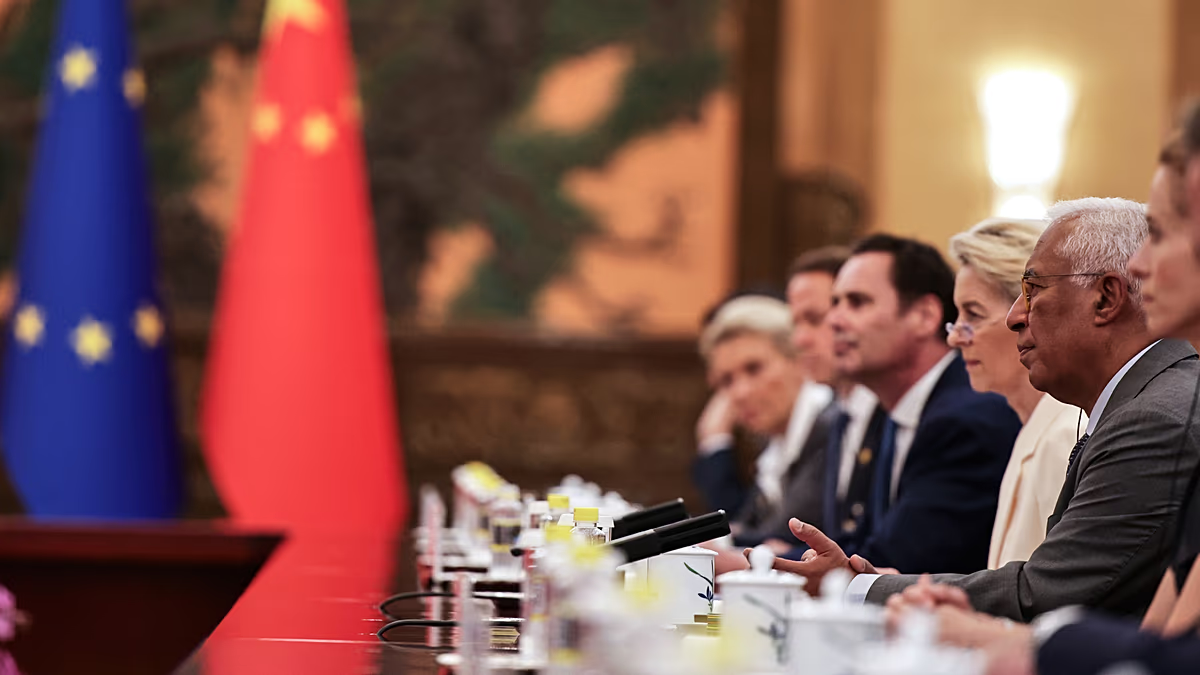
- EU trade chief Maros Sefcovic will hold two days of talks with Chinese officials in Beijing.
- The meetings on October 8 and 9 aim to rebalance trade relations and avert a trade war.
- France and Germany want faster EU tools to counter market distortions and protect European businesses from unfair competition.
- China has criticised the proposed trade tools and urged France and Germany to uphold openness and free trade.
- Expectations for a breakthrough remain limited, while EU negotiators seek progress on Chinese imports, including hybrid electric cars.
Timeline · 6 moments
EU negotiators depart with expectations for talks restrained
South China Morning Post ↗Paris and Berlin prepare for limited negotiating results
Le Monde ↗Negotiators target cheap hybrid electric car imports
World news | The Guardian News ↗China warns against proposed protectionist trade tools
World News CNA ↗France and Germany propose faster EU trade defences
Euronews ↗EU announces Beijing talks to avert trade war
Arab News ↗How it started
The dispute centres on European concerns that Chinese imports are putting key industries under growing pressure. The EU has toughened its stance to defend businesses against what it considers unfair competition, including in cars, according to World News CNA.
The pressure extends beyond established manufacturing sectors. Japan Times reported that Chinese firms moving into more high-tech manufacturing are threatening traditional EU industries. The Beijing talks are an attempt to address those tensions before they turn into a wider trade war.
How it unfolded
On October 5, Arab News reported that EU trade chief Maros Sefcovic would travel to Beijing for two days of meetings with Chinese officials. The negotiations were presented as an effort to stave off a trade war.
That same day, France and Germany called for a new EU trade instrument to respond more quickly to market distortions. Euronews reported that their proposals also included retaliation planning and an overhaul of trade defence tools. According to South China Morning Post, the proposed instrument could cut off access to the EU market when third countries cause severe distortions.
On October 6, China pushed back. Its commerce ministry urged France and Germany to uphold openness, cooperation and free trade, according to World News CNA. Beijing characterised the proposed tools as protectionist.
By October 7, the focus had sharpened on what negotiators could deliver. The Guardian News reported that EU negotiators were seeking to curb cheap imports of hybrid electric cars, while member states were hardening their demands for protection against Chinese imports.
Expectations were nevertheless restrained. Le Monde reported on October 7 that Paris and Berlin were anticipating limited results from the October 8 and 9 talks and beginning to prepare for what would follow.
Where it stands
As of October 7, the talks remain ahead, not concluded. South China Morning Post reported that EU negotiators were departing for Beijing on Wednesday, with expectations in Brussels measured about what two days of intensive negotiations would produce.
The EU is weighing tougher measures while still pursuing negotiations. Euronews reported that Brussels had yet to find a way to curb Chinese imports and that EU leaders were demanding results. France and Germany's proposed tools are proposals, not measures reported as adopted in the supplied coverage.
What to watch
The immediate test is whether the October 8 and 9 meetings produce concrete progress on the trade relationship, including the concerns over hybrid electric car imports reported by The Guardian News.
The next decision is how the EU responds if progress is limited. Le Monde reported that Paris and Berlin want existing trade defence instruments used more extensively and strengthened. Their preparations for the period after the talks make that policy response another development to watch.
More in World
All →
Christa Pike regains consciousness after failed execution attempt in Tennessee
Pike is speaking after surviving two lethal injection doses, but her prognosis remains uncertain as lawyers seek to replace her death sentence with life imprisonment.
47 sources · over 2 days
Pakistan, Saudi Arabia and Turkey Activate Defence Pact Against Houthi Threat
The three countries have moved from emergency consultations to collective defence commitments, with rapid force deployments announced as Houthi attacks on Saudi Arabia intensify.
21 sources · over 7 days
Trump approves firing squad execution for Fort Hood shooter Nidal Hasan
The Pentagon says President Donald Trump approved Defense Sec. Pete Hegseth's recommendation to execute Hasan by firing squad, advancing the case over the 2009 killings.
35 sources · over 2 days