
Disclosure: Hushread is our app. We’ve tried to be fair, and we say where the others are the better choice.
Leave Google News and you usually lose Full Coverage, the view that groups every outlet’s take on one event. So the right alternative depends on what’s pushing you out, and whether you want to keep that grouping. The short version: Hushread keeps the grouping but uses sources you pick, in chronological order; Particle and Ground News group stories from their own source lists; Apple News works if you’re only on Apple devices; and Inoreader or Feedly give you a classic RSS reader without story grouping.
Why people look for a Google News alternative
Google is upfront about it: “Computer algorithms determine which stories show up… and in what order.” Headlines and Top Stories are set by language and region, while For you, Following and Picks for you are personalized using your settings and “activity on Google services and YouTube” (Google support). Some people like that; one June 2026 Play reviewer said “the algorithm does a pretty good job of identifying my interests.” Others want out, for a few recurring reasons.
- The algorithm itself. One Reddit user was “tired of having a layer… that decides which stories I should see” (Reddit).
- Ads and tracking. The Play listing says the app contains ads, and the App Store privacy label lists data linked to you for “Third-Party Advertising”, including coarse location, device ID and product interaction. A September 2026 Play review called it “choked with ads.”
- Sources you can’t get rid of. Google documents a “Hide all stories from [source]” option (Google support), but 2026 reviews say it isn’t working for some sources: “it seems Google has removed the option to hide/block sources” (App Store, August 2026). A support thread shows some sources have been unhideable since 2019.
- Paywalls and clickbait. One App Store reviewer in April 2026 said “over 80% of the articles… have a paywall”; another called it “merciless shameless clickbait” (App Store reviews).
- No RSS. You can’t add your own feeds, and since late March 2025 Google “will no longer use RSS feeds” that publishers submitted (Publisher Center). As one Reddit user put it, it would be “better if I could add good old RSS feeds” (Reddit).
The feature you’ll miss: Full Coverage
In November 2025, an Android Authority writer who had tried the alternatives argued that Google News is still the best option on Android (Android Authority). Most of what the alternatives lose comes down to Full Coverage.
Full Coverage shows one event as reported by many outlets, side by side. Google says it “has no personalization other than your language, region, and subscriptions” (Google support). A plain RSS reader does the opposite: follow 30 outlets and a big event shows up as 30 separate headlines. Duplicate filters help with near-identical copies, but two outlets writing the same news in their own words still show up twice.
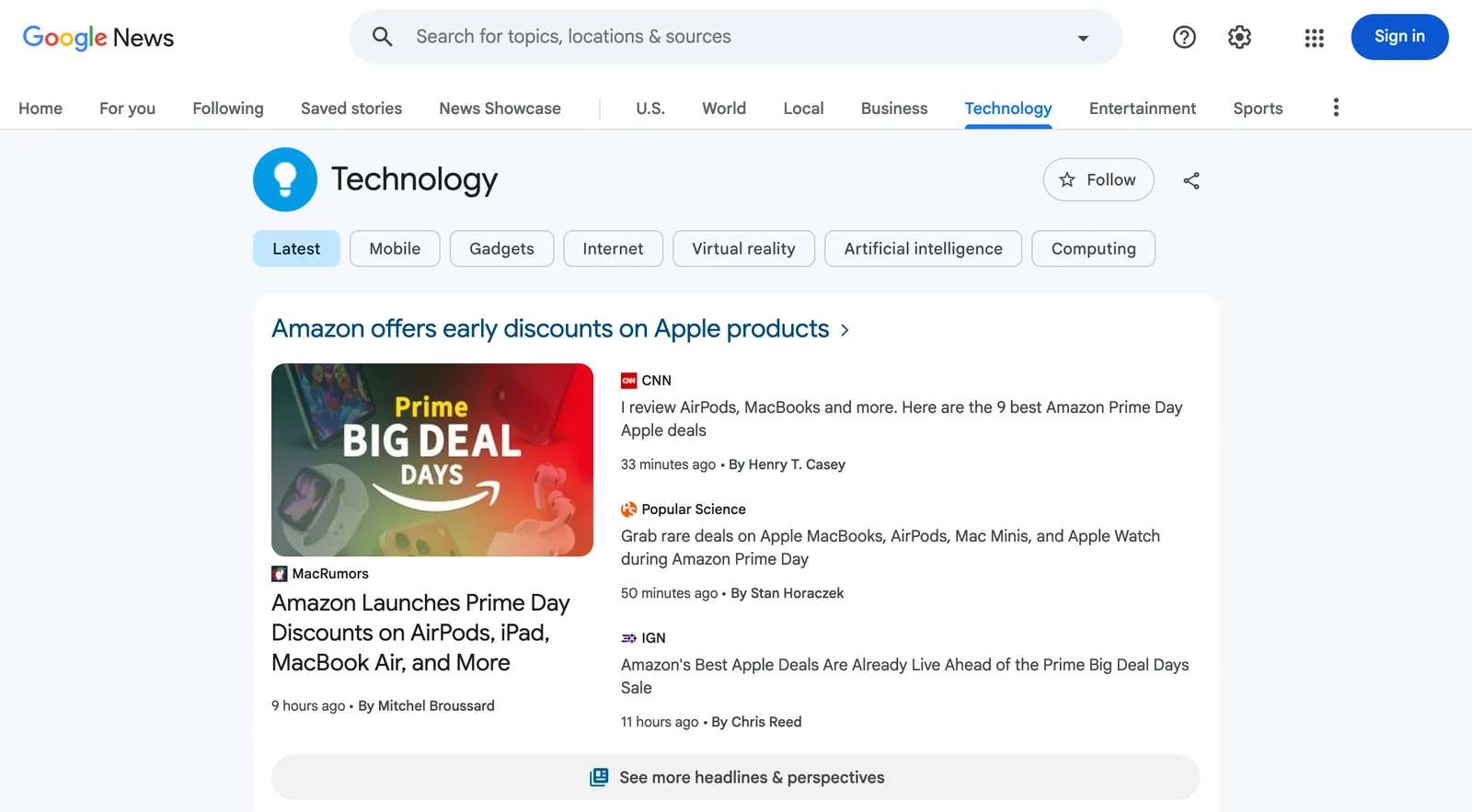 Google News grouping one story’s coverage from four outlets, 6 October 2026. Source: news.google.com
So decide first: if you want grouped stories, pick an app that groups; if you want a clean list from outlets you trust, an RSS reader is fine.
Google News alternatives at a glance
Prices as of September 2026:
| App | Groups one event’s coverage | Your own sources | Free plan and paid price |
|---|---|---|---|
| Google News | Yes (Full Coverage) | No | Free, with ads |
| Hushread | Yes, from your sources | Yes: RSS, websites, Reddit, YouTube, Facebook | Free, unlimited sources; Pro $2.08/mo billed yearly, for instant source alerts |
| Particle | Yes | No | Free; Particle+ $29.99/yr |
| Ground News | Yes, with bias labels | No (suggest only) | Free; paid $9.99 to $99.99/yr |
| Inoreader | No (duplicate filters on Pro) | Yes, RSS | 150 feeds free; Pro $89.99/yr |
| Feedly | No (near-copy dedup on Pro+) | Yes, RSS | 100 feeds free; Pro about $6 to $7/mo |
Apple News and SmartNews are covered below; neither lets you add your own sources.
1. Hushread: keeps the grouping, with your sources, in order
Hushread is the option for people who want Full Coverage’s grouping without Google choosing the outlets. You pick the sources: RSS feeds, websites without a feed, topics (type “chip exports” and matching articles arrive), subreddits, YouTube channels and Facebook pages, or one-tap bundles from 2,500+ curated sources. Everything you follow arrives in chronological order, with nothing ranked or injected.
As articles come in, coverage of the same event from different outlets is grouped into one story. “See whole story” opens a timeline of every outlet’s coverage, day by day, with a summary of how it developed, and long stories chain into chapters. See live examples on our stories page. Repeats collapse too: syndicated copies, cross-feed duplicates and rewrites fold under the freshest version. Between that and grouping, you shouldn’t run into the problem one App Store reviewer described, where giving a story a thumbs-down brings back “the same headline, only from a different outlet”.
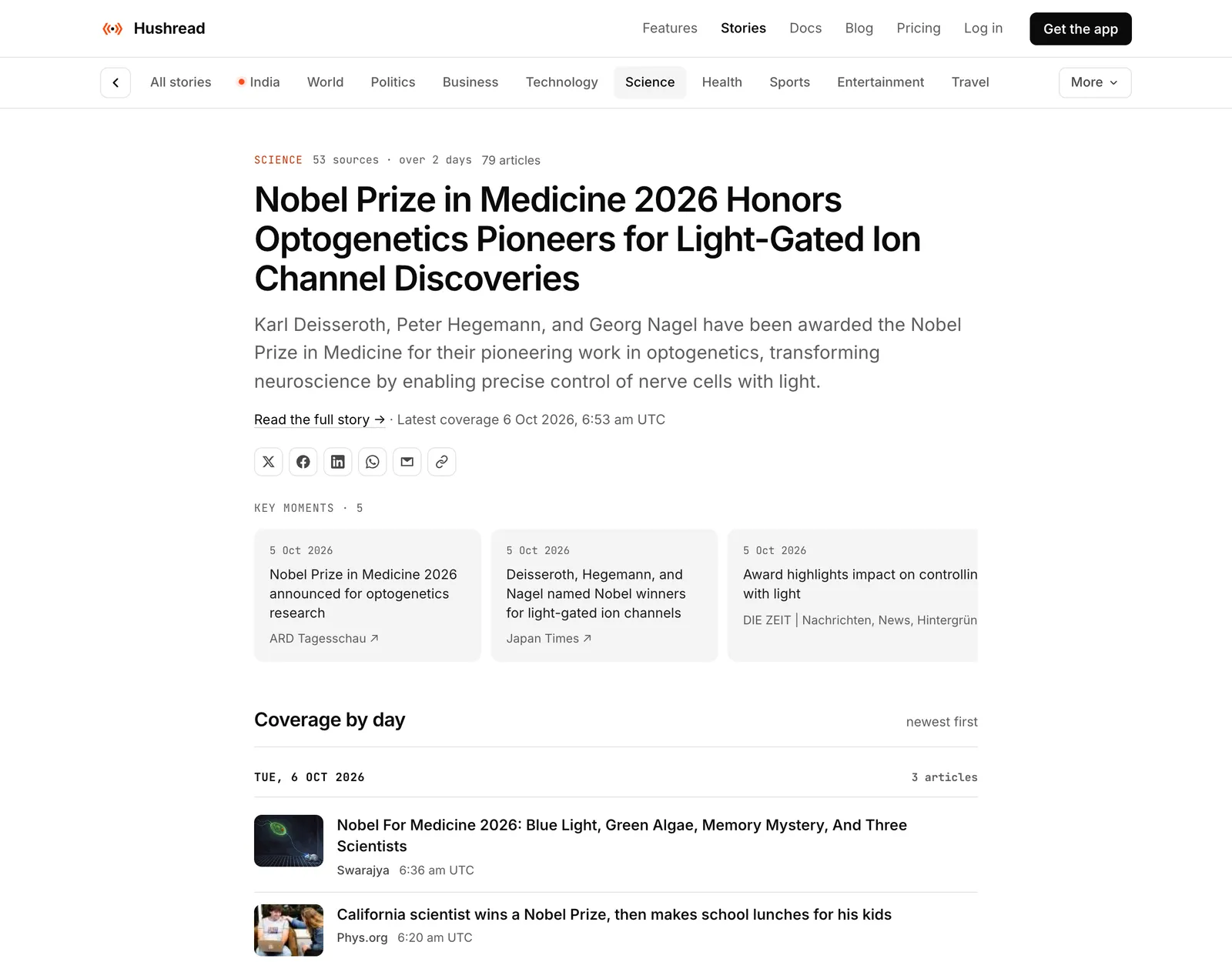 A Hushread story timeline with every outlet’s coverage by day, 6 October 2026. Source: hushread.com
For headline skimming, a separate News section has daily top global stories in a regional mix and a one-minute audio briefing, and Trending ranks stories by how many distinct publishers cover them, hour by hour. Your feed has nothing injected and the reader view has no ads or popups. AI stays small: a two-sentence quick take inside articles you open, and the feed keeps the original headlines.
The free plan has no limit on sources, and Pro, at $2.08 a month billed yearly, only adds instant alerts when a source you pick publishes. The honest limits: Hushread only groups what your sources and topics bring in, so its timelines are as wide as what you follow. Grouping is automatic and occasionally splits one event into two stories. And it’s built by one independent developer. Details in Hushread vs Google News.
2. Particle: the closest to Full Coverage, with AI on top
Particle clusters coverage of a story from many outlets, writes AI summaries and links to the publishers. It comes from an ex-Twitter team led by CEO Sara Beykpour (TechCrunch). You can follow people, places, journalists and publishers and see opposing sides of a story. It’s an App Store Editors’ Choice at 4.8 stars from about 1,200 ratings (App Store), on iOS, Android and the web. Particle+ costs $2.99 a month or $29.99 a year.
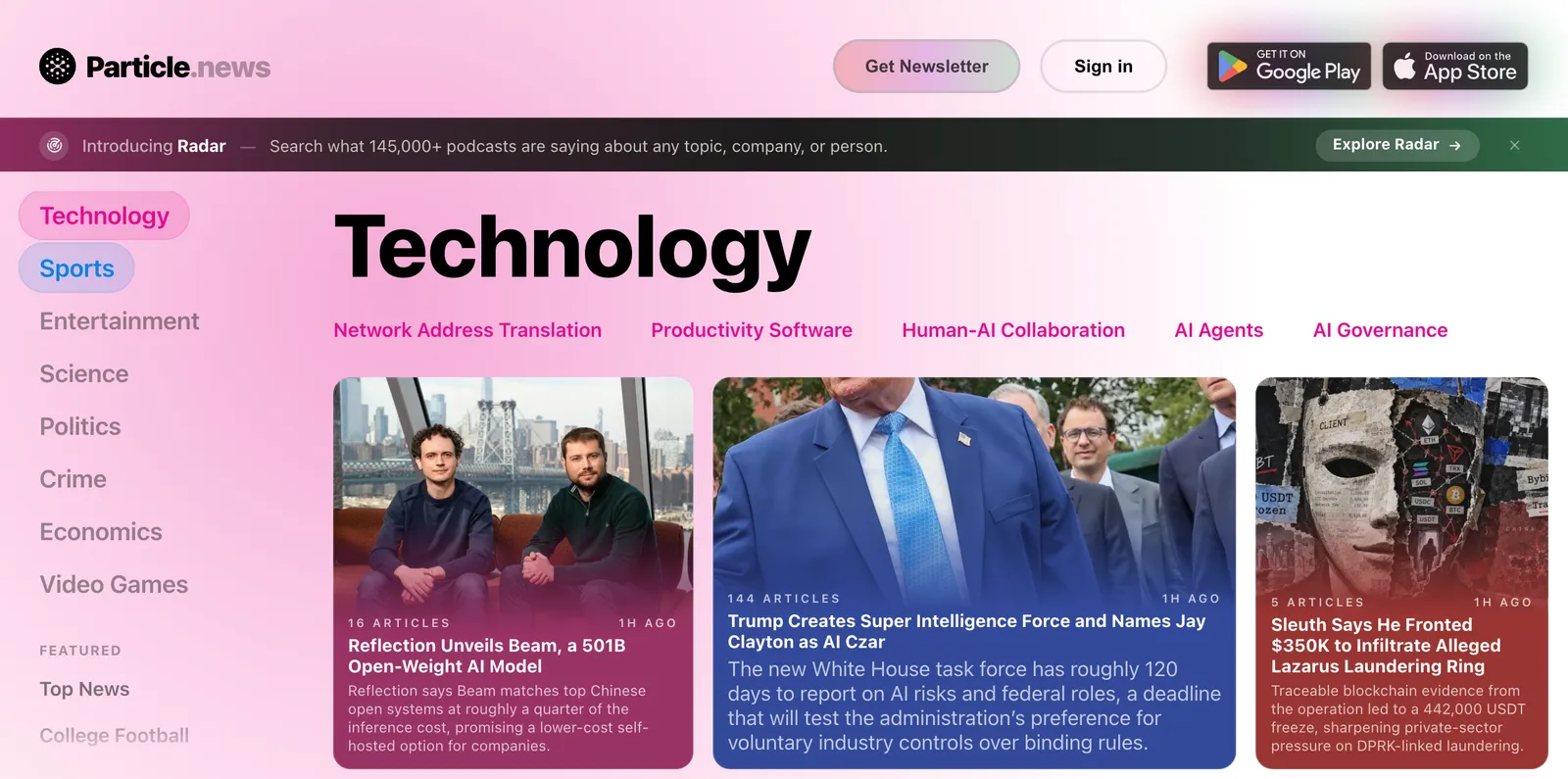 Particle on the web, where each card is one story built from many articles, 6 October 2026. Source: particle.news
The catch is the same as Google News: you can’t add RSS or your own sources. Personalization also has its critics; an October 2025 App Store reviewer said it had “only gotten nominally better, even after continued attempts to ‘train it’.” Pick Particle if you want polished grouped stories with no setup.
3. Ground News: grouped coverage plus bias labels
Ground News groups coverage of the same event and labels each outlet left, center or right, with a Blindspot feed for stories one side barely covered (rating system). Ratings are per outlet, not per article, and pricing is split between the web (Free and Vantage at $99.99 a year) and the app (Pro from $9.99 a year, Premium and Vantage) (Ground News, App Store). It can’t take your own feeds, and one Belgian Reddit user found it US-centric. Pick it if lean labels are the point; more in Ground News alternatives.
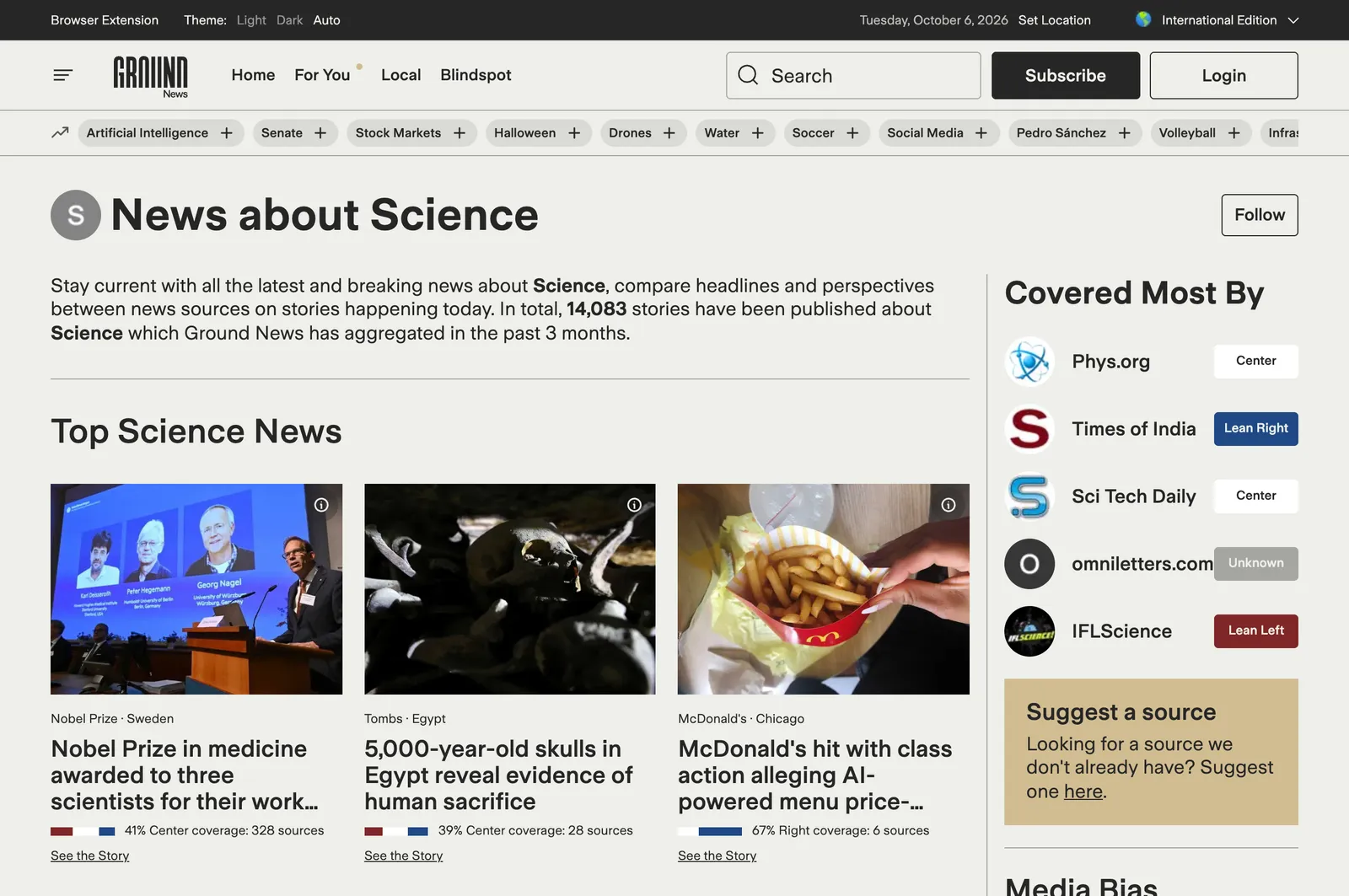 Ground News showing the left, center and right split under each story, 6 October 2026. Source: ground.news
4. Apple News: fine on iPhone, not an option on Android
Apple News has editors picking Top Stories, with an algorithmic Trending section (Cult of Mac). Channels come from Apple’s catalog only, and adding your own RSS feeds was reportedly removed in 2019 (Michael Tsai). It runs on iPhone, iPad and Mac only. News+ costs $12.99 a month after a one-month trial (Apple) and is only available in the US, UK, Canada and Australia (Apple support).
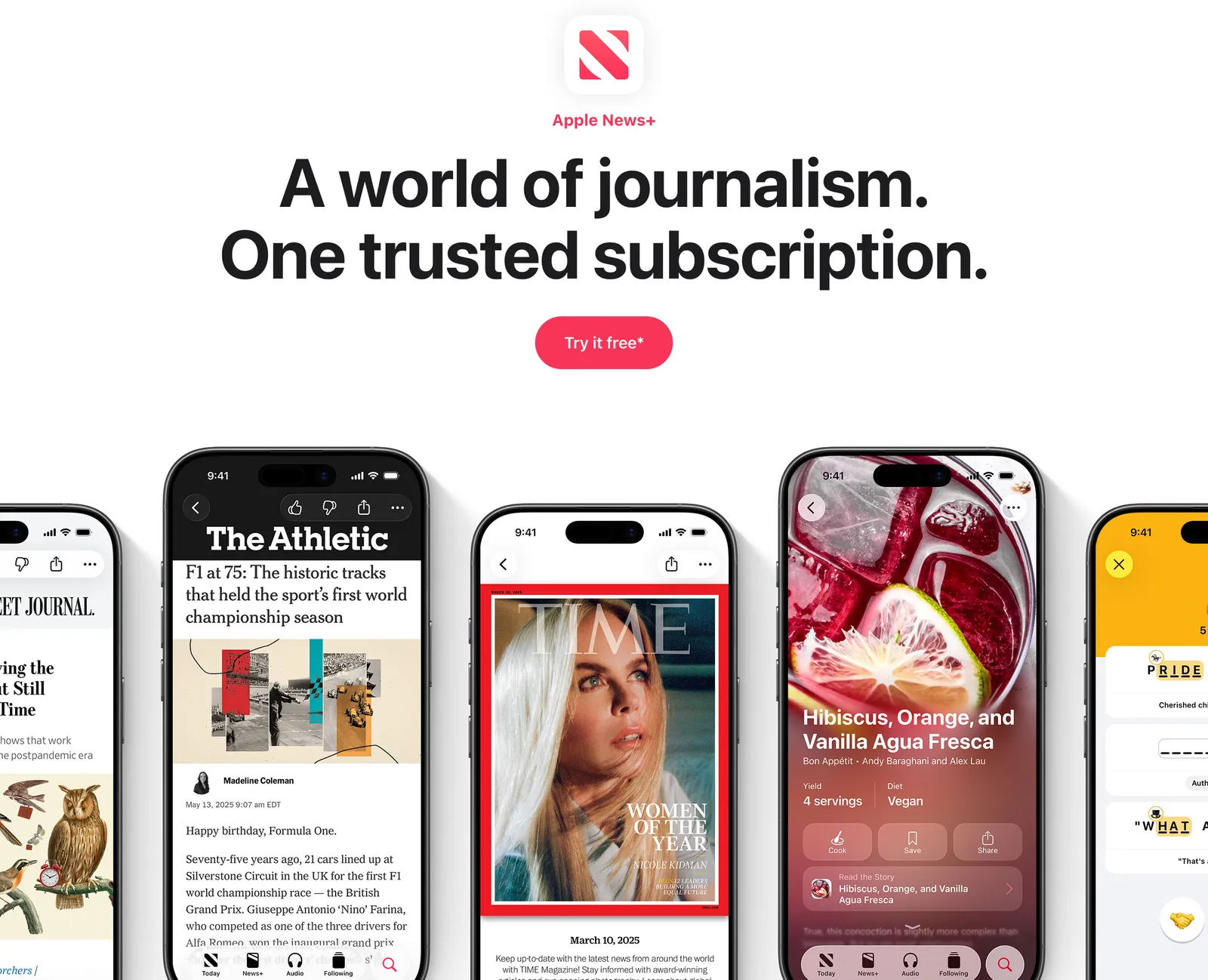 Apple’s News+ page, 6 October 2026. Source: apple.com
It isn’t an escape from ads either. Kirk McElhearn wrote in February 2026 that “Many if not most of them look like and probably are scams” and that News+ subscribers “still get ads” (Kirkville). For paywalled magazines on an iPhone, News+ is something Hushread can’t replace.
5. Inoreader: a classic RSS reader with a big free plan
If you want your own list of outlets in a clean feed, an RSS reader is the traditional route. Inoreader Free lets you follow 150 feeds, search your own feeds and set up Google News alerts, and it has been ad-free since October 2024 (pricing, Inoreader blog). Pro costs $7.50 a month billed annually ($89.99 a year) or $9.99 monthly, and adds 2,500 feeds, rules, filters including duplicate filters, push notifications, social feeds and AI summaries.
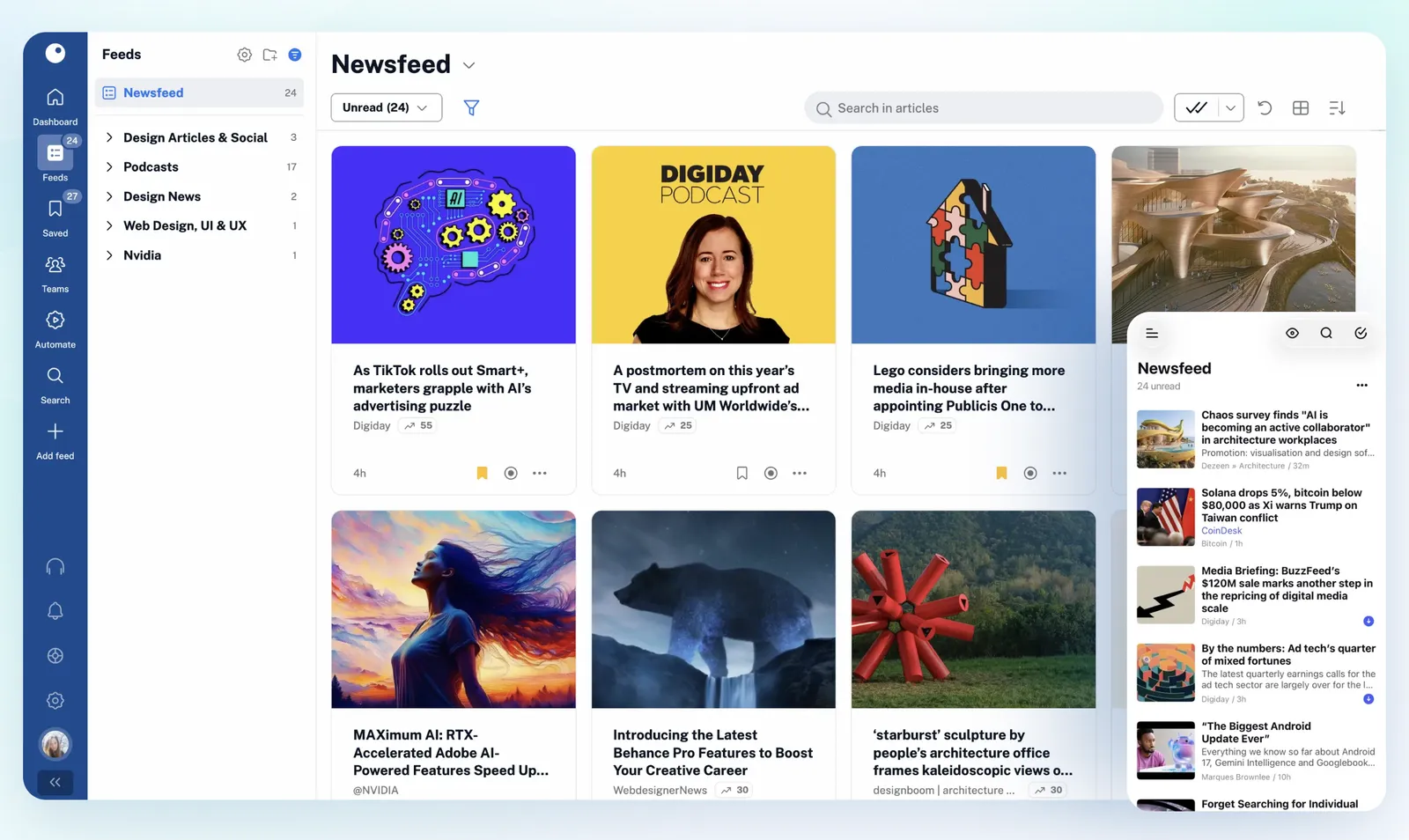 Inoreader’s reader as shown on its homepage, 6 October 2026. Source: inoreader.com
It doesn’t group different outlets’ coverage of one event: its duplicate filters match by URL, exact title or near-identical title (Inoreader blog), so the same news in different words stays separate.
6. Feedly: an RSS reader with near-copy dedup on its top plan
Feedly Free covers 100 feeds and 3 folders on web and mobile, with sponsored ads (pricing). Pro is about $6 to $7 a month billed annually and adds search, notes, highlights and integrations. Pro+ is about $8 to $9 a month billed annually in the first year, then about $12, and adds Feedly AI, newsletters, Deduplication and, relevant here, Google News feeds as a source type. Feedly’s Deduplication collapses articles with more than 85% content overlap (Feedly docs), which catches wire copies, not different outlets’ own reporting.
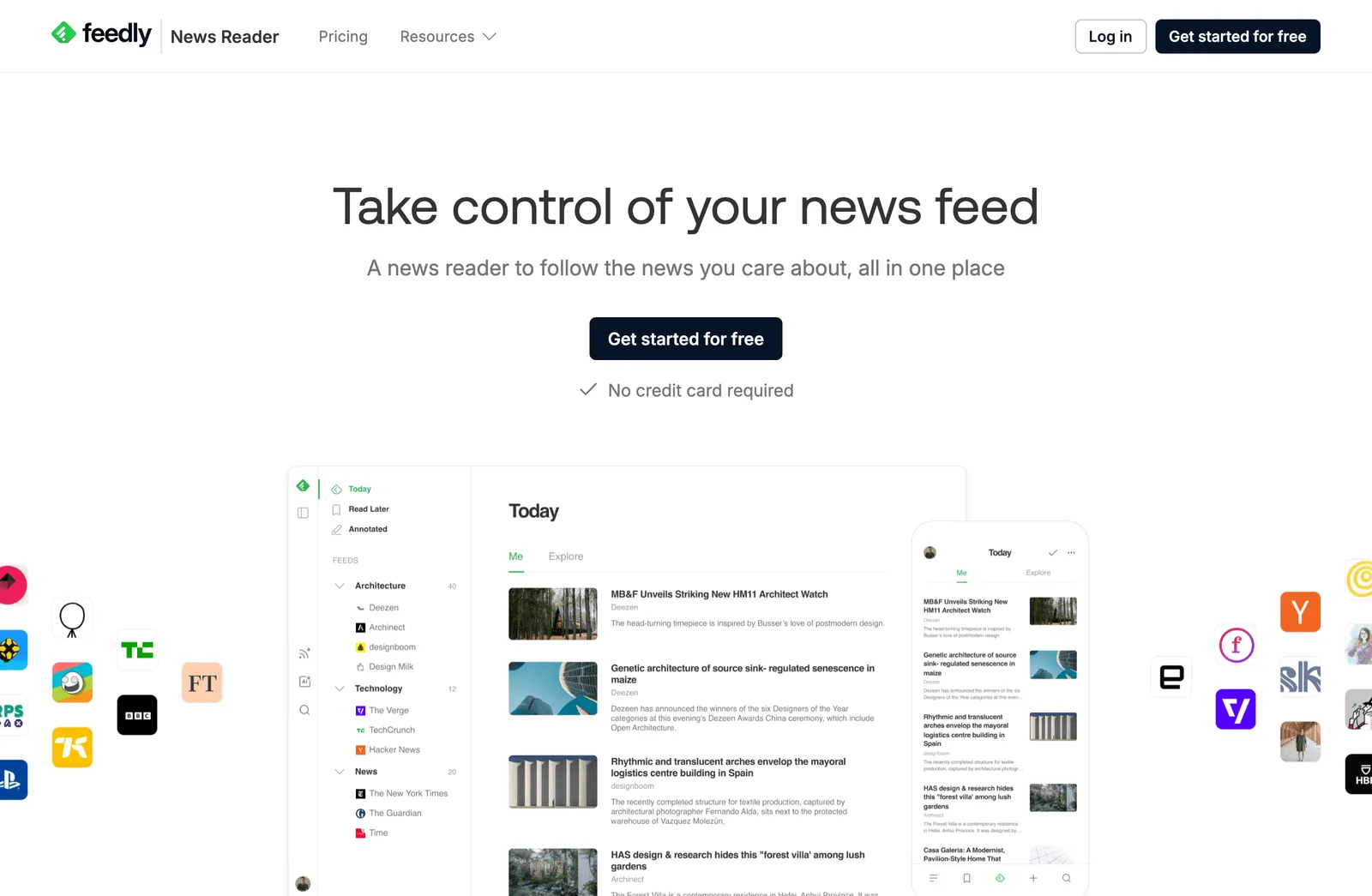 Feedly’s News Reader page, 6 October 2026. Source: feedly.com
Among RSS readers, NewsBlur’s Premium Archive plan ($99 a year) includes story clustering that groups duplicate stories (NewsBlur pricing). Our best RSS reader guide compares the RSS route in depth.
7. SmartNews: free local news with zero setup
SmartNews calls its feed a “blend of editor and algorithmic curation” and has a political spectrum slider (SmartNews). It’s free with ads on iOS and Android, with channels from its catalog only. Its ad-free plan is US-only and still allows publisher ads and sponsored content (terms). It’s the easy swap if you want broad US and local headlines and don’t need to choose outlets.
 The SmartNews homepage, 6 October 2026. Source: smartnews.com
When Google News is still the better choice
Stay with Google News if you want every outlet on a story, including ones you’d never think to follow, without paying or setting anything up. It’s free, it’s enormous (over a billion Play downloads), and Full Coverage is genuinely good at showing the spread of reporting. If the ads and the algorithm don’t bother you, there’s little reason to move.
FAQ
What is the best free alternative to Google News?
For grouped stories with no setup, Particle’s free tier is the closest match. For a large free feed list, Inoreader Free (150 feeds, ad-free) or Feedly Free (100 feeds) work. Hushread’s free plan has no source limit and groups your own sources into stories.
Is there a Google News alternative without an algorithm?
Yes. RSS readers like Inoreader and Feedly show what your feeds publish, and Hushread shows everything you follow in chronological order with nothing ranked or injected, while still grouping each event into one story. By contrast, Particle is personalized, Ground News says its My Feed is algorithmically curated, and SmartNews blends editors and algorithms.
Can RSS replace Google News?
For following specific outlets, yes. What you lose is discovery and grouping: an RSS reader shows each outlet’s article separately, so one event can fill your feed. Readers with duplicate filters catch copies, not different outlets’ coverage. Hushread groups related coverage from your feeds into one story on every plan, and NewsBlur clusters duplicate stories on its $99-a-year Premium Archive plan.
Is Google News going away?
There’s no sign of it. Google piloted AI article overviews and audio briefings in December 2025 (Google blog) and added custom briefing topics on Android in August 2026 (Google blog). Some parts have gone: Magazines were removed in December 2023 (9to5Google), and an unconfirmed July 2026 report said News Showcase is being phased out (Android Headlines).
If Full Coverage is the part of Google News you’d miss and the algorithm is the part you wouldn’t, Hushread keeps one without the other. Hushread is free, with no limit on sources, on iOS, Android and the web. Try Hushread.