
Disclosure: Hushread is our app. We’ve tried to be fair, and we say where the others are the better choice.
We compared ten RSS readers for this guide. There’s no single best RSS reader in 2026, but there is a clear best fit for most situations. Inoreader is the power user’s choice, with a generous ad-free free plan. Feedly is the most polished hosted reader, NewsBlur is the value pick, NetNewsWire is the free pick on Apple devices, Feeder is the free pick on Android, and FreshRSS leads for self-hosting. Hushread is for people who want coverage grouped into one story per event instead of one headline per outlet. Below, the picks by platform and by need, with current prices and the apps you should skip.
The best RSS feed readers at a glance
Prices are from each official pricing page or App Store listing (as of September 2026).
| Reader | Platforms | Free plan | Paid from | Best for |
|---|---|---|---|---|
| Inoreader | Web, iOS, Android | 150 feeds, no ads | $89.99/yr | Rules, filters, monitoring |
| Feedly | Web, iOS, Android | 100 feeds, 3 folders, ads | About $6 to $7/mo, billed yearly | Polish, teams |
| NewsBlur | Web, iOS, Mac, Android | 64 sites | $36/yr | Filtering on a budget |
| Feedbin | Web, iOS, Mac | 30-day trial | $70/yr | Clean paid service |
| NetNewsWire | Mac, iPhone, iPad | Free, open source | None | Free on Apple devices |
| Reeder | iPhone, iPad, Mac | 10 feeds | $14.99/yr | RSS plus social timeline |
| Feeder | Android | Free, open source | None | Free, no account |
| FreshRSS / Miniflux | Your server | Free | Miniflux hosted $15/yr | Self-hosting |
| Readwise Reader | Web, iOS, Android, Mac, Windows | 30-day trial | $119.88/yr | Read-later and highlights |
| Hushread | iOS, Android, web | Unlimited sources | $2.08/mo billed yearly, for instant source alerts | One story per event |
Best RSS reader for Android
Feeder is the free pick. It’s open source (GPLv3), has no in-app purchases, needs no account, and has a per-feed “skip duplicates” option, text-to-speech, and AI summaries if you bring your own API key (Google Play, changelog). It’s also on F-Droid for Android 10 and up. One Hacker News commenter called it their Android pick and pleasantly unexciting (HN). The catch: it rates 3.8 on Play and doesn’t sync with cloud services.
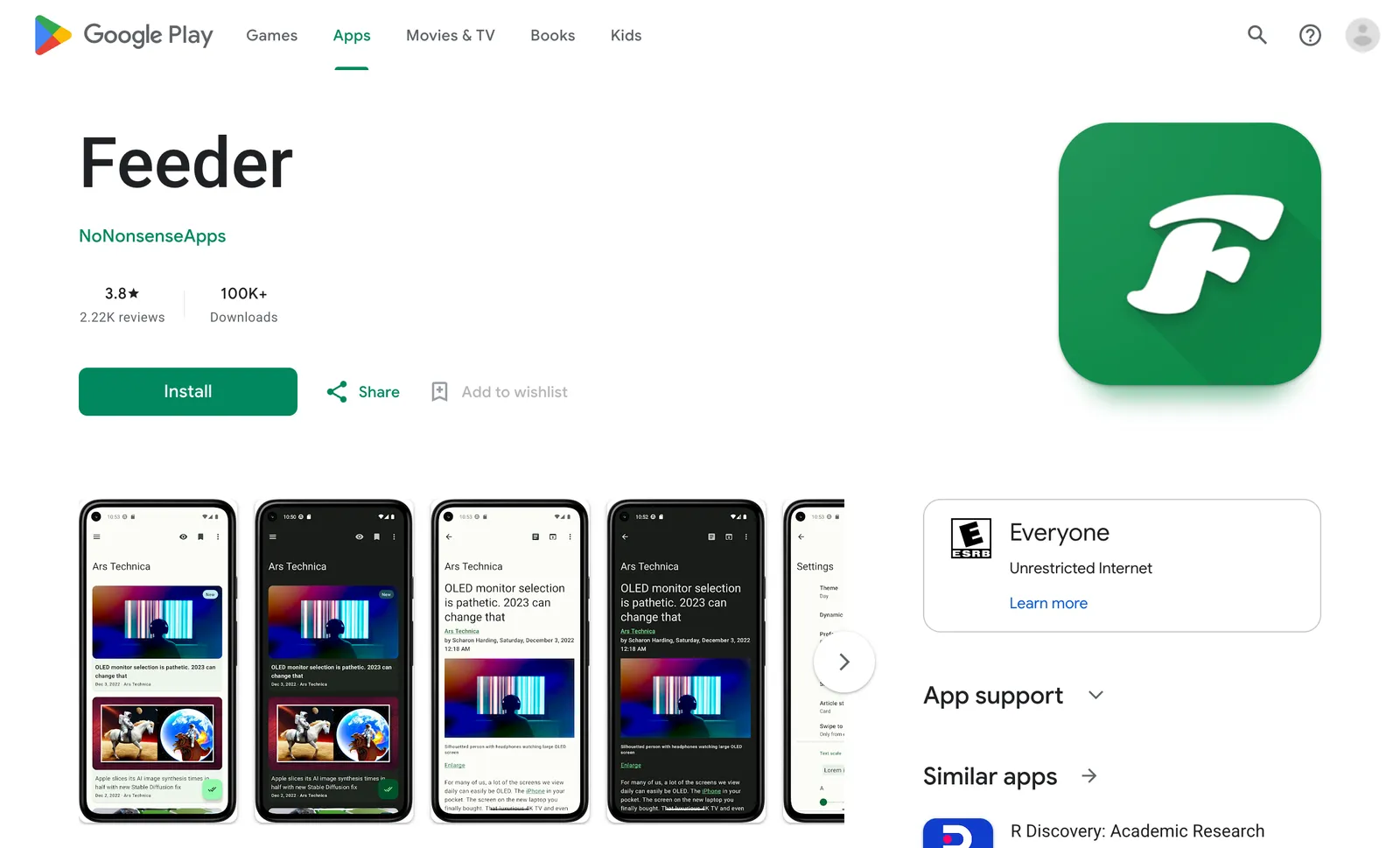 Feeder on Google Play, 6 October 2026. Source: play.google.com
Feedly has the best-rated Android app of the hosted services, at 4.4 from about 317,000 reviews and more than 5 million installs (Google Play). Free is 100 feeds and 3 folders with sponsored ads.
NewsBlur rates 4.2 on Google Play, with its own sync across web, iOS and Mac, strong filtering and a $36 a year Premium plan.
Inoreader has the deepest feature set on this list, but its Android app rates 2.8 on Google Play against 4.68 on iPhone. If you’re on Android, try the free plan before paying $89.99.
Hushread runs on Android, iOS and the web, synced. It follows RSS feeds, websites without a feed, subreddits, YouTube channels and Facebook pages, and groups coverage of the same event into one story. Free has no limit on sources; Pro adds instant source alerts.
Feedbin has no native Android app, only the mobile website. NetNewsWire and Reeder aren’t on Android at all; our NetNewsWire and Reeder for Android guide covers the closest replacements, and if you’re coming from an iPhone, see Apple News alternatives for Android.
Best RSS reader for iPhone and Mac
NetNewsWire is the free default for Apple devices: Mac, iPhone and iPad, open source, with no AI, and sync through iCloud or services including Feedbin, Feedly, Inoreader, NewsBlur and FreshRSS (NetNewsWire). It rates 4.7 on the App Store, version 7.1.4 shipped on September 21, 2026, and its creator Brent Simmons now works on it full-time after retiring in June 2025 (inessential). Some 2026 App Store reviewers dislike the Liquid Glass redesign, and the Mac 7.x versions need macOS 15 or later.
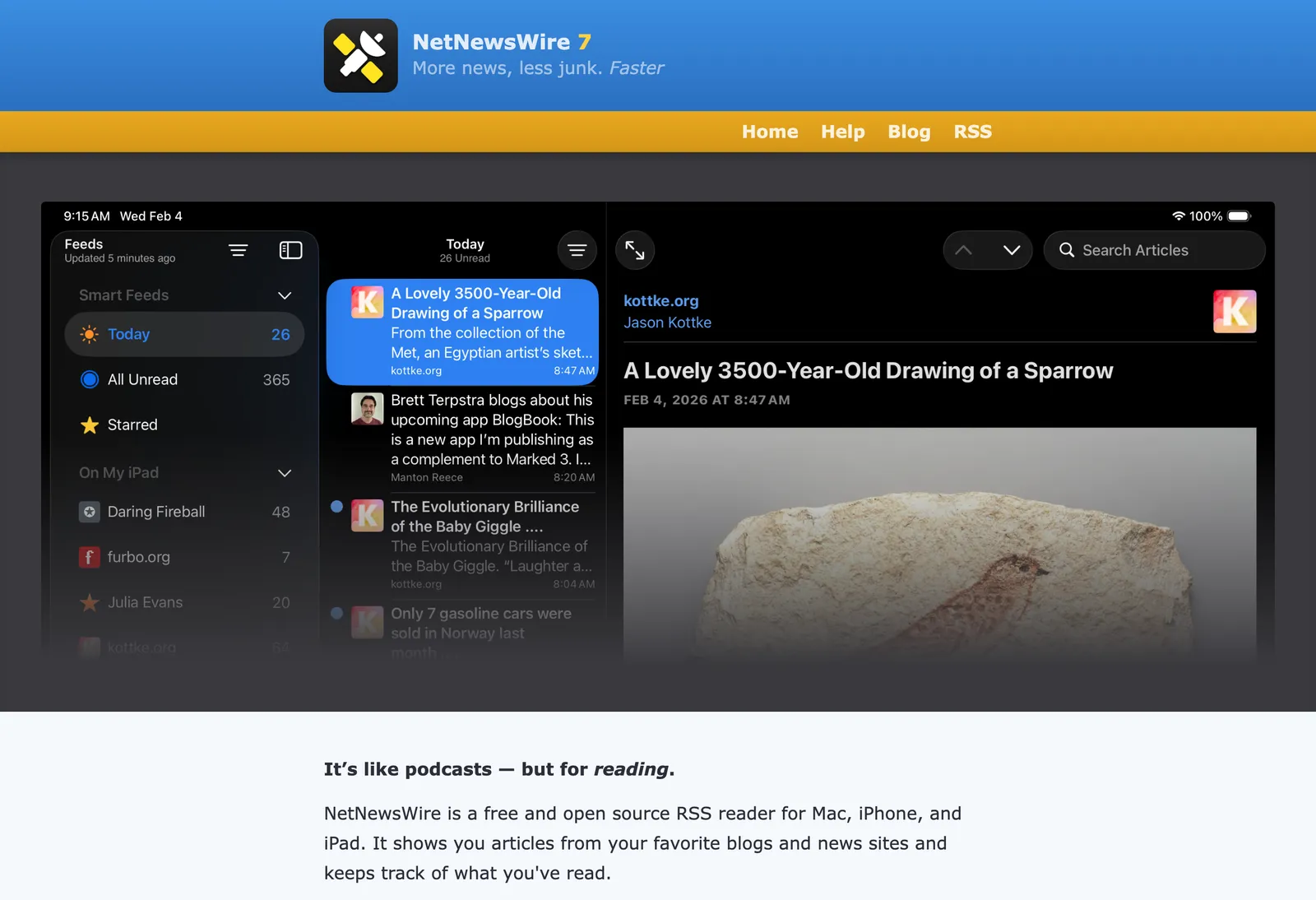 NetNewsWire’s homepage, 6 October 2026. Source: netnewswire.com
Reeder is for people who want RSS, YouTube, Reddit, Mastodon, Bluesky and podcasts in one timeline. It costs $1.99 a month or $14.99 a year on the US App Store, with 10 feeds free (App Store). It syncs through iCloud only and has no unread counts (MacStories). If you want unread counts and a sync service, Reeder Classic is a one-time $4.99 on iOS or $9.99 on Mac and was updated for iOS 27 on September 25, 2026 (App Store).
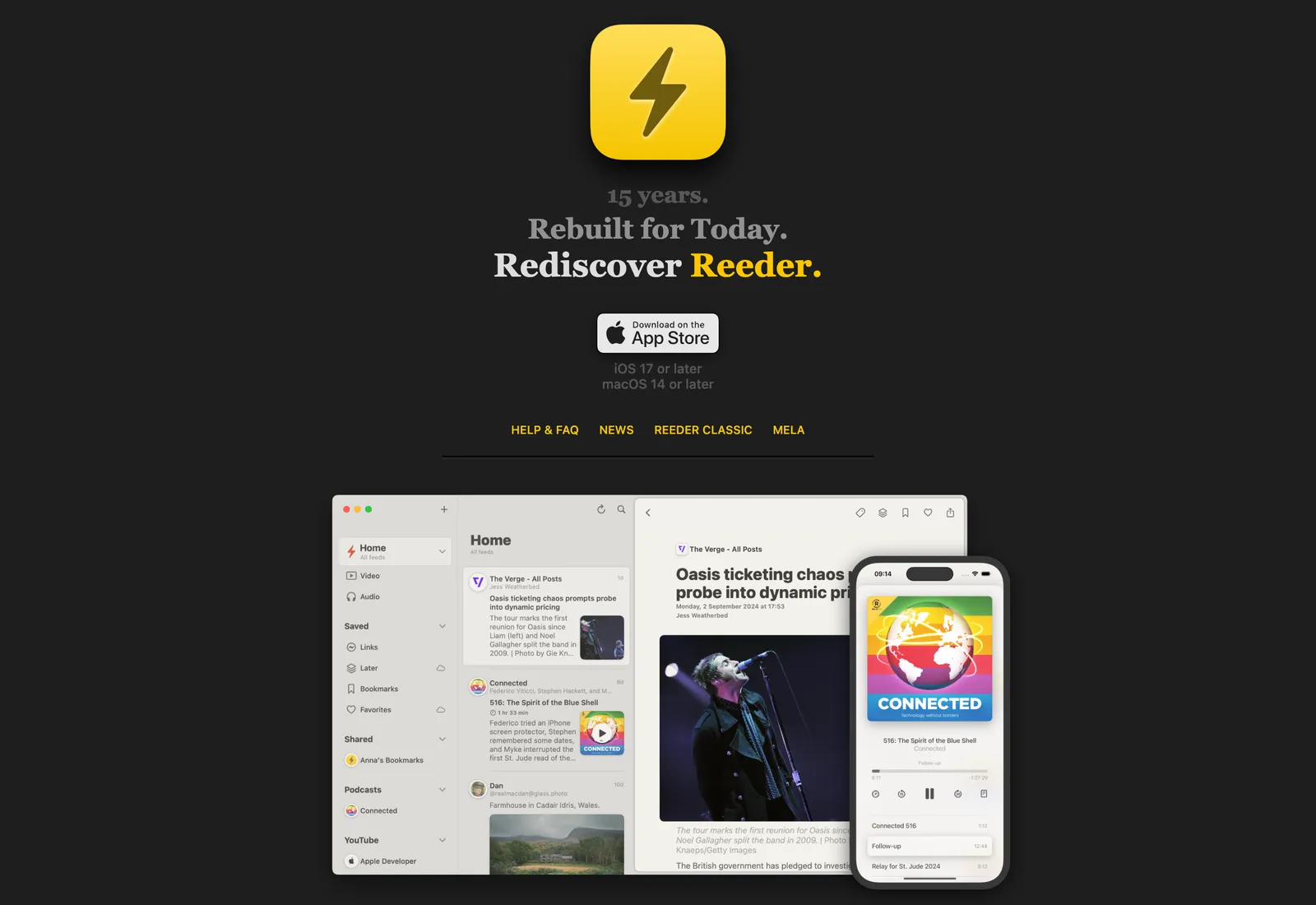 Reeder’s homepage, 6 October 2026. Source: reederapp.com
Feedbin has native iOS and Mac apps and works as the sync backend for NetNewsWire, Reeder Classic and others, at $70 a year (Feedbin).
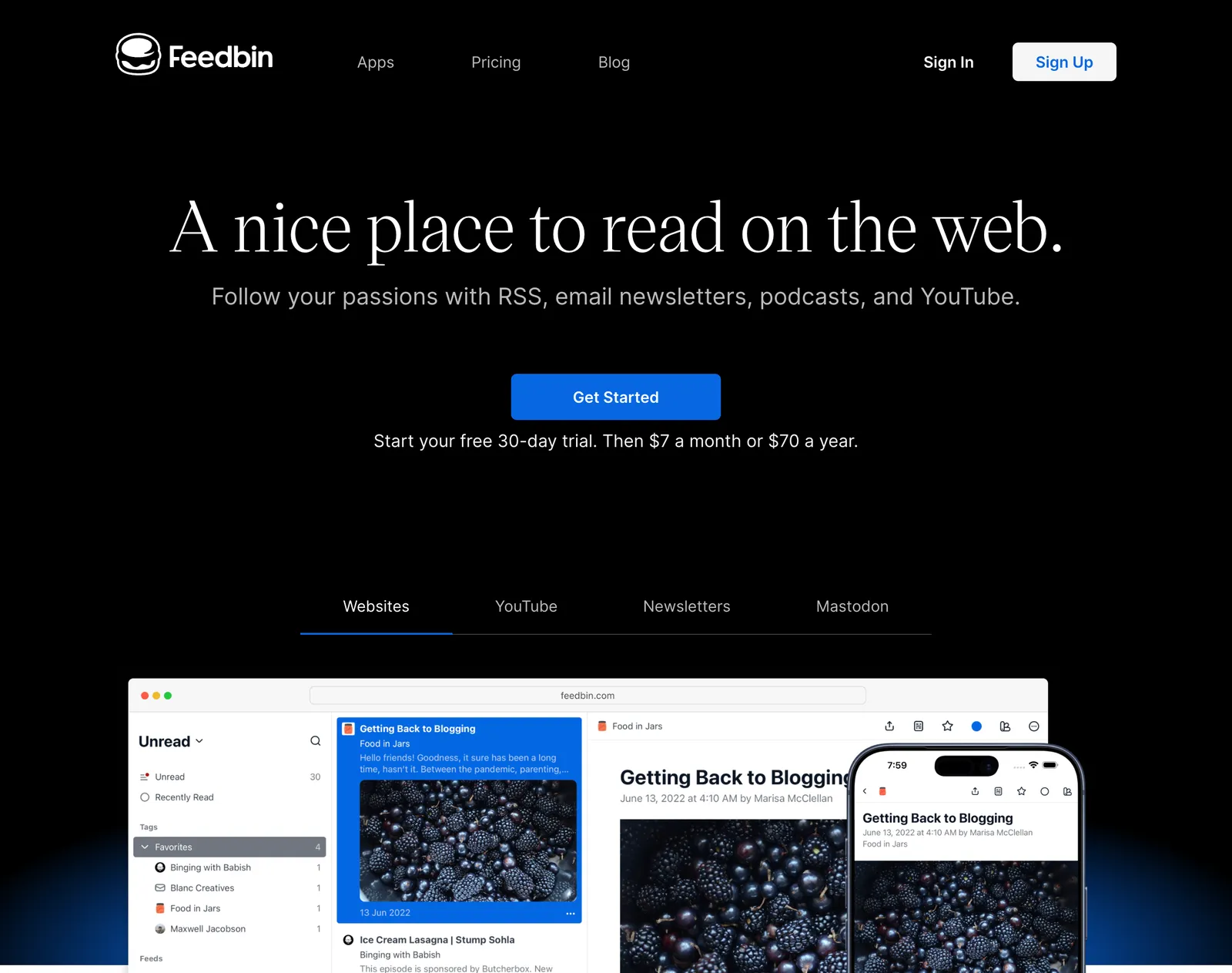 Feedbin’s homepage with its price, 6 October 2026. Source: feedbin.com
The hosted services all have well-rated iPhone apps: NewsBlur 4.7, Inoreader 4.68 and Feedly 4.6. Hushread has an iPhone app too; it has no Mac app, but the web app works in any browser.
Best web-based RSS reader (and for Windows)
On the web, Inoreader and Feedly are the most complete, NewsBlur is the most flexible for the price, and Feedbin is the cleanest paid option. Hushread’s web app lives at app.hushread.com and syncs with the phone apps.
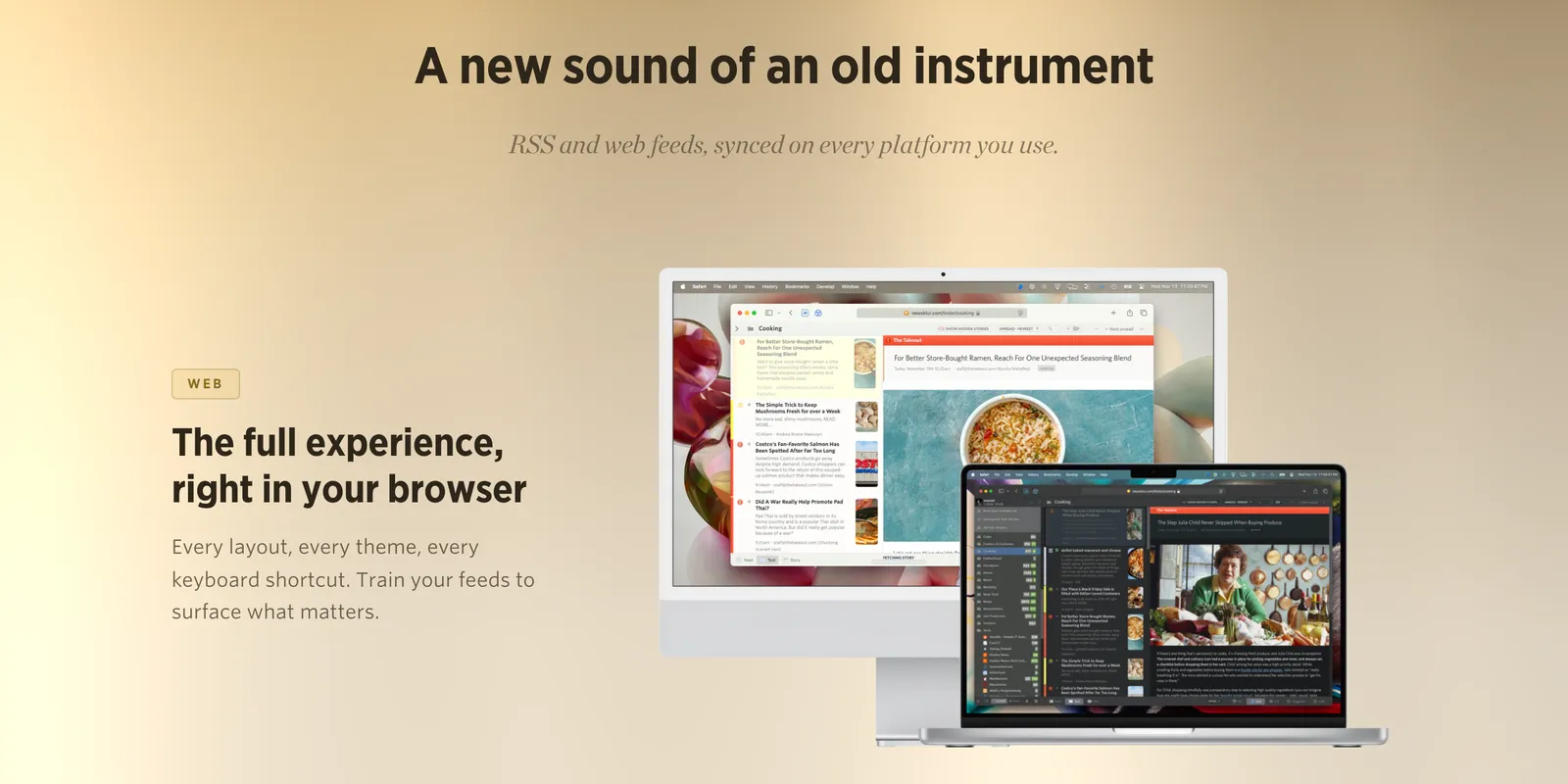 NewsBlur’s web reader as shown on its homepage, 6 October 2026. Source: newsblur.com
On Windows, none of the Apple apps apply. A web reader is the practical answer, or Readwise Reader, which has a Windows app but is built for saving and highlighting rather than following news.
Best free RSS reader
What “free” gets you varies a lot:
- Inoreader Free: 150 feeds, search within your feeds, Google News alerts, no ads (pricing). Inoreader removed ads from Free in October 2024 (Inoreader blog), so older roundups that say otherwise are out of date. No rules, filters, social feeds or push notifications.
- Feedly Free: 100 feeds, 3 folders, sponsored ads, no search (pricing).
- NewsBlur Free: 64 sites (pricing).
- Reeder Free: 10 feeds, Apple only (Reeder help).
- Hushread Free: unlimited sources, with story grouping, Trending, breaking-story push, keyword and sentiment rules, AI quick takes and narration included.
- Free with no plan limits listed: NetNewsWire (Apple), Feeder (Android), and FreshRSS or Miniflux if you host them.
For a free hosted reader with search and power features to grow into, Inoreader Free is the strongest plan; if you want no cap on sources and the news grouped into stories, Hushread Free has no source limit. For a free app, pick NetNewsWire or Feeder by platform. Our Inoreader alternatives and Feedly alternatives guides compare the free plans in more depth, and Inoreader vs Feedly puts the two big ones side by side.
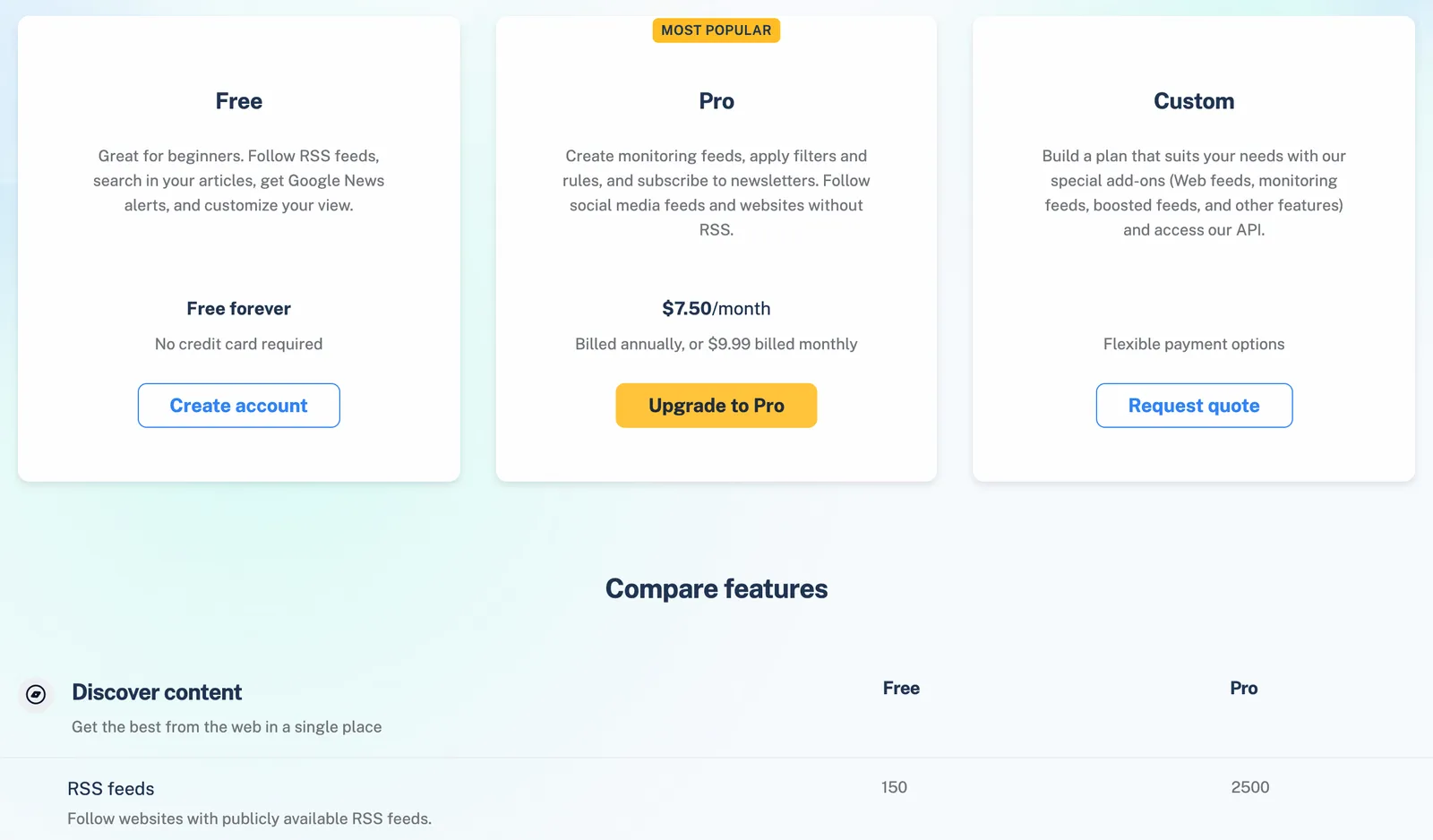 Inoreader’s plans, 6 October 2026. Source: inoreader.com
Best RSS reader with AI summaries
AI in RSS readers is mostly on the top plan or bring-your-own-key:
- Inoreader Pro ($89.99 a year): “Inoreader Intelligence” summaries since March 2025 (Inoreader blog), plus podcast and video transcripts, suggested tags and Mentions. Since Q2 2026 you can choose OpenAI, Anthropic or Mistral models. Intelligence reports and email digests are paid add-ons even on Pro (pricing).
- Feedly Pro+ (about $8 to $9 a month billed annually in the first year, then about $12): Feedly AI, AI Feeds, topics, deduplication and mute filters (Feedly pricing).
- NewsBlur Premium Archive ($99 a year): Ask AI, a daily briefing and full control of story clustering (pricing).
- Readwise Reader ($119.88 a year): Ghostreader auto-summarizes documents you save; summarizing feed items automatically needs your own OpenAI key (Readwise docs).
- Feeder (free): AI summaries with your own API key since November 2024, and on-device translation since June 2026.
- Hushread (free): a two-sentence quick take at the top of any article you open, plus natural-voice narration and a one-minute audio briefing of the day’s top global stories in the News section.
If you want AI to read and digest everything for you, Inoreader, Feedly Pro+ or NewsBlur’s top plan will do more. Hushread takes a lighter approach: your feed keeps the original headlines and nothing in it is rewritten by AI, a short quick take appears inside an article when you open it, and it costs nothing extra.
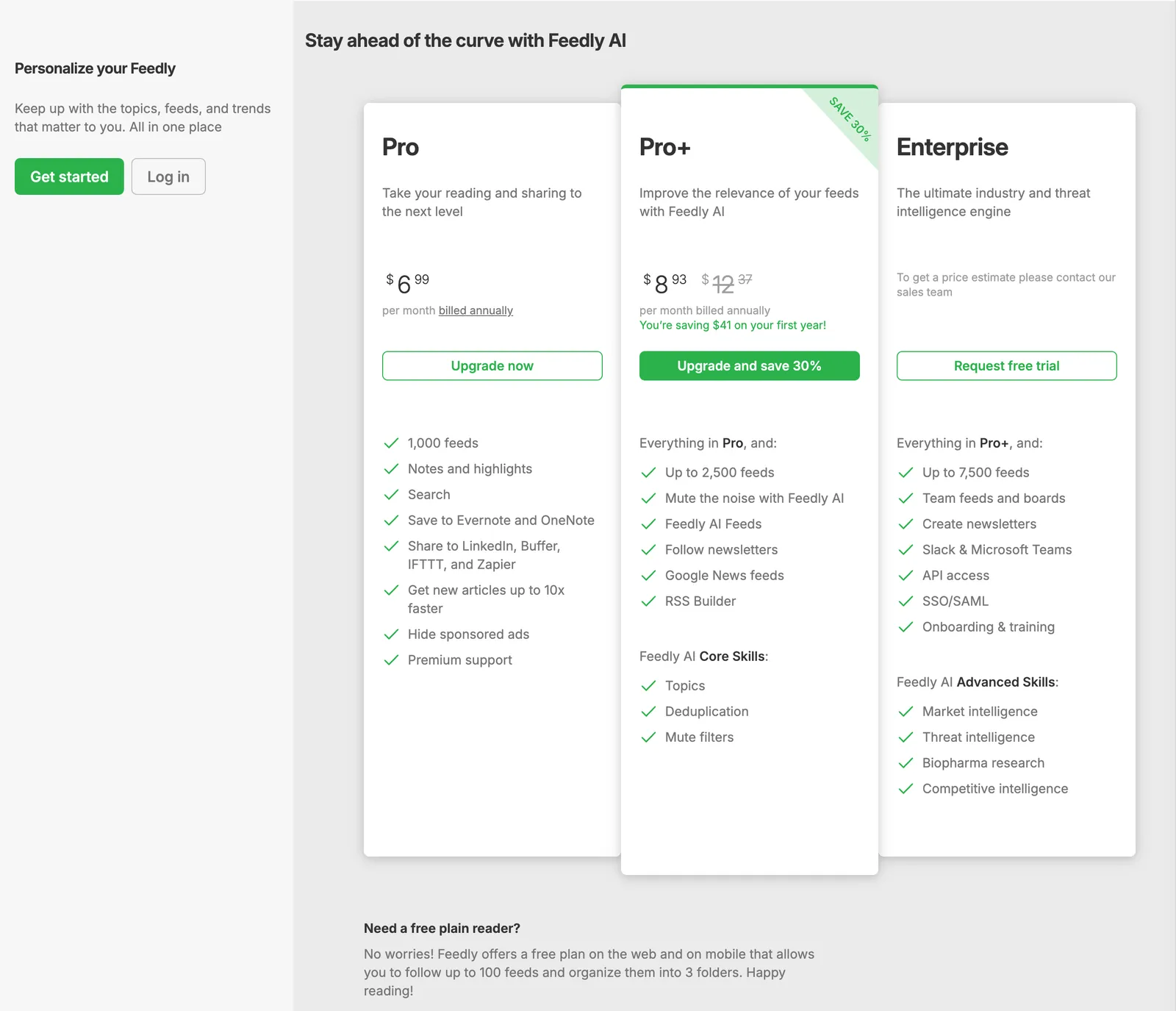 Feedly’s plans, with Feedly AI starting at Pro+, 6 October 2026. Source: feedly.com
Best RSS reader without AI
A lot of readers are tired of AI features. A four-star App Store review of Feedly in July 2026 read: “I hate how it tries to shove AI down my throat.” (App Store). If you want none at all:
- NetNewsWire: no AI, free, Apple only.
- Feedbin: no AI, $70 a year.
- Miniflux: no AI, self-hosted or $15 a year hosted.
- Reeder: no AI.
- NewsBlur: AI starts at the $99 plan, so the cheaper plans don’t include it.
Hushread isn’t AI-free: your feed keeps the original headlines, but a short quick take appears inside articles you open and story timelines carry a summary. More in our guide to an RSS reader without AI.
Best self-hosted RSS reader
FreshRSS is the most complete: free (AGPL-3), multi-user, extensions, WebSub, page scraping, and support for the Google Reader and Fever APIs so mobile apps can connect (FreshRSS). Version 1.30.0 shipped on September 9, 2026, and version 1.29.0 added an LLM classification extension if you want AI tagging on your own terms (releases). It can auto-mark duplicate titles as read. One Hacker News user found FreshRSS with NetNewsWire works well (HN).
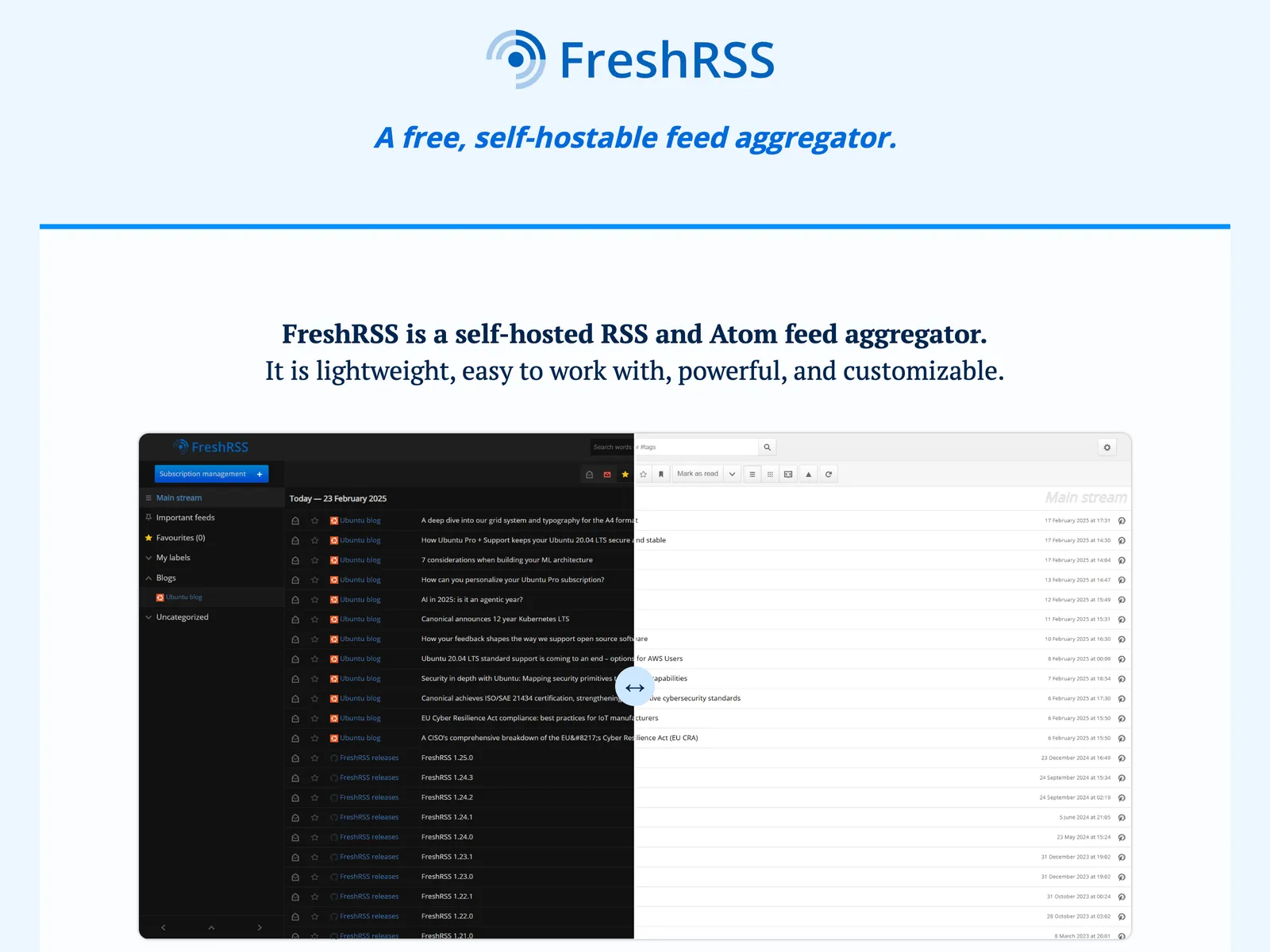 FreshRSS’s homepage, 6 October 2026. Source: freshrss.org
Miniflux is the minimalist choice: Apache 2.0, needs PostgreSQL, no AI, with the same two APIs. Version 2.3.3 shipped in July 2026, and one Hacker News user said its full-text fetch works on nearly all of their 150+ feeds (HN). If you’d rather not run it, hosted Miniflux is $15 a year with a 15-day trial (Miniflux).
NewsBlur is open source (MIT) and self-hostable with Docker, if you want its filtering on your own server.
The cost of all three is your time: updates, backups and the occasional site that blocks your server. If you remember Google Reader fondly, our Google Reader alternative guide explains why FreshRSS is one of the closest things to it.
RSS readers that group stories and remove duplicates
Follow enough news sources and the same event shows up once per outlet. Readers handle this in three ways.
Hiding copies. Inoreader Pro’s duplicate filters match by URL, exact title or near-identical title (Inoreader blog). Feedly Pro+ collapses articles from different sources with more than 85% content overlap (Feedly docs). Feeder skips duplicates per feed, and FreshRSS can mark duplicate titles read. These catch syndicated copies, not different outlets’ own reporting.
Clustering. NewsBlur launched story clustering in March 2026, using title matching plus semantic similarity to fold duplicates under the highest-scoring version. Free and Premium users see clusters only on popular feeds; Premium Archive ($99 a year) gets full control (NewsBlur blog).
Grouping by event. Hushread groups coverage from your own sources into one story on every plan, including Free. Different outlets’ reports on the same event join one card, copies and rewrites collapse under the freshest version, and “See whole story” opens a day-by-day timeline of every outlet’s coverage with a summary of how it developed. Long stories chain into chapters. Because stories are grouped, Hushread can also count how many distinct publishers cover each one hour by hour, which is what powers Trending. You can see it working on our stories page. It’s automatic and not perfect: occasionally one event lands in two stories.
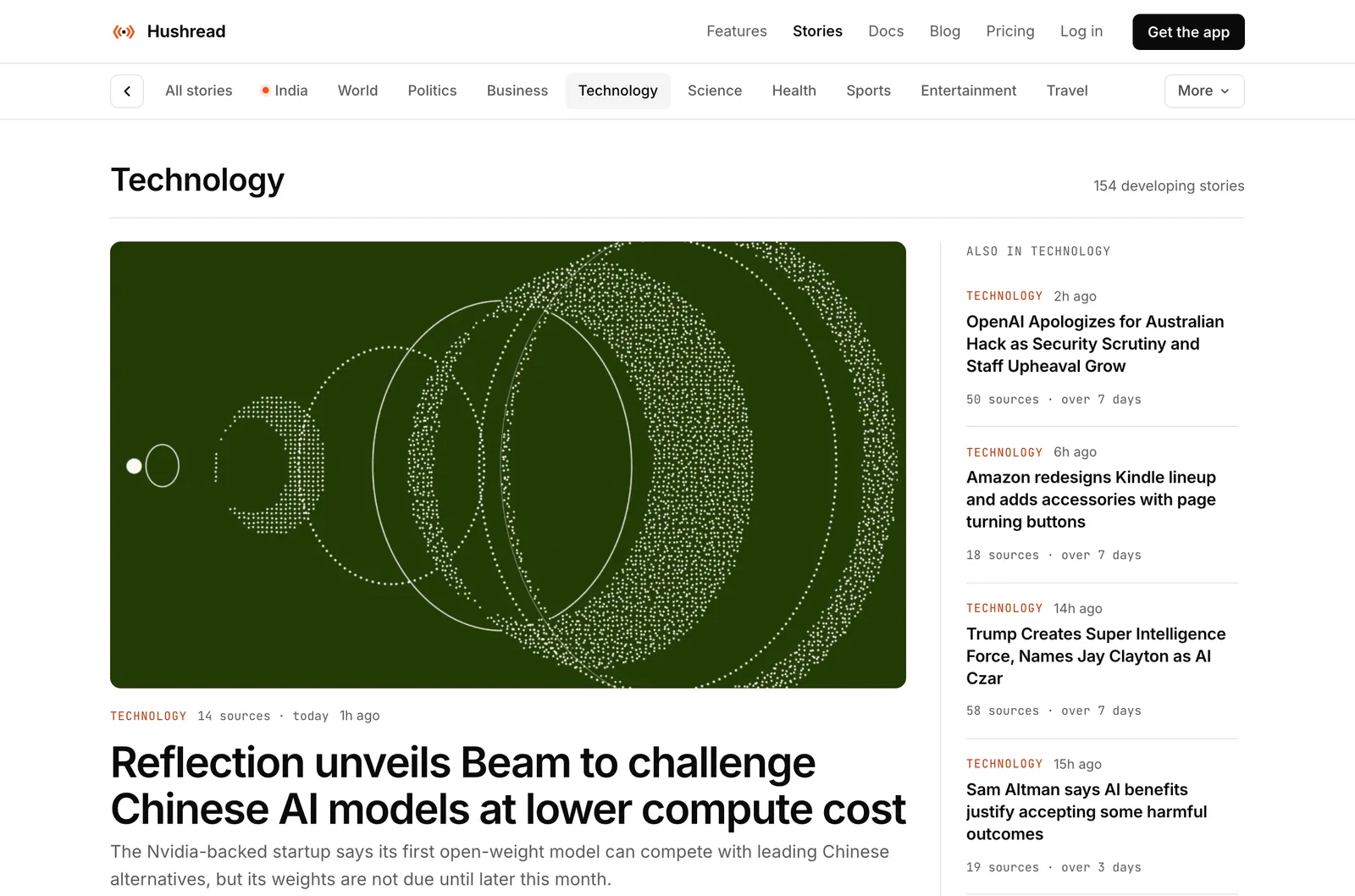 Hushread grouping each event into one story with a source count, 6 October 2026. Source: hushread.com
Google News Full Coverage, Particle and Ground News also group coverage by story, but they pick the outlets; you can’t bring your own feeds. See our Google News alternatives, Particle alternatives and Ground News alternatives, and the how-to on an RSS reader that removes duplicates.
Abandoned or risky picks to avoid
- The Old Reader. Web only, with no official mobile apps; its apps page still lists Windows Phone and Symbian (The Old Reader). Ownership changed in March 2024 (Wikipedia), the blog’s last post is from December 2021, and the official site lists no price. It looks barely maintained.
- Pocket. Mozilla shut it down on July 8, 2025 (9to5Mac). See our Pocket alternatives.
- Omnivore. Closed on November 15, 2024, and user data was deleted (heise).
- Artifact. The news app from Instagram’s founders shut down in early 2024 (Engadget).
- Twitter/X as a feed source. Inoreader dropped it in March 2023 (Inoreader blog), Feedly limits it to intelligence customers with their own API credentials (Feedly docs), and Nitter, the usual workaround, is essentially gone after a cease-and-desist from X in August 2026 (Wikipedia).
- Old Reddit feed URLs. Old Reddit has required a login since July 2026 (Slashdot), and Reddit cut logged-out RSS to about one request a minute in June 2026 (Lapcat Software). Our subreddit RSS feed guide has working URLs.
- Feed43. It was unreachable when we checked on September 29, 2026.
- The new Reeder, if you rely on a sync service. It syncs through iCloud only and third-party sync isn’t planned (Reeder help). Reeder Classic still supports services.
How we picked these readers
We started from the readers that come up most in forums, app store charts and other roundups, then kept the ten that are maintained, available on at least one major platform, and worth paying for or clearly worth their free plan. For each one we checked:
- Price and free-plan limits on the vendor’s own pricing page or US App Store listing, on 6 October 2026, not on an older roundup. Several of those are out of date (Inoreader Free lost its ads in 2024, for example).
- Platforms and apps from the stores themselves, with the current rating and review count where it affects the pick (Inoreader’s Android app rates far below its iPhone app).
- Activity from changelogs and release pages, so an app that last shipped years ago doesn’t make the list.
- What users complain about in recent App Store reviews and Hacker News threads, with links where we quote them.
Every claim above links to its source so you can check it. Hushread is our own app, so we put it where it fits (grouping coverage into one story per event) and say plainly where another reader is the better choice.
How to switch RSS readers without losing your feeds
The standard way to move is OPML, a plain text file listing your feed addresses and folders. Export it from the old reader (usually in settings, under import/export), import into the new one, and check the feed count. Read state, saved articles, tags, rules and filters don’t come across, and feeds that exist only inside one service, like newsletter addresses or Inoreader’s web feeds, may need re-creating. Hushread imports OPML too, and brings in every feed on the free plan.
If you just want a different app on top of the same service, you may not need to export at all: NetNewsWire and Reeder Classic can sign in to Feedly, Inoreader, NewsBlur, Feedbin and FreshRSS directly.
More comparisons and guides
- RSS readers: Inoreader alternatives, Feedly alternatives, Inoreader vs Feedly, Google Reader alternative, NetNewsWire and Reeder for Android
- Head to head: Hushread vs Inoreader, Hushread vs Feedly, Hushread vs Google News, Hushread vs Ground News
- News apps: Google News alternatives, Ground News alternatives, Flipboard alternatives, SmartNews alternatives, Apple News for Android, Particle alternatives, Pocket alternatives
- How-tos: subreddit RSS feeds, YouTube channel RSS feeds, Facebook page RSS feeds, RSS reader with notifications, news app without an algorithm
FAQ
What is an RSS feed reader?
An RSS reader, also called a feed reader or news aggregator, checks the sites you follow and lists their new articles in one place, usually newest first. You choose the sources. Every app in this guide is one.
What is the best free RSS reader?
For a hosted reader, Inoreader Free: 150 feeds, search and no ads. For a free app, NetNewsWire on Apple devices or Feeder on Android. For full control, self-hosted FreshRSS or Miniflux.
Do Feedly and Inoreader have AI summaries?
Yes, on paid plans. Inoreader’s summaries are part of Pro at $89.99 a year, with reports and digests as extra add-ons. Feedly AI is in Pro+, which costs about $8 to $9 a month billed annually in the first year, then about $12. Neither free plan includes them.
Can I summarize RSS feeds with ChatGPT?
Some readers let you connect your own AI key. Feeder does, Readwise Reader needs your own OpenAI key to summarize feed items automatically, and Inoreader Pro, while it doesn’t take your own key, lets you choose between OpenAI, Anthropic and Mistral models.
What is the best RSS reader for a small business or team?
Feedly and Inoreader are the two built for it. Feedly has team plans with shared feeds and boards, and Inoreader has team plans with shared subscriptions and rules. Both start from their standard pricing pages (Feedly, Inoreader). For a small business that only needs monitoring, Inoreader’s rules and search alerts on Pro do most of the job without a team plan.
Is RSS dead?
No. In September 2026 alone, NetNewsWire, FreshRSS, Feeder and Reeder Classic all shipped updates, Inoreader launched Mentions, and NewsBlur added a new top plan earlier in the year. What faded is RSS as a mainstream Google product, not the format.
Which RSS reader works on both iPhone and Android?
Inoreader, Feedly, NewsBlur and Hushread all have native apps on both, with their own sync. Feedbin works on Android through its mobile site. You can also mix apps: NetNewsWire on iPhone can sync with Feedly, Inoreader or NewsBlur, whose own Android apps then show the same feeds.
The bottom line
Pick the reader that fits how you read, not the one with the longest feature list. A sensible way to start is the free pick for your platform: NetNewsWire on Apple devices, Feeder on Android, or Inoreader Free on the web. Pay only when you hit a limit you care about: Inoreader Pro for rules and monitoring, Feedly for polish and teams, NewsBlur for filtering on a budget, Feedbin or Miniflux for a quiet reader with no AI, and FreshRSS if you’d rather host it yourself. None of these choices is permanent, because your feeds move between readers as an OPML file.
Hushread fits a narrower case. Most of the readers above list every article from every feed, and their duplicate filters only hide copies, so ten outlets reporting one event still means ten headlines. Hushread is what we built for that: you choose every source, and it shows each event as one story, with a timeline of how the coverage unfolded. It also follows websites without a feed, subreddits, YouTube channels and Facebook pages alongside RSS. It’s the wrong pick if you want a Mac app or no AI at all. If the pile of repeated headlines sounds familiar, Hushread is free, with no limit on sources, on iOS, Android and the web. Pro, at $2.08 a month billed yearly, adds instant alerts when a source you pick publishes. Try Hushread.