
Disclosure: Hushread is our app. We’ve tried to be fair, and we say where the others are the better choice.
Google Reader closed on July 1, 2013, and nothing official replaced it. The Old Reader is still the closest in look, but it appears barely maintained. For a dependable Google Reader replacement, Inoreader (150 free feeds, no ads) and Feedly are the big hosted options, NewsBlur and Feedbin are solid paid ones, NetNewsWire is free on Apple devices, and FreshRSS lets you self-host a reader that still speaks Google Reader’s sync API. Hushread is a different kind of reader, and we explain below when that helps and when it doesn’t.
What happened to Google Reader?
Google launched Reader on October 7, 2005. On March 13, 2013, it announced the shutdown, and the service closed on July 1, 2013. By then it had a loyal but shrinking following, according to Wikipedia’s history of the product, and the move sent a lot of people looking at once: Feedly picked up 500,000 new users within 48 hours of the announcement.
More than thirteen years later, “Google Reader alternative” and “best Google Reader replacement” are still searched. Some of that is people who never found a home. Some is newer readers who’ve heard the name and want the same thing: the sites you chose, in one place, in order.
What made Google Reader hard to replace
Google Reader’s appeal was mostly its simplicity. It was free, it ran in the browser, and it showed you what the sites you followed had published, without trying to decide what you should read. Its API also outlived it: FreshRSS and Miniflux still implement a Google Reader-compatible API so other apps can sync with them (FreshRSS).
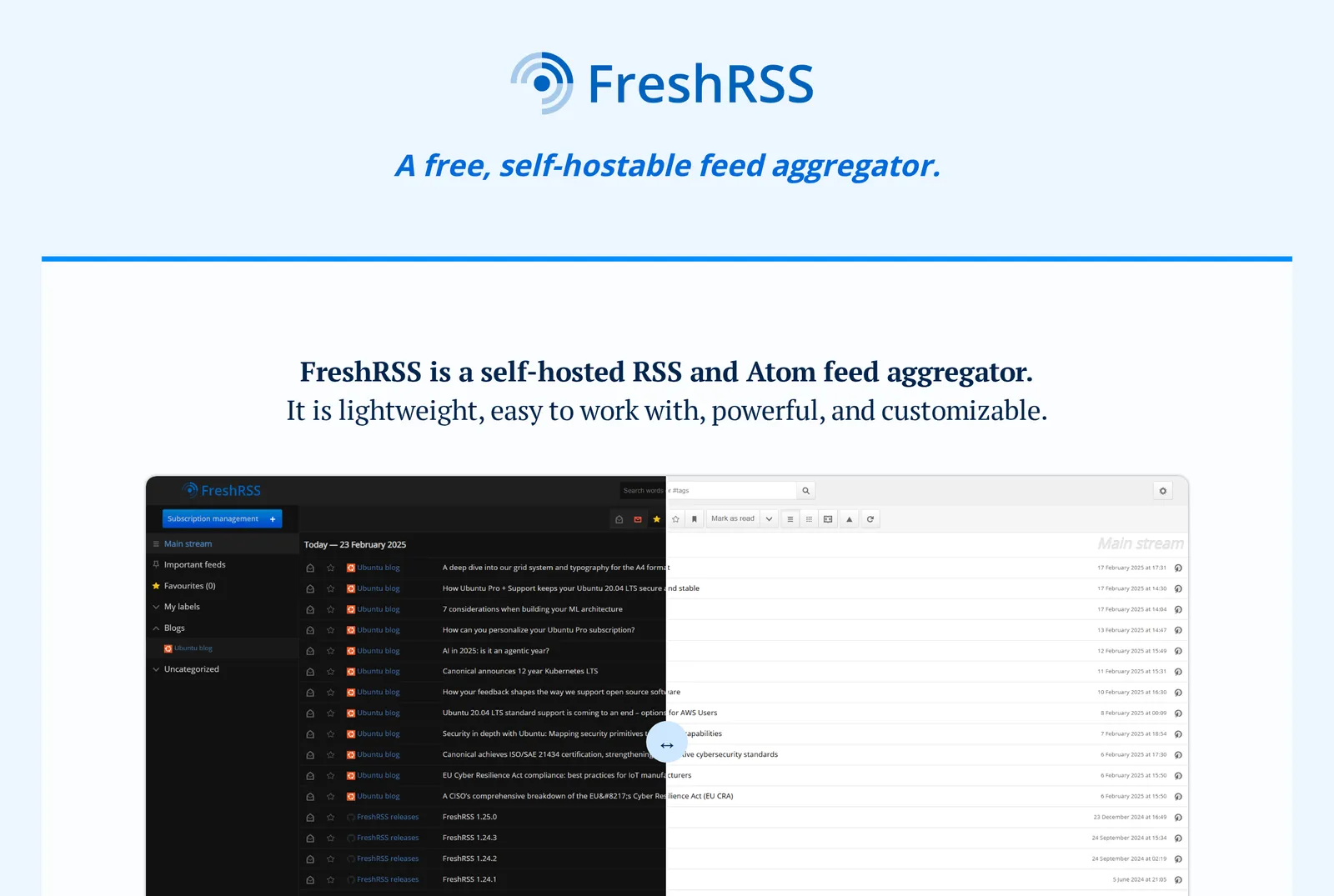 FreshRSS’s home page, as shown on 9 October 2026. Source: freshrss.org
It also taught a lesson. A free product from a very large company can still disappear. When you choose a replacement, it’s worth asking not only “does it look right?” but “who runs it, how is it paid for, and can I leave easily?” Check that a replacement exports your feeds as OPML, so leaving stays easy. As you’ll see below, who runs each one varies a lot.
The closest Google Reader replacements today
Prices are from each official pricing page or App Store listing (as of September 2026).
| Reader | Closest to Reader in | Free plan | Paid | Platforms |
|---|---|---|---|---|
| The Old Reader | Look and feel | Price not listed on site | Not listed | Web |
| Inoreader | Scope, web plus apps | 150 feeds, no ads | $89.99/yr | Web, iOS, Android |
| Feedly | Where users went in 2013 | 100 feeds, 3 folders, ads | About $6 to $7/mo, yearly | Web, iOS, Android |
| NewsBlur | Veteran hosted service | 64 sites | $36/yr | Web, iOS, Mac, Android |
| Feedbin | Quiet, clean, paid | 30-day trial | $70/yr | Web, iOS, Mac |
| NetNewsWire | Free and simple | Free, open source | None | Mac, iPhone, iPad |
| FreshRSS | Google Reader API, self-hosted | Free | None | Your server |
| Hushread | Not a clone: grouped stories | 5 sources | $1.25/mo billed yearly | iOS, Android, web |
The Old Reader: the closest look, with a caveat
The Old Reader offers Google Reader-style web reading, and its name says what it’s going for. It’s web only, with no official mobile apps; third-party apps connect through its API, and its apps page still lists Windows Phone and Symbian (The Old Reader). NetNewsWire and Reeder Classic can both sync with it, which gives you a native app on Apple devices.
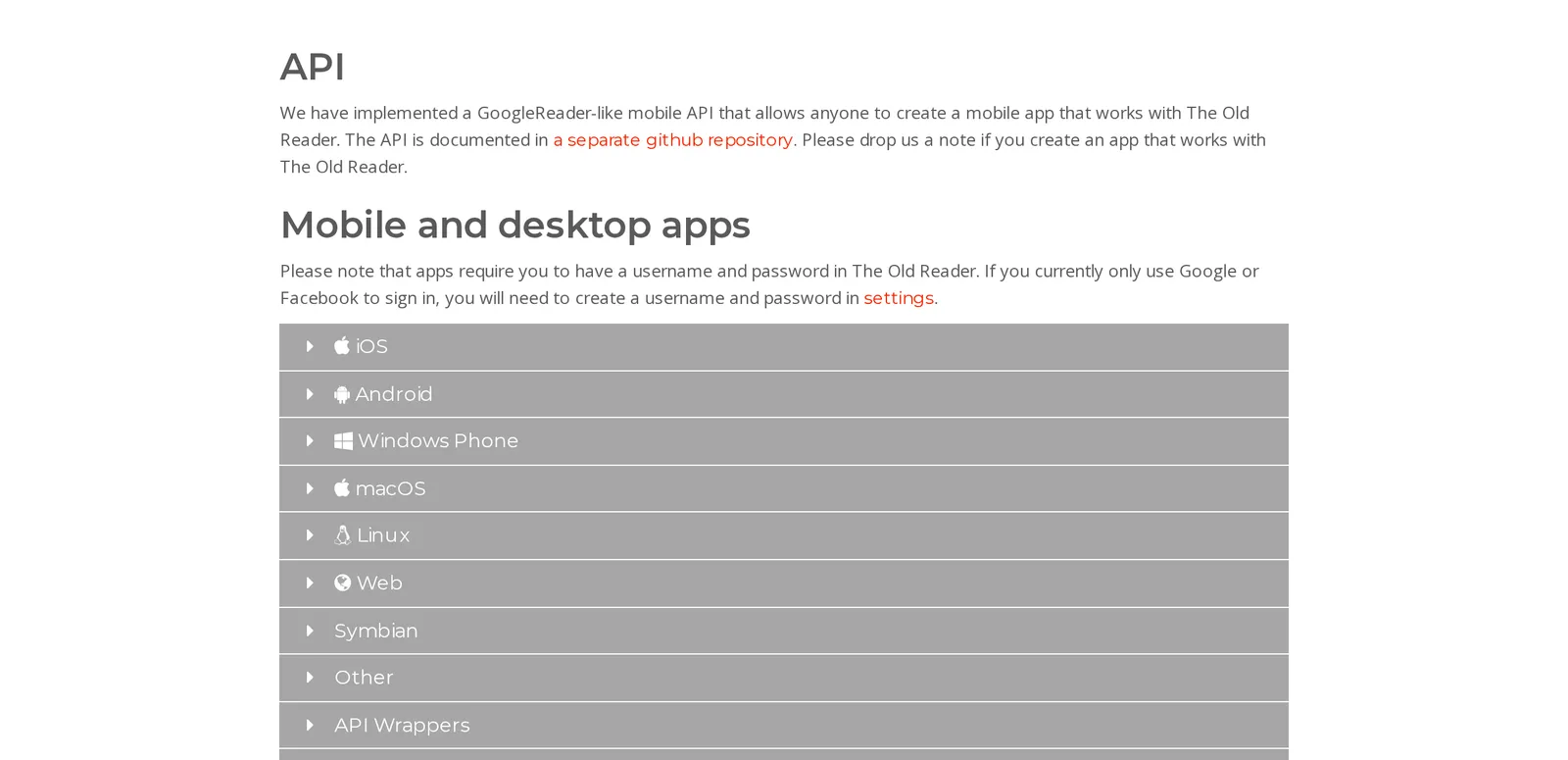 The Old Reader’s apps page, as shown on 9 October 2026. Source: theoldreader.com
The caveat: ownership changed in March 2024 (Wikipedia), the blog’s last post is from December 2021, and the official site doesn’t list a price. At the time of writing, it appears to offer a free tier of up to 100 feeds and Premium at $3 a month or $30 a year, the terms it launched with in 2014 (The Next Web) and still cited in an April 2026 comparison (Serene Reader), but the official site doesn’t confirm them. It looks barely maintained. Fine for casual reading; we wouldn’t make it the only place your feed list lives.
Inoreader: the full-featured successor
If Google Reader was your daily tool and you want something bigger, Inoreader is it. Inoreader Free allows 150 feeds with search in your own feeds and no ads; Inoreader removed them from Free in October 2024 (Inoreader blog). Pro, at $89.99 a year, adds rules, filters, monitoring, newsletters, social feeds, push notifications and offline reading.
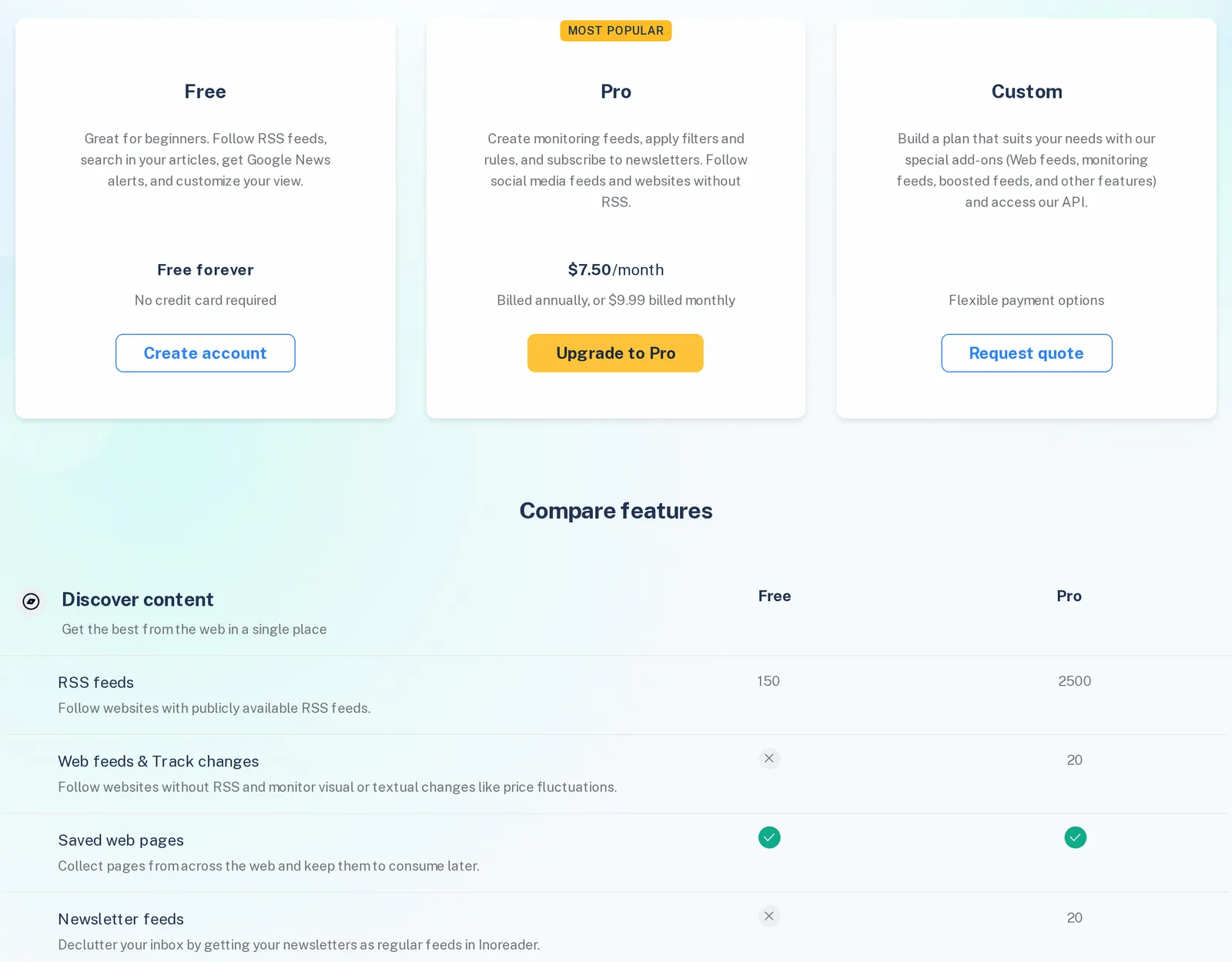 Inoreader’s plans as shown to an address in India on 9 October 2026. Source: inoreader.com
The common complaints are price and clutter: users call it “good but expensive” (Reddit) and some dislike the growing AI features. If you only want Google Reader’s basics, Free may be all you need. Our Inoreader alternatives post covers who should pay.
Feedly: where many Google Reader users went
Feedly took in many Google Reader users in 2013. Today Feedly Free allows 100 feeds and 3 folders with sponsored ads and no search, and Pro costs about $6 to $7 a month billed annually (Feedly pricing). Its homepage now leads with threat intelligence for security teams (Feedly), and a week-long slowdown in August 2026 worried users, though the CEO told TechCrunch that basic RSS remains a priority (TechCrunch). If you sort feeds into many folders, the 3-folder limit on Free will pinch. See our Feedly alternatives guide.
NewsBlur: a veteran with serious filtering
NewsBlur is free for 64 sites and $36 a year for 1,024. It runs on the web, iOS, Mac and Android, it’s open source and self-hostable, and feed training and filtering are its signature. The top plan, Premium Archive at $99 a year, adds Ask AI, a daily briefing and full control of story clustering. The interface isn’t the most modern, as one Hacker News commenter put it while wishing they’d paid sooner (HN).
Feedbin: quiet, clean, paid
Feedbin costs $7 a month or $70 a year after a 30-day trial. It follows RSS, newsletters, podcasts, YouTube and Mastodon, has no AI, and has native iOS and Mac apps. Many other apps, including NetNewsWire and Reeder Classic, use it for sync. There’s no native Android app.
NetNewsWire: free and simple on Apple devices
NetNewsWire is free and open source for Mac, iPhone and iPad. It has no AI, and it syncs through iCloud or with Feedbin, Feedly, Inoreader, NewsBlur, The Old Reader and FreshRSS. Its creator, Brent Simmons, works on it full-time, and recent updates have focused on speed and sync (inessential). It’s the closest thing to Google Reader’s spirit of a free, plain reader, but it’s Apple only.
FreshRSS and Miniflux: Google Reader’s API lives on
If what you learned in 2013 is that you don’t want anyone else able to switch your reader off, self-host. FreshRSS is free, supports multiple users and extensions, and implements the Google Reader and Fever APIs, so apps like NetNewsWire can sync with it. One Hacker News user found that pairing works well (HN). Miniflux is a minimalist alternative with the same two APIs and a $15 a year hosted option (Miniflux). The price is your time: you run the server.
Where Hushread fits, and where it doesn’t
Hushread is our app, and it is not a Google Reader clone. If you want Reader exactly as it was, pick The Old Reader, NetNewsWire or FreshRSS.
What Hushread shares with Google Reader: you choose every source, and everything you follow arrives in order with nothing injected by an algorithm. You can import your feeds as OPML and organize sources in folders. It runs on iOS, Android and the web, synced.
Where it differs is what happens after articles arrive. Articles from different outlets about the same event are grouped into one story. “See whole story” opens a day-by-day timeline of every outlet’s coverage with a summary of how it developed, and long stories chain into chapters. Syndicated copies and rewrites collapse under the freshest version. Trending shows which stories are surging by counting distinct publishers hour by hour. You can see live examples on our stories page. Beyond RSS, it follows websites without a feed, topics, subreddits, YouTube channels and Facebook pages.
That makes Hushread a good fit if you mostly followed news sites in Google Reader and got tired of reading the same event once per outlet. It’s a weaker fit if:
- You followed hundreds of blogs. Free allows only 5 sources. Pro is unlimited at $1.25 a month billed yearly (regional pricing may differ).
- You want a plain list per feed and nothing else. Grouping is the point of Hushread, and it’s automatic, so occasionally one event lands in two stories.
- You relied on extras. There’s no browser extension, no newsletter intake, no integrations and no public API.
- You want a big company behind it. Hushread is built by one independent developer. That cuts both ways after 2013, but you should know it.
How to move your feeds
Export an OPML file from whatever reader you use now (usually under settings, in an import/export section), then import it into the new one and check the feed count. If your list goes back to the Google Reader days, expect some sites to have moved or stopped publishing, so prune after importing. Read state, stars and tags don’t travel in OPML. Our best RSS reader guide covers more options by platform.
FAQ
Is Google Reader coming back?
Google hasn’t brought it back. The service has been closed since July 1, 2013, and the closest things today are the readers above.
What replaced Google Reader?
Nothing official. Feedly absorbed many users right after the announcement, gaining 500,000 in 48 hours. Today the main hosted successors are Inoreader, Feedly, NewsBlur and Feedbin, and FreshRSS carries on Google Reader’s sync API for self-hosters.
Is there a free Google Reader alternative?
Yes. Inoreader Free allows 150 feeds with no ads, Feedly Free allows 100 feeds with ads, NetNewsWire is free on Apple devices, and FreshRSS and Miniflux are free to self-host. The Old Reader has historically had a free tier, but its current pricing isn’t published on its site.
Is The Old Reader still working?
Its site is still up, but it shows signs of neglect: no official mobile apps, a blog last updated in December 2021, and no price on the official site. Use it with an export of your feeds kept somewhere safe.
If Google Reader’s charm was that it stayed out of your way, NetNewsWire or FreshRSS will feel most like home. If what you want now is the news from your own sources without ten copies of every story, Hushread is worth a look. Hushread is free with up to 5 sources on iOS, Android and the web. Try Hushread.