
Disclosure: Hushread is our app. We’ve tried to be fair, and we say where the others are the better choice.
There is no NetNewsWire for Android and no Reeder for Android: both are Apple-only. The closest Android match to NetNewsWire is Feeder, which is free, open source and needs no account. If you want Reeder’s mixed timeline or you use an iPhone as well, pick a reader with its own sync on both platforms, such as NewsBlur, Feedly, Inoreader or Hushread, or keep your iPhone app and sync it through a service that has an Android app.
Is NetNewsWire available for Android?
No. NetNewsWire runs on Mac, iPhone and iPad only, with no Android, Windows or web version (NetNewsWire). It’s free, open source and actively developed: version 7.1.4 for iPhone and iPad shipped on September 21, 2026 (App Store), and its creator Brent Simmons has been working on it in retirement since June 2025 (inessential).
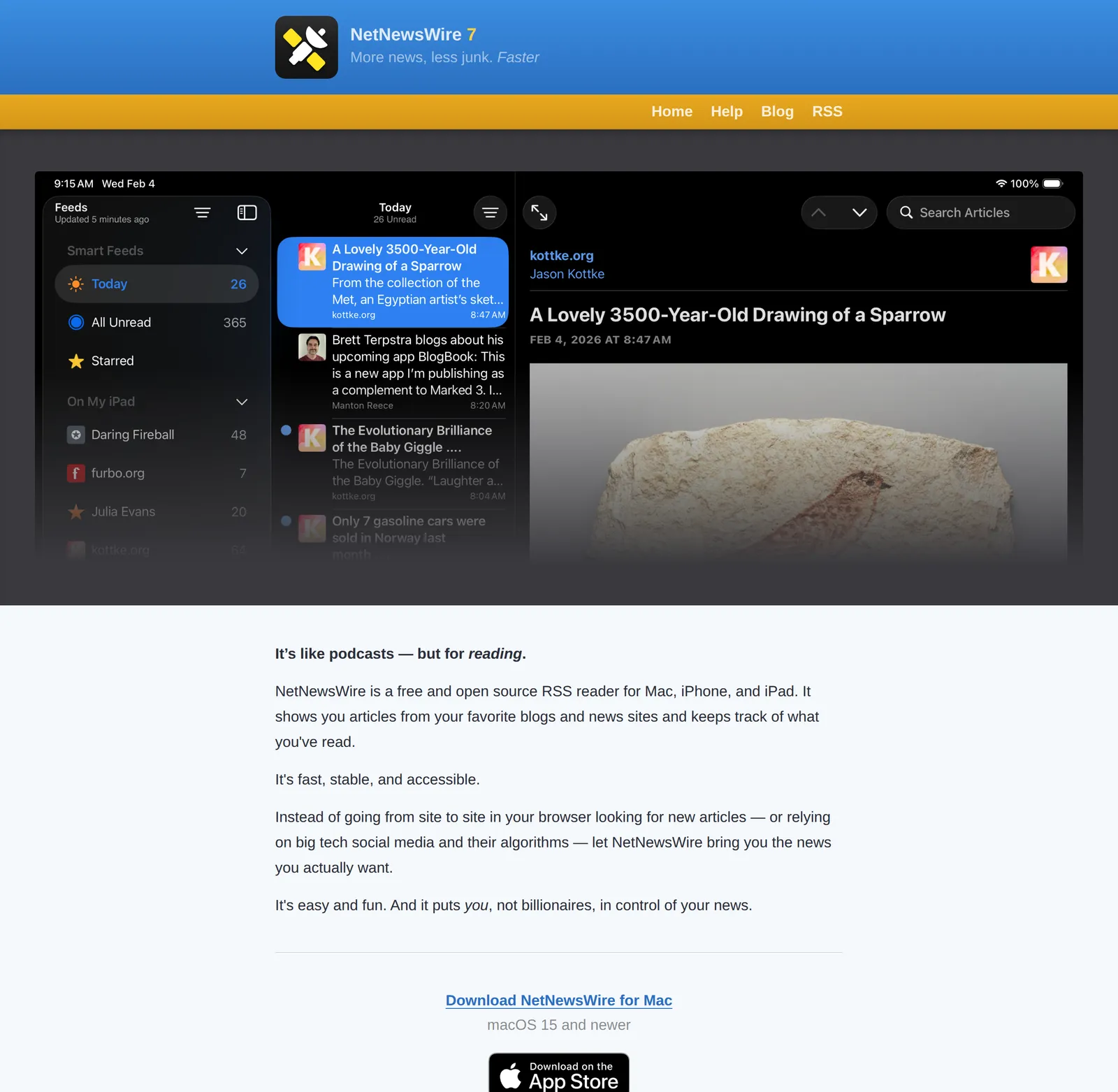 NetNewsWire’s home page lists Mac, iPhone and iPad and nothing else, as shown on 9 October 2026. Source: netnewswire.com
What people like about it is what you should look for on Android: free, open source, no AI, and a plain list of what your feeds published. Feeder is the closest match on those terms.
Is Reeder available for Android?
No. The new Reeder runs on iPhone, iPad and Mac (iOS 17 and macOS 14 or later) and syncs through iCloud only, with third-party sync services not planned (Reeder, Reeder help). Reeder Classic is also iOS and Mac only (Reeder Classic).
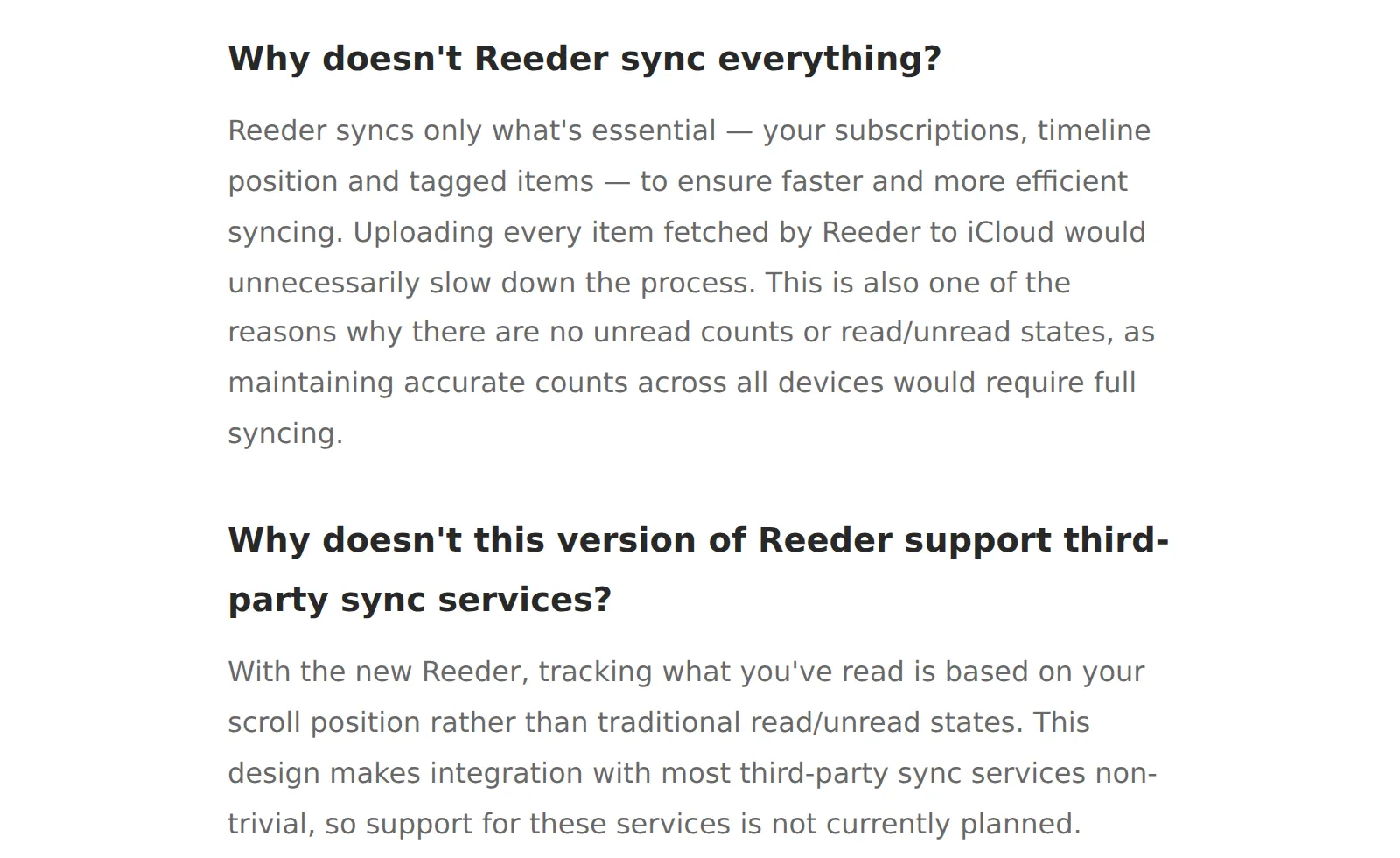 The sync answers in Reeder’s help, as shown on 9 October 2026. Source: reederapp.com
Reeder’s draw is a single timeline that mixes feeds with YouTube, Reddit, Mastodon, Bluesky, Pixelfed, SoundCloud and podcasts, at $14.99 a year on the US App Store (App Store). No Android app copies that exactly. The nearest options are NewsBlur, whose version 15 added shortcuts for finding YouTube, Reddit, newsletter and podcast sources (NewsBlur blog), Feedly, which follows subreddits and YouTube channels, and Hushread, which puts RSS feeds, websites, subreddits, YouTube channels and Facebook pages in one chronological feed. If Mastodon is essential, Feedbin supports it, but only through its mobile website on Android. Mastodon profiles also publish their own RSS feeds at https://instance/@user.rss (Mastodon docs), and Bluesky profiles at https://bsky.app/profile/<handle>/rss, though Bluesky items have no titles. You can add those to most readers as ordinary feeds.
Best Android RSS readers compared
Prices are from each official pricing page or store listing (as of October 2026).
| Reader | On Android | Free plan | Paid | Also on iPhone |
|---|---|---|---|---|
| Feeder | Native app, 3.8 on Play | Free, open source | None | No |
| NewsBlur | Native app, 4.1 on Play | 64 sites | $36/yr | Yes, own app and sync |
| Feedly | Native app, 4.4 on Play | 100 feeds, 3 folders, ads | About $6 to $7/mo, yearly | Yes, own app and sync |
| Inoreader | Native app, 2.8 on Play | 150 feeds, no ads | $89.99/yr | Yes, own app and sync |
| Hushread | Native app | 5 sources | $1.25/mo billed yearly | Yes, own app and sync |
| Feedbin | Mobile website only | 30-day trial | $70/yr | Yes, native app |
The closest NetNewsWire alternative on Android: Feeder
Feeder is free and open source (GPLv3), with no in-app purchases and no account. It’s also on F-Droid for Android 10 and later. It’s actively maintained, with version 2.23.2 released on September 20, 2026.
It does a few things NetNewsWire doesn’t: a per-feed “skip duplicates” option and AI summaries if you bring your own API key. It also has text-to-speech, plus AI translation since May 2026 and on-device translation since June 2026 (changelog). All of it is optional. One Hacker News commenter called it their pick on Android (HN).
The trade-offs: it’s Android only, and it doesn’t connect to cloud sync services, so it can’t share read state with an iPhone. There’s an optional community “Device sync” feature, but not a Feedbin or Inoreader login. It rates 3.8 from about 2,200 ratings on Play.
Pick Feeder if Android is your only device and you want NetNewsWire’s simplicity.
Other strong Android RSS readers
NewsBlur: power features on every platform
NewsBlur has native apps on Android, iOS, Mac and the web, all on its own sync, and it rates 4.1 on Google Play with more than 100,000 downloads. Free covers 64 sites, Premium is $36 a year for 1,024, and Premium Archive at $99 a year adds Ask AI, a daily briefing and full control of story clustering (pricing). Feed training and filtering are its strength. Some App Store reviewers in March 2026 complained about a gesture redesign, and one Play reviewer in July 2026 said the free plan stopped showing new stories after their trial ended.
Feedly: the most polished Android app of the big services
Feedly rates 4.4 on Play from about 317,000 reviews, with more than 5 million installs. Free gives you 100 feeds and 3 folders with sponsored ads and no search; Pro is about $6 to $7 a month billed annually (Feedly pricing). It follows subreddits (Feedly docs) and YouTube channels (Feedly docs). Its homepage now leads with threat intelligence for security teams, and some users dislike its AI push. More in our Feedly alternatives guide.
Inoreader: the most features, a weaker Android app
Inoreader Free is generous: 150 feeds, search in your own feeds and no ads (pricing). Pro at $89.99 a year adds rules, filters, monitoring, social feeds, push notifications and offline reading. But its Android app rates 2.8 from about 9,600 reviews on Google Play, compared with 4.68 on iPhone, so try it on Free before paying. Our Inoreader alternatives post explains who Pro is worth it for.
Hushread: one story per event, from sources you pick
Hushread is our app. It’s a native Android app, with iOS and web versions synced to the same account. You add RSS and Atom feeds, websites without a feed, topics, subreddits, YouTube channels or Facebook pages, or import an OPML file from your old reader. Everything arrives in order with nothing injected.
What’s different is grouping. Articles from different outlets about the same event become one story, and “See whole story” opens a day-by-day timeline of every outlet’s coverage with a summary of how it developed. Syndicated copies and rewrites collapse under the freshest version, and Trending flags stories that more distinct publishers are covering hour by hour. See live examples on our stories page. Narration keeps playing in the background, and push notifications tell you when a source publishes (for every feed on Pro).
The limits: Free is 5 sources, far fewer than the others’ free plans. Pro is $1.25 a month billed yearly (regional pricing may differ). There are no newsletters, podcasts, integrations or browser extension, and no Mac app, though the web app works in any browser. Grouping occasionally splits one event into two stories. And it’s built by one developer.
Feedbin in the browser
Feedbin has no native Android app, but its mobile website works, and it’s a common sync backend for NetNewsWire and Reeder Classic on the iPhone side. It costs $70 a year after a 30-day trial (pricing), follows newsletters, podcasts, YouTube and Mastodon, and has no AI. It makes sense if your iPhone is your main device and Android is secondary.
If you have an iPhone and an Android phone
This is where the Apple-only apps hurt most. iCloud sync, which NetNewsWire offers and the new Reeder uses exclusively, doesn’t reach Android. You have three workable setups.
1. One service, its own app on both phones. Inoreader, Feedly, NewsBlur and Hushread all have native iOS and Android apps with their own sync. This is the simplest option: same account, same feeds, same read state.
2. Keep NetNewsWire or Reeder Classic on the iPhone, sync through a service. NetNewsWire syncs with Feedbin, Feedly, BazQux, Inoreader, NewsBlur, The Old Reader and FreshRSS. Reeder Classic supports much the same list. Sign the iPhone app in to Feedly, Inoreader or NewsBlur, then use that service’s own Android app. You keep your favorite iPhone reader and get a native Android app on the same feed list. If you’d like to do this for free, check that the service’s free plan allows third-party apps before you rely on it.
3. Self-host FreshRSS. FreshRSS is free, open source and speaks the Google Reader and Fever APIs, and NetNewsWire can sync with it. On Android, use its web interface or an app that supports either API. One Hacker News user runs FreshRSS with NetNewsWire and says it works well (HN). The cost is running a server.
What won’t work: Feeder on Android plus NetNewsWire on iCloud, or the new Reeder with anything on Android. Neither pair can share state.
When your Apple reader is still the better choice
Keep NetNewsWire or Reeder if:
- Your Android phone is secondary. Setup 2 above lets you keep the iPhone app you like.
- You read on a Mac. NetNewsWire, Reeder and NewsBlur have native Mac apps. Hushread doesn’t; its web app works in a browser.
- You want Mastodon, Bluesky and feeds in one place. Reeder’s timeline was built for exactly that.
- You want a one-time purchase. Reeder Classic is $4.99 on iOS or $9.99 on Mac, once.
FAQ
Is there a NetNewsWire for Android?
No. NetNewsWire is only for Mac, iPhone and iPad. Feeder is the closest Android equivalent: free, open source and simple.
Is Reeder available on Android?
No. Both the new Reeder and Reeder Classic are Apple-only, and the new Reeder syncs through iCloud only.
What is the best free RSS reader for Android?
Feeder, if you want a free app with no account and no in-app purchases. If you want a hosted account that also works on iPhone, Inoreader Free (150 feeds, no ads) and Feedly Free (100 feeds, with ads) are the most generous. Our best RSS reader guide compares every platform.
Which Android RSS reader syncs with NetNewsWire?
No Android app syncs with NetNewsWire directly. Instead, sync NetNewsWire to a service such as Feedly, Inoreader or NewsBlur, and use that service’s Android app.
If you’ve moved to Android, or carry both, you don’t need to give up a clean, chronological reader. Feeder covers the simple case, the big services cover sync, and Hushread adds one story per event across your own sources. Hushread is free with up to 5 sources on iOS, Android and the web. Try Hushread.