
Disclosure: Hushread is my app. I’ve tried to be fair, and I say where the others are the better choice.
Ground News vs Google News comes down to one question: do you want to know who covered a story, or just read it? Both apps show you many outlets covering one event. Ground News tells you who covered it by political lean (left, center, right, with counts) and keeps factuality and ownership behind a paid plan. Google News Full Coverage gives you one free page of reporting, posts from officials and the wider coverage, with no labels at all. If you want to check a story’s political spread, use Ground News. If you want the whole story in one place for free, Google News is enough.
I opened the same event in both on 13 November 2026: the building collapse in Flatbush, Brooklyn, that killed eight people. Neither app needed an account to show me its story page.
Ground News vs Google News at a glance
US prices checked on 13 November 2026, from each app’s US App Store listing and Ground’s subscribe page:
| Ground News | Google News | |
|---|---|---|
| What a story page shows | Every article, split into Left, Center and Right counts | Top news, posts on X, then all coverage |
| Political lean labels | Yes, per outlet, from three rating groups | None |
| Factuality and ownership | Yes, on paid plans | None |
| Who picks the outlets | Its catalog of over 50,000 sources | Google’s index, picked by algorithm |
| Personalized feed | My Feed, from what you follow and read | For you, from your Google activity |
| Price | Free; paid tiers from $9.99 a year to $99.99 a year | Free, no paid tier |
| Ads | Play listing has no “Contains ads” label | Play listing says “Contains ads” |
| App Store rating | 4.7 from about 49,000 ratings | 4.6 from about 226,000 ratings |
The same story in both apps
Google News: one page, no labels
Google’s front page put the collapse at the top of Top stories. On the web, a button under it, “See more headlines & perspectives”, opened the Full Coverage page titled “Eight people killed in Brooklyn building collapse”. It had three parts: Top news (CNN, The New York Times, the BBC and Gothamist), Posts on X (statements from Governor Kathy Hochul and Mayor Zohran Kwame Mamdani), and All coverage, a long list of articles from national, local and trade outlets.
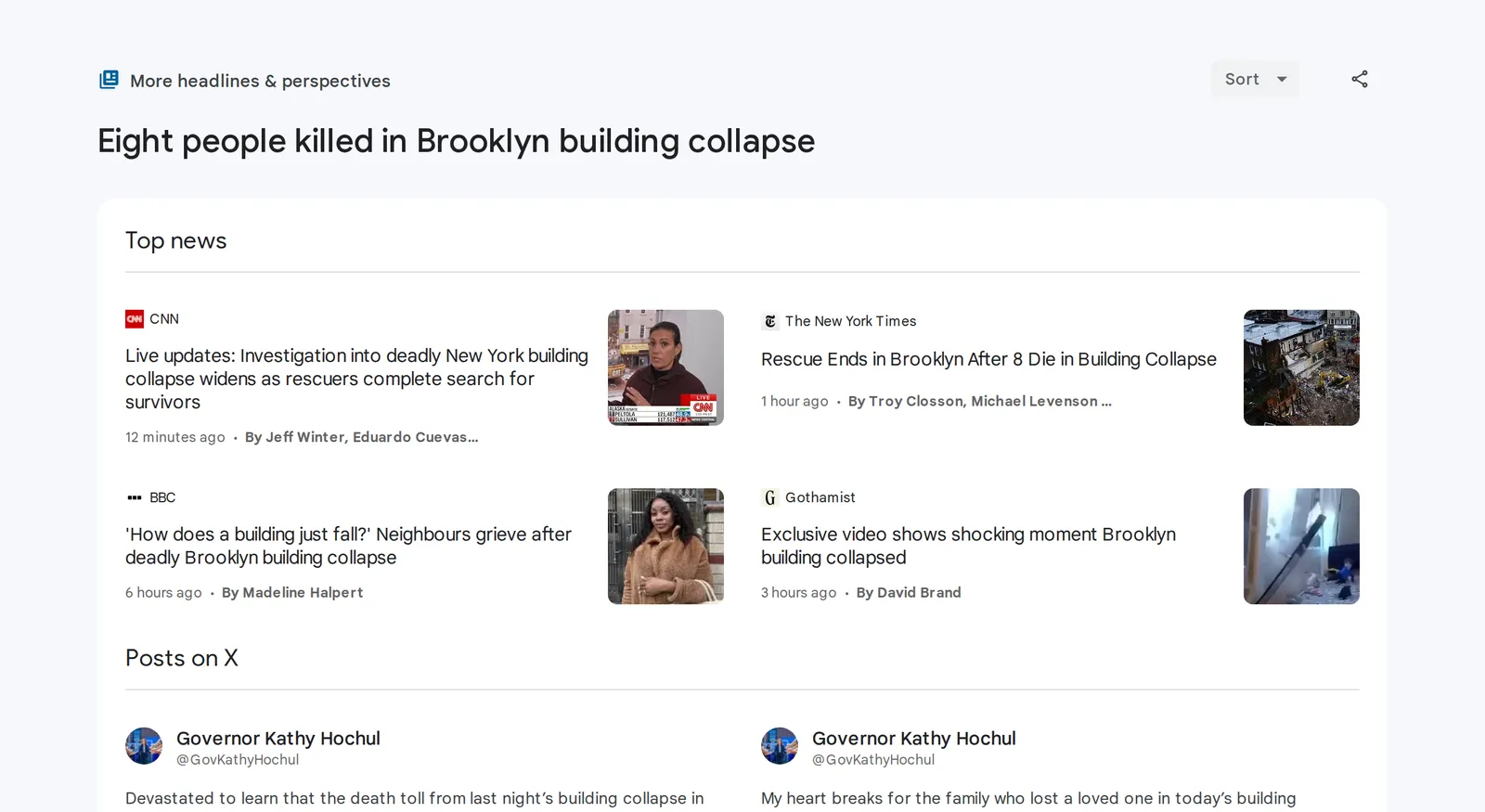 Google News Full Coverage of the Brooklyn collapse, US edition, signed out, 13 November 2026. Source: news.google.com
There were no counts and no labels. You see who reported it, not what side they sit on. Google’s help is explicit that this page isn’t tailored to you: “Full Coverage has no personalization other than your language, region, and subscriptions” (Google News Help). Anyone signed out in the US English edition should get the same page I did. In the app, the same help page says to tap “Full Coverage of this story” at the bottom of a story.
Ground News: counts, labels and padlocks
Ground’s story page for the same event said 407 articles, with a Left 82, Center 96 and Right 65 split at the top of the list. Each outlet carried a label such as Lean Right or Center, and outlets with a paywall had a $ next to their name. The Factuality panel said “To view factuality data please Upgrade to Premium” and Ownership said “To view ownership data please Upgrade to Vantage”. The summary was marked “Insights by Ground AI”.
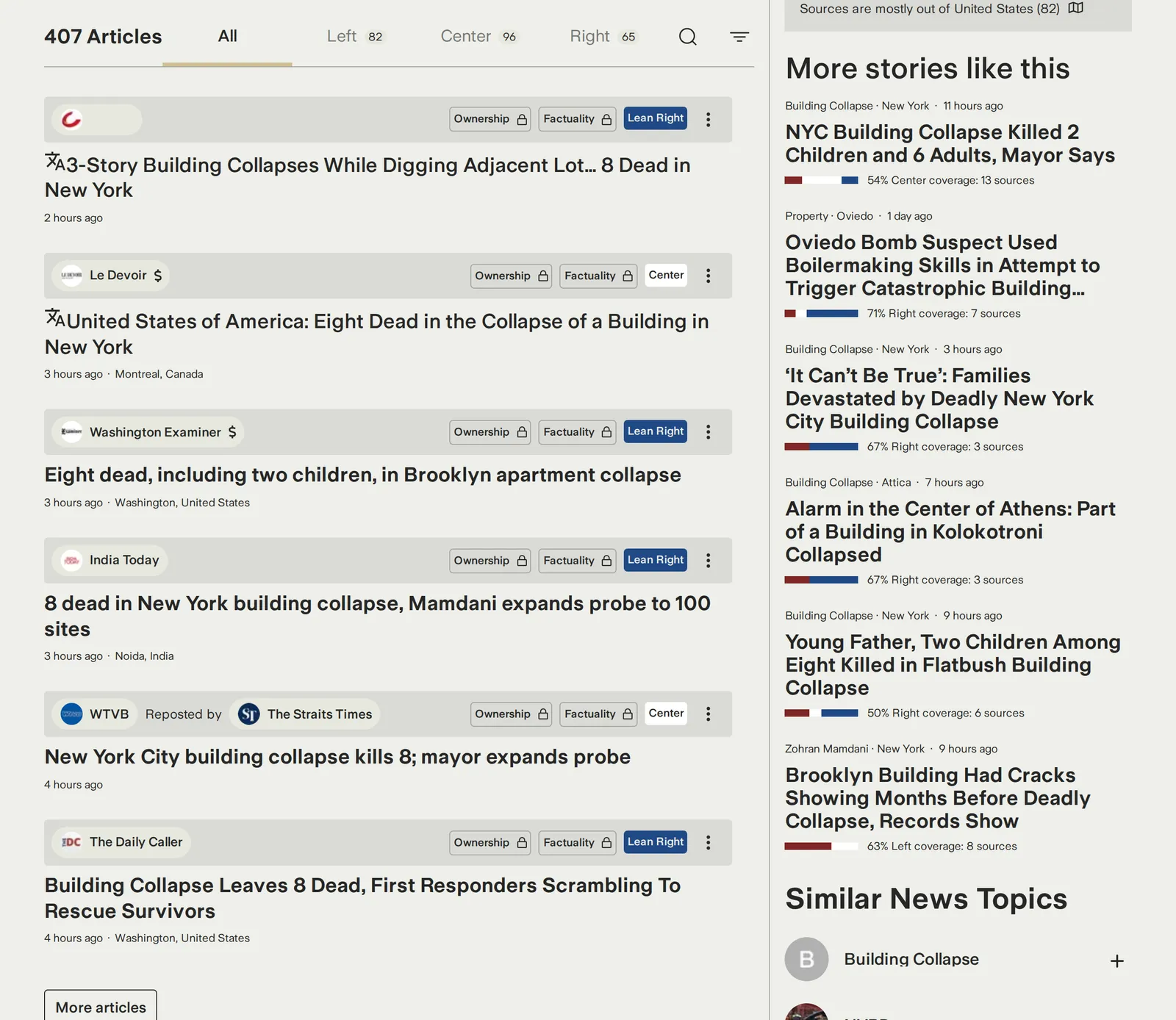 A Ground News story page on the Brooklyn collapse, opened without an account from India, 13 November 2026. Source: ground.news
The three counts add up to 243, not 407, so about four in ten articles had no lean rating at all. The “More stories like this” column also lists more pages on the same collapse, with 13, 3, 6 and 8 sources each.
Ground had also split the event into two big pages: one started when two people had died, the other after the toll rose to eight. The first opened at 805 sources, with Left 103, Center 227 and Right 115, so its percentages also left out more than four in ten articles (Ground News). If you read the left-right bar on one of those pages, you’re looking at part of the coverage, not all of it.
Grouping is hard, and every app that does it makes mistakes. But for a reader the result was plain: Google put the collapse on one Full Coverage page; Ground spread it across two big pages and several small ones.
Where the outlets and the labels come from
Ground’s lean labels aren’t its own. The rating system page says they are an average of AllSides, Ad Fontes Media and Media Bias Fact Check, and that the rating “does not measure the bias of specific news articles”, only the publication. Factuality averages Ad Fontes and Media Bias Fact Check (Ground News). So a Lean Right tag tells you about the outlet’s reputation, not about the article in front of you.
The catalog is Ground’s too. Its FAQ says the news comes from “over 50,000 major news publications” (Ground News FAQ). You can suggest an outlet, but Ground says it “cannot guarantee that a news source will be added or provide a specific timeframe for inclusion” (Ground help).
Google states its approach in one line: “Computer algorithms determine which stories show up on Google News and in what order.” Full Coverage, search results and headline stories are picked by language and region, so everyone in an edition sees the same subjects; For you and Following are personalized from your settings and “Your activity on Google services and YouTube” (Google News Help).
Algorithms, in both
Ground’s subscribe page says “We don’t use algorithms to shape what you see” (Ground News). Its FAQ, though, says My Feed “is algorithmically curated based on stated and observed reading behaviors”. So the personal feed is ranked for you, much like Google’s For you, whatever the subscribe page says.
Ground also uses AI to help produce its bias comparison summaries, with what it calls “human-in-the-loop oversight” (Ground help). Google’s Full Coverage page I opened had no summary, just the articles and the posts.
On both, you can steer the feed but not the catalog. In Google News you can tap “Fewer stories like this” or “Hide all stories from” a source (Google News Help), and you can search for a source and follow it, but only outlets Google already carries; that page offers no way to suggest a new one. Ground takes suggestions without promising to add them.
Price and ads
Google News is free. Its US App Store listing shows no in-app purchases, and its Google Play listing is marked “Contains ads” (Google Play).
Ground News is free to use, and it sells several tiers. The US App Store lists Pro at $0.99 a month or $9.99 a year, Premium at $3.99 a month or from $29.99 a year, and Vantage at $9.99 a month or $99.99 a year (App Store). The web subscribe page sells Vantage at $8.33 a month billed annually. Its Play listing shows in-app purchases and no “Contains ads” label (Google Play). What each tier adds is in my Ground News free vs paid breakdown.
For the job this post is about, seeing many outlets on one story, both free plans do it. Ground’s free plan shows the left-center-right counts and outlet labels I saw; you pay for factuality, ownership and the rest.
Which one to use
Use Ground News if the question you ask of a story is “who is covering this, and from which side”. The counts are the product, and so is Blindspot, a feed of stories with political undertones that one side of the spectrum covers far more than the other (Ground News). Google has nothing like either. Read the bars with care: on the collapse, four in ten articles had no rating.
Use Google News if you want the whole story in one free place: the big outlets, the local ones, and statements from officials, in one page. It’s also in 46 languages on the App Store (App Store), while Ground’s listing names English only.
Use both if you like: Google News for the daily read, Ground when a story looks one-sided and you want to check.
There is a third case: you want the grouping, but from outlets you chose. That’s what I built Hushread to do. Add the papers, sites, subreddits and YouTube channels you read, and articles about one event link into one story, with a day-by-day page once eight or more publishers cover it (how stories work). It has no lean or factuality labels, its grouping occasionally splits an event in two, as Ground’s did here, and Pro is $2.08 a month billed yearly (plans). My Hushread vs Ground News comparison goes deeper.
FAQ
Is Ground News better than Google News?
For checking how outlets of different political leans cover a story, yes: Ground News shows Left, Center and Right counts and outlet labels, and Google News shows none. For reading a story’s full coverage for free, Google News Full Coverage does the job with one page per event.
Does Google News have bias ratings?
No. Google News Full Coverage lists outlets and posts on X without lean or factuality labels. Ground News labels each outlet using an average of AllSides, Ad Fontes Media and Media Bias Fact Check ratings.
Is Google News Full Coverage personalized?
Google says Full Coverage has no personalization other than your language, region and subscriptions. Everyone in the same edition sees the same page for a story.
Is Ground News free?
Yes, with paid tiers. The free plan shows coverage counts and lean labels on story pages; factuality needs Premium and ownership needs Vantage, which is $99.99 a year in the US App Store.
Does Ground News use an algorithm?
Yes, for My Feed. The subscribe page says “We don’t use algorithms to shape what you see”, but the FAQ says My Feed “is algorithmically curated based on stated and observed reading behaviors”. Its summaries are produced with AI help under human oversight.
If you care about lean, keep Ground News and read the counts alongside the unrated share. If you just want to know what happened, Google News Full Coverage is free and was the cleaner page on this story. For a wider look at the field, my Google News alternatives roundup covers the rest, and if you’d rather group your own sources, Hushread runs on iPhone, Android and the web.