
Army Detonates Five Tons of Degraded Lead Azide at Iowa Ammunition Plant
The Army destroyed the nation's entire lead azide stockpile in a controlled blast after a court cleared the way, and early EPA readings show no airborne lead, but questions persist.
By Hushread Stories, from 58 outlets · First published 26 Nov 2026 · Chapter 2 of 2
Earlier: Army Detonates Five Tons of Lead Azide at Iowa Plant Despite Court Challenge
In brief
- The Army detonated about 9,700 pounds of degraded lead azide, stored in 68 barrels, at the Iowa Army Ammunition Plant on Wednesday morning.
- Officials said the material had crystallized and could explode unpredictably as temperatures changed, making a controlled blast the safer option.
- EPA Administrator Lee Zeldin said air monitors detected no lead after the blast, though he stopped short of calling the result safe.
- Residents of Middletown were told to shelter in place or evacuate, and a federal appeals court had cleared the way for the detonation.
- Testing will continue, and questions remain about the White House reaction and a canceled chemical treatment contract.
Timeline · 6 moments
Scientists say contamination questions linger
NBC News ↗Shelter-in-place order lifted in Middletown
The Hill ↗Army calls the operation a huge success
World News CNA ↗Plumes rise over the Iowa Army Ammunition Plant
CNN Top Stories ↗Army detonates 68 barrels of degraded lead azide
Ars Technica Tech ↗Residents urged to shelter or evacuate before Army detonation
UPI ↗How it started
The material at the center of this story is lead azide, an initiating explosive used in munitions. The Army had about five tons of it stored in 68 barrels at the Iowa Army Ammunition Plant in Middletown, in the southeastern part of the state.
According to NDTV, the lead azide had degraded, and crystallization inside the containers raised the risk of an explosion as outside temperatures changed. Scientific American reported that officials considered the detonation necessary because the material becomes explosively unstable at certain temperatures.
The Army's position, as Deutsche Welle put it, was that a controlled blast was the safest way to deal with the chemicals. Residents nearby saw it differently, and worried about toxic lead dust drifting over farmland and towns.
How it unfolded
The plan met resistance before it happened. Axios reported that the detonation came after multiple delays, a court challenge and presidential intervention, and that elected officials criticized the military over communication with the public. The Hill noted the Army went ahead despite public health fears that had initially pushed back the plans.
In the days before the blast, residents were urged to evacuate or shelter indoors, according to UPI, and France24 reported that local people were urged to leave amid concerns over lead contamination. Some Thanksgiving plans were disrupted. Forbes reported that officials had warned lead could travel as many as 100 miles from the site.
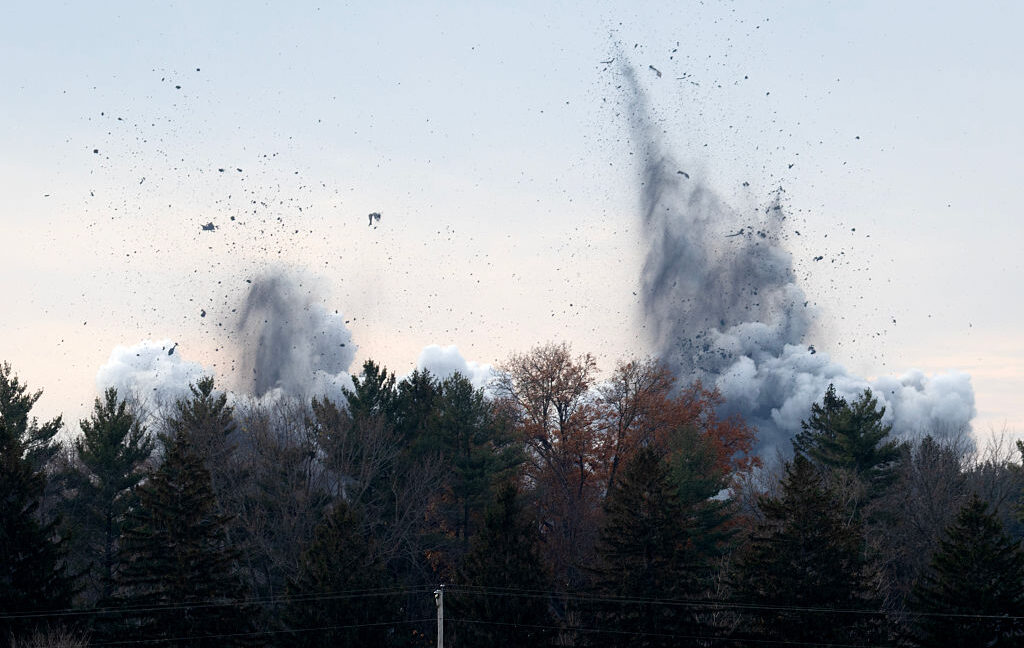
The detonation took place at about 9 am Central time on Wednesday, 25 November. Ars Technica described gray-white clouds launched over southeastern Iowa, and CNN reported two hazy plumes rising over the plant. Top Stories video showed that despite warnings to stay inside, some residents watched from vehicles upwind of the plant.
Afterward the Army called it a success. CNA quoted Acting Secretary of the Army Adam Telle calling the operation a huge success, and the Globe and Mail reported that Major General Eric Shirley, commanding general of the U.S. Army Sustainment Command, said it exceeded expectations. Deutsche Welle reported that President Donald Trump said mitigation efforts had far exceeded expectations.
Where it stands
The early air data is reassuring. AllSides reported that EPA monitors detected no lead more than half an hour after the blast, according to Zeldin on CNN. The New York Post added that Zeldin said it had gone about as well as it could but stopped short of calling it safe. The Hill reported that federal officials lifted the shelter-in-place order in Middletown.
Not everything is settled. NBC News reported that scientists and residents said questions remain about how much contamination the blast caused, though they were hopeful about the initial results. PrepperIntel pointed to Army maps showing a dust plume drifting toward Missouri, and the New York Times reported that testing will continue to make sure residents are safe.
The politics are also unresolved. CBS News reported, citing sources, that the White House was blindsided and had to scramble, and a separate CBS News piece said the chaotic lead-up has prompted questions inside the administration.
What to watch
The main open question is whether ongoing soil and air testing confirms what the first EPA readings suggested, particularly in areas downwind of the plant. Doctors quoted by Fox News warned about lead exposure risks, so follow-up results will matter to residents.
There is also the matter of how a stockpile reached this state, and the canceled chemical treatment contract that remains unexplained in the coverage so far. Expect continued scrutiny from elected officials who criticized the Army's communication.
More in World
All →
Saurav Das stopped from UK flight, takes passport dispute to Delhi High Court
The Cockroach Janta Party leader says he was blocked from flying to Oxford. The government cites a passport discrepancy and a look out circular, and the Delhi High Court is now involved.
14 sources · over 3 days
Two men charged with burglary and trespass over break-in at Prince William and Kate's Norfolk home
Mirgen Doku and Arilen Ndoci are due before Norwich Magistrates' Court after the incident at Anmer Hall on the Sandringham estate.
41 sources · over 3 days
At Least 31 Killed as Fuel Tanker Overturns and Burns on Cairo Ring Road
A petroleum-laden truck overturned on the Giza Ring Road near Cairo, killing at least 31 people and injuring dozens more as the fire spread through a crowded area.
45 sources · today