
Audi's Georgia factory plan draws growing backlash over Trump rally appearance
Audi's planned $4.2 billion US factory has become a political dispute in Germany, with criticism spreading from employee representatives to Environment Minister Carsten Schneider.
By Hushread Stories, from 29 outlets · First published 28 Oct 2026 · Chapter 4 of 4
Earlier: Audi's Georgia factory announcement sparks backlash over Döllner's Trump rally appearance
In brief
- Audi plans its first US factory in Georgia, investing $4.2 billion and targeting annual production of 200,000 SUVs.
- President Donald Trump announced the investment at a campaign rally, where Audi CEO Gernot Döllner appeared alongside him.
- The plant is expected to create about 4,500 jobs, with construction scheduled for 2027 and production in the early 2030s.
- Döllner defended his appearance as serving Audi's interests, while criticism spread within Volkswagen and among German politicians.
- Environment Minister Carsten Schneider has now criticized both the planned SUV factory and Döllner's appearance with Trump.
Timeline · 5 moments
Environment Minister Schneider criticizes Audi's planned SUV factory
DIE ZEIT | Nachrichten, News, Hintergründe und Debatten ↗Volkswagen switches off intranet comments amid internal dispute
n-tv.de - Wirtschaft ↗Döllner defends rally appearance as serving company interests
DIE ZEIT | Nachrichten, News, Hintergründe und Debatten ↗Volkswagen works council chair sharply criticizes Döllner's appearance
nu.nl ↗Trump announces Audi factory at Georgia campaign rally
Reuters ↗How it started
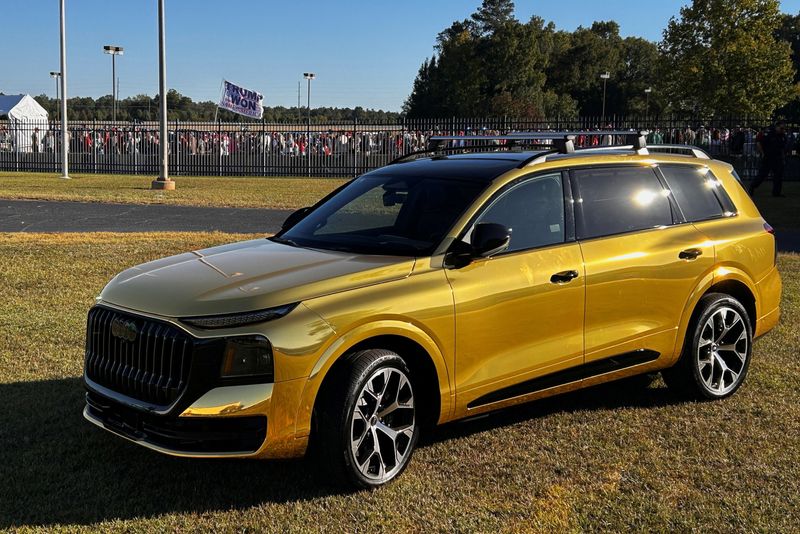
Audi's first US factory was announced on a campaign stage. At an October 24 rally in Perry, Georgia, President Donald Trump said the company planned an assembly plant capable of producing 200,000 SUVs annually, according to Reuters.
The investment comes as tariffs put pressure on Audi's existing business. The Volkswagen division imports all its cars into the US from Europe or Mexico and has been hit hard by US tariffs, NYT Politics reported.
Reports differ on the investment figure. Reuters put it at $4 billion, while The Hindu reported $4.2 billion and said Audi had confirmed the investment in a release. The company expects the plant to create about 4,500 jobs.
How it unfolded
At the October 24 rally, Trump presented the factory as evidence that his tariffs were working. The announcement gave him a political win while he was facing criticism over the tariffs' domestic effects, according to Japan Times. Audi CEO Gernot Döllner appeared at the event, n-tv.de reported.
By October 26, that appearance had become a dispute within Germany. The chair of Volkswagen Group's works council sharply criticized Döllner's participation in the rally, according to nu.nl. ABC reported that the appearance had triggered political and union criticism.
Döllner defended himself on October 26, saying he had acted in the company's interests, according to DIE ZEIT. DIE WELT reported that he addressed employees in writing as he responded to the backlash.
On October 27, the dispute spread through Volkswagen's internal communications. DER SPIEGEL reported that debate on the group's intranet had escalated enough for Volkswagen to intervene. n-tv.de reported that comments were switched off.
On October 28, Environment Minister Carsten Schneider criticized both the planned SUV factory and Döllner's appearance with Trump. DIE ZEIT reported that Schneider described the factory plan as a bet on a "dead horse."
Where it stands
Audi has confirmed the investment, but the factory remains a future project. Construction is scheduled to begin in 2027, according to Mint, and production is planned for the early 2030s, NDTV reported, citing Audi's release.
The criticism now covers both the political setting of the announcement and the investment itself. It also comes amid severe pressure on employment in Germany's automotive industry, a context highlighted by Deutsche Welle. Döllner has defended his participation, but that has not ended the dispute.
What to watch
The next concrete milestone is the planned start of construction in 2027. The production timetable extends into the early 2030s, according to NDTV, leaving several years between the campaign announcement and the first vehicles.
A separate question is whether Volkswagen takes further action over Döllner's appearance. ARD Tagesschau reported that SPD General Secretary Klüssendorf had called for consequences from the parent company, while Audi continued to defend the appearance.
More in Business
All →
Jio Platforms Lists at ₹1,358 After Record-Breaking IPO Demand
Jio Platforms shares debuted on the BSE and NSE at a 21% premium to their ₹1,119 issue price, valuing the company at about ₹12.5 lakh crore.
20 sources · over 3 days
SK Hynix Profit Surges Sevenfold as AI Memory Demand Grows
Strong AI memory demand lifted SK Hynix's quarterly profit above expectations, sending shares higher and prompting shareholder return plans whose reported size differs sharply across coverage.
14 sources · today
Microsoft offers voluntary buyouts to roughly 60,000 employees across four countries
The offer opens a voluntary route out for roughly a quarter of Microsoft's workforce as the company cuts costs while expanding its artificial intelligence infrastructure.
68 sources · over 2 days