
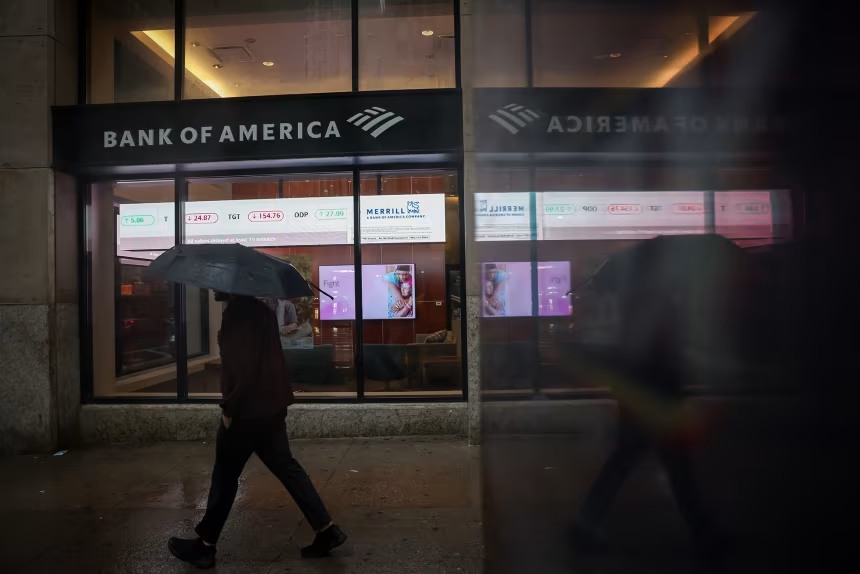
Bank of America profits fall after $1.2 billion Treasury penalty
The penalty over money laundering safeguards and sanctions violations has hit quarterly earnings, while weaker trading revenue added to pressure on Bank of America shares.
By Hushread Stories, written with AI from 31 outlets · First published 14 Oct 2026 · Chapter 2 of 2
Earlier: Bank of America fined $1.2 billion over laundering and sanctions failures
In brief
- The US Treasury Department announced more than $1.2 billion in penalties against Bank of America on October 13.
- Regulators said the bank failed to report billions in suspicious transactions and address longstanding weaknesses in its safeguards.
- The alleged failures involved suspected Chinese money laundering networks, border activity, and sanctions violations involving Iran and Russia.
- Third quarter profits fell 17 percent, while weaker trading results added to the financial pressure from the penalty.
- Shares fell 5 percent on October 14, with future compliance changes and scrutiny of transactions remaining open questions.
Timeline · 5 moments
Shares drop 5 percent after earnings and penalty
CNBC International ↗Quarterly profits fall 17 percent after regulatory fine
Financial Times ↗Sanctions settlement linked to Iran and Russia allegations
Euronews ↗Coverage identifies $5 billion in unflagged suspicious transactions
Financial Times ↗Treasury announces more than $1.2 billion in penalties
cnn.com ↗How it started
The case centres on transactions Bank of America allegedly failed to flag, rather than simply the size of the fine. According to the Financial Times, the bank failed to flag $5 billion in suspicious transactions linked to suspected illicit finance from China and the southern US border.
The failures extended over years, according to Axios. Its report described shortcomings both in reporting suspicious transactions and in addressing weaknesses in the bank's anti-money laundering programme.
How it unfolded
On October 13, the Treasury Department announced more than $1.2 billion in penalties, accusing Bank of America of violating anti-money laundering and sanctions laws, CNN reported. ABC Top Stories described the fines as the third-largest amount in Treasury Department history.
The department linked the transactions to suspected Chinese money laundering networks and illicit financial activity along the US-Mexico border, citing national security concerns, according to News18. These were suspicious transactions, not a finding that every transaction involved proven criminal activity.
Coverage on October 14 added detail about the sanctions component. Euronews reported that Bank of America also settled alleged sanctions violations involving Iran and Russia.
The financial consequences became clearer that day. The Financial Times reported a 17 percent fall in profits after the fine, alongside disappointing trading and investment banking performance. CNN Brasil reported that the bank had reserved $1.2 billion to cover the regulatory fines.
Trading weakness compounded the earnings pressure. According to Bloomberg, bond-trading revenue fell 17 percent and equity trading revenue fell 10 percent, with both businesses missing estimates. CNBC International reported that shares dropped 5 percent after the quarterly revenue miss and regulatory penalty.
Where it stands
The penalty is no longer just a potential threat to earnings. The October 14 results show a profit decline and a market reaction, although the coverage also identifies weaker trading performance as a separate source of pressure. The share decline cannot be attributed to the fine alone, according to the account from CNBC International.
Most reports put the penalty at about $1.2 billion, with Bloomberg specifying more than $1.21 billion. One October 14 summary from DIE ZEIT instead says $1.2 million, conflicting with the billion-dollar amounts reported across the other coverage.
What to watch
The remaining questions concern how the bank will fix the reporting and compliance weaknesses described by Axios. The supplied coverage does not set out a remediation timetable or specific changes the bank must make.
The wider effect on transaction scrutiny also remains uncertain. The South China Morning Post reported that analysts see the action as a signal that could prompt Western banks to tighten scrutiny of transactions involving Chinese money laundering networks. That is a possible response, not an announced industry-wide change.
More in Business
All →
Trump says Taiwan will buy 30% of Alaska project's gas
The announced twenty year purchase commitment, alongside a proposed $4.4 billion investment, would give the planned Alaska gas project a major buyer as Taiwan seeks closer ties with Washington.
10 sources · today
ASML Raises Sales Outlook as AI Demand Outstrips Machine Capacity
Rising AI investment is lifting demand for ASML's chipmaking machines, but the Dutch company faces capacity constraints that could leave customers short of equipment through 2028.
15 sources · over 2 days
Lufthansa wins contest for minority stake in Portugal's TAP airline
Portugal has selected Lufthansa for a 44.9 percent stake in TAP, beating Air France-KLM as the government moves its state-owned airline back towards partial private ownership.
8 sources · today