
Fed Sees AI as Top Financial Risk and Growing Inflation Pressure
Officials cite AI investment, asset valuations and hedge fund leverage as stability concerns while Jefferson links the buildout to inflation.
By Hushread Stories, from 23 outlets · First published 18 Nov 2026 · Chapter 2 of 2
Earlier: Fed Survey Ranks AI Top Financial Risk, Then Barr Warns of AI-Driven Bank Runs
In brief
- The Fed's semi-annual survey ranks AI as the top risk to the financial system, cited by 87% of market contacts, up from 50% in spring.
- Governor Michael Barr warned that autonomous AI agents could accelerate bank runs and enable cyberattacks and market manipulation.
- Chair Kevin Warsh said staff are sketching scenarios from an AI-driven growth boom to a downturn if the technology disappoints.
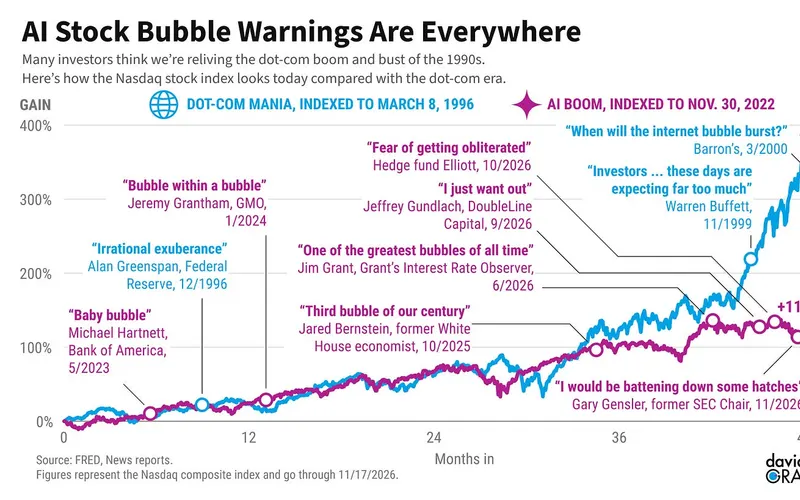
- Former SEC Chair Gary Gensler argues the AI boom is already a bubble likely to burst before the 2028 election.
- October minutes show nearly all officials expect more rate hikes and flagged AI-driven demand and financing structures as inflation risks.
Timeline · 12 moments
Jefferson says AI buildout is pushing up US inflation
CNBC ↗Fed warns AI boom and elevated valuations threaten financial stability
Economic Times Business & Economy ↗Fed minutes flag AI demand as inflation risk
CNBC ↗Barr flags cyberattacks and market manipulation risks
Economic Times Business & Economy ↗Tech leaders brief Warsh on AI's economic impact
Axios ↗Warsh says Fed staff are gaming out AI contingencies
Bloomberg Economics ↗ECB warns of abrupt repricing in AI shares
Euronews ↗Barr warns AI agents could accelerate bank runs
The Defiant ↗Gensler says AI bubble could burst before 2028
New York Post ↗87% of contacts cite AI, up from 50%
The Defiant ↗Update 19 Nov 2026, 4:45 pm UTC
New coverage from November 19 shows the Fed's concern about AI has widened beyond financial stability. Economic Times reported that policymakers also flagged elevated asset valuations and rising hedge fund leverage, warning that disappointing returns on AI investment could be a problem. CNBC reported that Vice Chair Philip Jefferson said the AI buildout is putting upward pressure on inflation through demand, with productivity gains possible later. The inflation thread in the original piece is now stronger, and the story is about the Fed's broader AI assessment rather than the survey alone.
How it started
On 13 November, the Federal Reserve flagged vulnerabilities tied to artificial intelligence and elevated asset valuations in its semi-annual financial stability report, Bloomberg reported. The accompanying survey of market contacts made the point sharper.
AI rocketed to the top of worries about the financial system, according to CNA and Kitco. The Defiant put the figure at 87% of market contacts citing AI, up from 50% in the spring.
CNBC noted the timing: Wall Street is on edge over high-flying AI hyperscalers, while communities are on alert over the rapid spread of data centers. The Fed also traced how leases, guarantees and debt link the infrastructure buildout to lenders, per The Defiant.
How it unfolded
The following Monday, 16 November, the story widened. The Defiant reported that Governor Barr urged authentication and model safeguards, extending his discussion from infrastructure financing to automated financial decisions. Gizmodo summarized his worry as AI agents triggering bank runs in minutes, and added that the industry's debt is finding its way into life insurance.
The same day, Chair Kevin Warsh spoke about AI's economic effects. Bloomberg reported that Fed staff have begun sketching contingencies for how surging adoption might affect the US economy. MarketWatch described the work as early days, with various scenarios in development.
Warsh stressed AI's importance but said it could disappoint, according to CNBC. The Next Web said the scenarios run from a broad growth boom to a downturn, and that Warsh also said AI empowers bad actors. The New York Times reported he has assigned a task force to explore how productivity gains could affect the labor market. Fast Company observed that he sidestepped the question of inflation risk.
Also on 16 November, Gary Gensler told CNN, ahead of Anthropic's IPO, that "it's already a bubble," as quoted by the New York Post. He argued it could burst and bring a recession before the 2028 election. Euronews reported a parallel warning from the ECB of an "abrupt repricing," noting eurozone funds have bought heavily into AI shares.
On 17 November, Axios reported that tech leaders met Warsh to explain how AI could transform the economy. The Economic Times covered Barr's warnings about cyberattacks, automated trading and market manipulation, and the South China Morning Post noted that a software glitch disrupted several major US banks on Monday as regulators weighed autonomous AI risks.
Where it stands
AI is now an openly acknowledged financial stability and macro concern inside the Fed, even though, as Yahoo Finance put it, it is not explicitly part of the dual mandate.
The issue is tangled up with inflation. CNBC reported that minutes from the October meeting, at which the Fed held its rate at 3.75%-4%, show officials expect more hikes and worry about AI's impact on inflation. CNBC added that policymakers flagged AI-driven demand and complex financing structures as inflation risks, and the Economic Times said some saw a need for a bigger hike.
What to watch
The main open question is what Fed staff's scenario work and the labor-market task force produce, and whether the Fed turns warnings into any supervisory expectations, such as the authentication and model safeguards Barr urged.
The other is rates. Officials are debating the pace of hikes, with Bloomberg reporting that New York Fed President John Williams dismissed the need for an outsized move, while AI-fueled demand complicates the inflation picture.
More in Business
All →
Anthropic Opens at $111.50 After Record $83 IPO Price on Nasdaq
Shares jumped about 34 percent in early trading after the AI company priced its offering at $83, the largest IPO on record.
107 sources · over 4 days
Nvidia's board rules out Jensen Huang's return as earnings beat forecasts
Nvidia's founder resigned over affairs, one with an alleged Chinese spy, and now wants his job back. The board says no, just as export controls and a Senate appearance loom.
196 sources · over 11 days
Chase software bug disrupts online banking and Zelle payments at major US banks
A software bug at JPMorgan Chase slowed transactions across several big US banks on November 16, and days later the bank confirmed a separate vendor hack that exposed customer names and emails.
69 sources · over 4 days