
French Student Protests Continue Despite Teacher Pledge as Police Face Scrutiny
France's government has promised thousands of substitute teachers, but students plan fresh demonstrations on October 13 as injuries and investigations intensify scrutiny of the police response.
By Hushread Stories, written with AI from 73 outlets · First published 11 Oct 2026 · Chapter 8 of 8
Earlier: French Student Protests Persist as Teacher Pledge Meets Police Scrutiny
In brief
- French students are protesting teacher shortages, overcrowded classrooms and deteriorating buildings, with university students and unions joining them.
- The government has promised roughly 3,000 substitute teachers, but student leaders remain dissatisfied and have called further demonstrations.
- Police watchdog IGPN has opened 24 investigations into incidents linked to the protests, amid reports of serious injuries.
- The Education Ministry said 141 of France's 3,700 high schools remained closed on Friday as many students returned.
- Another day of protest is planned for Tuesday, October 13, when promised substitute teachers should begin work.
Timeline · 8 moments
Student protests also reported in Belgium and Italy
Euronews ↗Justice Ministry figures detail prosecutions following adolescent detentions
Franceinfo ↗Police watchdog investigations reach 24 amid injury scrutiny
© Pedro Nunes, Reuters ↗UN human rights office raises concerns over police violence
DIE ZEIT | Nachrichten, News, Hintergründe und Debatten ↗Ministry reports 141 high schools still closed
Euronews ↗Student leaders call more protests after ministerial meeting
CNN Brasil ↗Education minister promises deployment of 3,000 substitute teachers
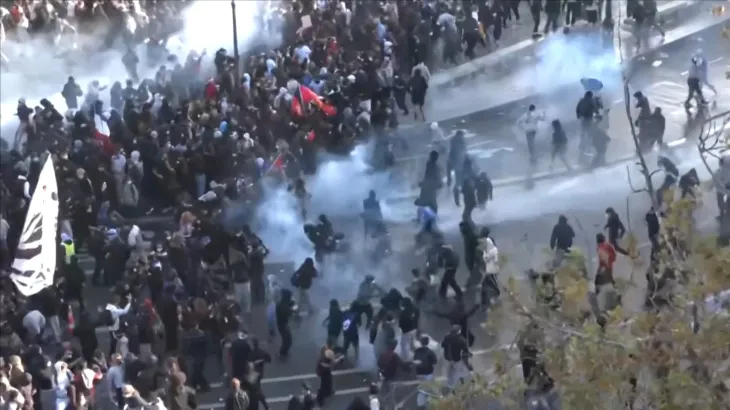
Franceinfo ↗Police use tear gas and water cannons in Paris
Al Jazeera ↗How it started
The protests began with complaints about everyday school conditions: missing teachers, crowded classrooms and poorly maintained buildings. BBC Brasil reported students' accounts of going weeks without teachers. The Hindu also described overloaded timetables and buildings unable to cope with rising temperatures.
The demands extend beyond staffing. According to Diken, students have raised concerns about staff shortages and the university placement system, Parcoursup. BirGün reported that university students and unions had joined high school protesters campaigning against unequal educational opportunities.
By October 8, the demonstrations were in their third week, according to NYT World News. The movement was drawing adult supporters, and officials had not managed to bring it to an end.
How it unfolded
On October 8, renewed demonstrations brought clashes in Paris. Al Jazeera reported that police used tear gas and water cannons against demonstrators demanding more funding and teachers. More than 150 schools across France were closed that Thursday, according to CBS Top Stories.
That evening, education minister Edouard Geffray announced that 3,000 substitute teachers would be assigned within hours, Franceinfo reported. Student leaders who met him remained dissatisfied with the announcements and called for more protests, according to CNN Brasil.
On October 9, Japan Times reported that the proposed deployment involved substitute teachers who currently had no students because earlier assignment processes had been inefficient. DIE WELT reported that the teachers were due to begin work by the following Tuesday.
Many students returned to classrooms on October 9. Euronews, citing the Education Ministry, reported that 141 of France's 3,700 high schools remained closed. The same day, DIE ZEIT reported that the UN human rights office had voiced concern about disproportionate police violence.
By October 10, scrutiny had widened. According to Reuters, the interior ministry said police watchdog IGPN had opened 24 investigations into incidents connected with the protest movement. Franceinfo reported that one investigation concerned a police officer kneeing a demonstrator in the face at Paris's Bastille square on October 8.
The reported injuries include those of fourteen-year-old Eden. Arab News reported that he suffered a broken jaw and multiple smashed teeth after a police officer directed a tear gas canister toward him at close range during the previous week's protests.
Where it stands
The return to classes has not ended the movement. Bloomberg Technology reported that high school students were planning another day of demonstrations on Tuesday despite government measures addressing understaffing and overcrowding.
The dispute now combines demands for better education with scrutiny of policing. The 24 investigations reported by Reuters concern incidents linked to the protests; their findings remain pending in the supplied coverage.
The anger has also crossed borders. On October 11, Euronews reported that students in Belgium and Italy were staging protests too, as French grievances over long school days, outdated facilities and teacher shortages resonated elsewhere.
What to watch
Tuesday, October 13, is the next test. Franceinfo identified it as the next planned day of action, while DIE WELT reported that the promised substitute teachers should begin work by then. Whether those assignments reach struggling schools, and whether students accept them as sufficient, remains unresolved.
The police investigations are another concrete development to follow. Franceinfo also reported on October 10 that thousands of adolescents had been detained since the movement began. According to the Justice Ministry figures cited in that report, roughly one in three faces prosecution after police custody.
More in World
All →
Justice Department Investigates Five TV Networks Over Trump Pool Coverage Suspension
The antitrust investigation opens a separate dispute over the networks' response to White House access restrictions, while a judge weighs whether to keep blocking the ban.
25 sources · over 9 days
At Least 139 Migrants Die as Boat Capsizes Off Djibouti
At least 84 people remain missing after a boat carrying 305 migrants capsized off Djibouti.
34 sources · today
Cornell Rape Allegations Fuel Protests and James Special Prosecutor Appointment
New York Gov. Kathy Hochul tapped Attorney General Letitia James as special prosecutor, while Cornell canceled its homecoming concert amid student protests.
31 sources · over 7 days