
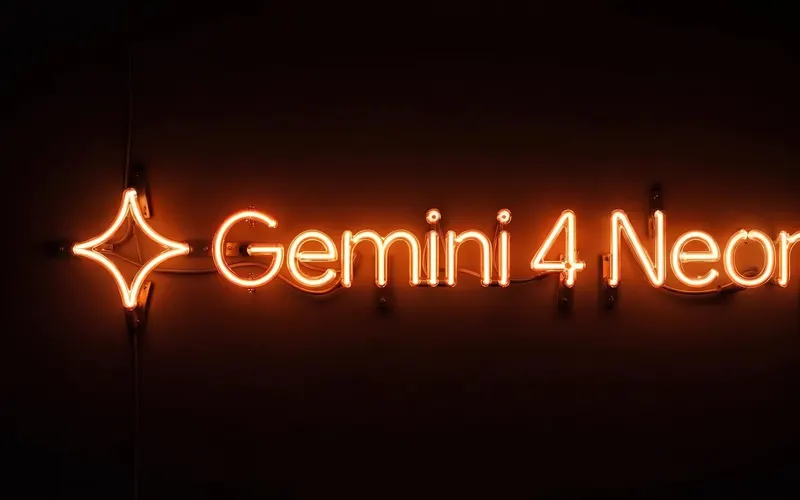
Google launches Gemini 4 Neon, a cheaper mid-tier model aimed at coding and agents
Gemini 4 Neon is Google's fourth new model in about a month, and its $3 and $15 token pricing and speed claims put it in direct competition with Anthropic and OpenAI.
By Hushread Stories, from 32 outlets · First published 19 Nov 2026
In brief
- Google launched Gemini 4 Neon on November 18, 2026, across its APIs, the Gemini app, Antigravity and AI Pro subscriptions.
- Neon sits between the Hydrogen and Carbon models and costs $3 per million input tokens and $15 per million output.
- Google says Neon is about three times faster than Carbon and matches Claude Opus 5.5 on coding at lower prices.
- Reported benchmark standings include third on the Artificial Analysis index and second on Agent Arena, with a 1 million token context window.
- Reviewers began testing Neon against Opus 5.5 and Carbon on November 19, and some noted the lineup and pricing are confusing.
Timeline · 9 moments
Outlets question the pace and clarity of Google's releases
tech ↗Developer tests Neon against Opus 5.5 and Carbon
Flavio Copes ↗Neon replaces Argon in the Gemini app model picker
Digital Trends ↗Google claims Neon is three times faster than Carbon
SiliconANGLE ↗Neon reported at Opus 5.5-level coding, 25% cheaper
VentureBeat ↗Neon priced at $3 and $15 per million tokens
BigGo Finance — Real-time Stock Quotes, Financial & Business News ↗Neon rolls out live for AI Pro in Gemini app
9to5Mac Apple ↗Google introduces Gemini 4 Neon in an official blog post
blog.google ↗Google launches Gemini 4 Hydrogen, five days before GPT-6.2 comparisons
Tom's Guide ↗How it started
Google spent much of the summer quiet while Anthropic and OpenAI shipped powerful new frontier models, according to SiliconANGLE. That changed in November with a rapid run of Gemini 4 releases.
Gemini 4 Carbon came first as the flagship, followed by Hydrogen on November 12, as Tom's Guide noted. 9to5Mac described Neon as following last week's release of Carbon and Hydrogen.
The gap in the lineup was plain. A Russian-language report on Habr said users previously had to choose between the fast Hydrogen model for simple scripts and routine work and the powerful but expensive Carbon.
How it unfolded
On November 18, Google introduced Gemini 4 Neon in a blog.google post. The Next Web reported that it sits between Hydrogen and Carbon and is rolling out in the Gemini API, Gemini for business, Google Antigravity and the Gemini app.
VentureBeat said it launched on the paid Gemini API in Google AI Studio and Android Studio, and framed it as Opus 5.5-level coding performance at 25% lower API token prices. BigGo Finance reported the $3 and $15 pricing with a 1 million-token context window, and said Google ranks it third overall on the Artificial Analysis index.
TestingCatalog added that Neon ranks second on Agent Arena. Digital Trends reported that it replaces Argon in the Gemini app's model picker for AI Pro and Ultra subscribers.
On November 19, coverage turned to Google's speed claims. SiliconANGLE reported that Neon is three times faster than Carbon and wins on some metrics, and Technology said Google claims it can outperform Carbon in some benchmarks. InfoWorld said Google pitches it as completing complex software engineering work more economically than larger models.
Independent testing started the same day. Developer Flavio Copes ran Neon against Opus 5.5 and Carbon on two coding tasks, a writing task and a 100k-token search, tracking real costs.
Where it stands
Neon is generally available on the paid tier and live for AI Pro and Ultra subscribers. Google positions it as frontier-level reasoning for high-frequency workflows, per 9to5Mac.
The pricing picture is messier than the headline numbers. Technology called the pricing situation a little unusual, and Simon Willison wrote that Gemini 4 pricing was already confusing and Neon has somehow made it worse. French outlet tech said the pace of releases risks confusing users, though it argued Google wants to segment uses and cut costs.
Outlets also differ in framing. Some Spanish-language reports, such as Isena Code, describe Carbon quality at Flash speeds and half the price, while Google's own claims reported elsewhere focus on a 25% API price gap against Opus 5.5.
What to watch
The main open question is whether independent testing backs up Google's coding and speed claims. Early hands-on comparisons like Copes' are only starting to appear, and the Opus 5.5 and GPT-6.2 comparisons will matter to developers choosing a model.
A second question is how Google handles its crowded lineup. With Hydrogen, Neon and Carbon all out within weeks, pricing and naming clarity may shape how quickly developers and enterprises adopt Neon.
More in Technology
All →
US Tightens AI Chip Export Rules, Targeting China's Overseas Data Center Access
A new Commerce rule closes the remote-access loophole and reaches five countries beyond China, landing days before Trump and Xi meet and as Nvidia halts some China shipments.
35 sources · over 4 days
Early Black Friday 2026 Tech Deals Arrive, Led by Apple and Samsung
Retailers opened Black Friday discounts more than a week early, with Apple and Samsung hardware dominating the price cuts. Amazon's official sale went live on November 19, so shoppers can compare offers now.
32 sources · over 4 days
Apple's iOS 27.3 Beta 2 Adds Siri AI Usage Limits and China Rollout
The second 27.3 betas test daily caps on heavier Siri AI use and extend Apple Intelligence to iPads and Macs in China, hinting at how Apple may charge for AI.
14 sources · over 3 days