
Israel seals West Bank as Hebron operation displaces thousands of Palestinians
Israel's response to a deadly checkpoint attack has expanded into demolitions, forced displacement and election day crossing closures, prompting a UN warning about possible ethnic cleansing.
By Hushread Stories, from 40 outlets · First published 27 Oct 2026 · Chapter 5 of 5
Earlier: Israel tightens West Bank restrictions after deadly Hebron checkpoint attack
In brief
- Two Palestinian gunmen killed two Israeli soldiers in an October 23 attack at a checkpoint near Hebron.
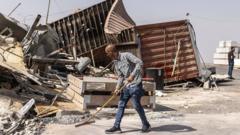
- Israeli forces launched searches and demolitions in Hebron, erecting roadblocks and forcing Palestinian families from their homes.
- More than 3,000 Palestinians have been forced from their homes, according to the United Nations' latest reported figures.
- Israel announced all West Bank land crossings would close for Tuesday's election and restricted Palestinian workers' movement.
- The UN human rights chief warned that threats to empty Hebron neighbourhoods raised serious concerns of ethnic cleansing.
Timeline · 8 moments
Palestinians protest demolitions as displacement exceeds 3,000 people
World News CNA ↗UN human rights chief warns of ethnic cleansing
Middle East Eye ↗Army restricts Palestinian workers' access to Israeli communities
The Hindu ↗Israel announces election day closure of West Bank crossings
Arab News ↗Around 250 Palestinian families removed from Hebron homes
Euronews ↗Military demolishes buildings and erects roadblocks in Hebron
The New York Times ↗Israel imposes lockdown across the occupied West Bank
Al Jazeera ↗Checkpoint attack kills two Israeli soldiers near Hebron
NPR : National Public Radio ↗How it started
Two Palestinian gunmen attacked an Israeli military checkpoint near Hebron on October 23, killing two Israeli soldiers, according to NPR. CBS reported that three others were wounded.
Prime Minister Benjamin Netanyahu pledged a major military operation in response, NPR reported. The attack came days before Israeli elections in which security had been a central issue, according to The Japan Times.
How it unfolded
On October 23, Israel imposed a lockdown across the occupied West Bank, Al Jazeera reported. The military described its response as a targeted and limited counterterrorism operation, according to Times of India.
By October 24, Israeli forces were demolishing buildings and erecting roadblocks in Hebron, The New York Times reported. The military said the operation would last several days and include searches and building demolitions, according to South China Morning Post.
Families were forced out as the operation progressed. Residents told Middle East Eye that soldiers gave them five minutes to leave. Euronews reported on October 24 that around 250 Palestinian families had been removed from the city.
On October 25, Israel announced that all land crossings with the West Bank would close on election day, according to Arab News. The army also said Palestinians would no longer be permitted to enter Israeli communities in the West Bank and Jordan Valley for work from that Sunday, The Hindu reported.
On October 26, UN human rights chief Volker Turk said Israeli threats to empty neighbourhoods in Hebron raised "serious concerns of ethnic cleansing," according to Middle East Eye. UN News also reported his warning as displacement reached thousands.
Where it stands
By October 27, more than 3,000 Palestinians had been forced from their homes, according to United Nations figures reported by CNA. The operation targeted neighbourhoods near the checkpoint where the soldiers were killed. Palestinians protested against military demolitions as Israelis voted.
Al Jazeera reported that Israel had sealed the West Bank and emptied parts of Hebron as the election campaign closed. The Palestinian Authority has called for international intervention, describing the military operation as collective punishment, according to Deutschlandfunk.
What to watch
The immediate questions are how long the crossing closures and movement restrictions will last, whether demolitions will continue, and when displaced families will be able to return. The military initially described an operation lasting several days, according to South China Morning Post, but the latest coverage does not establish an end date or a timetable for families to return.
More in World
All →
Two men charged under National Security Act over RAF Fairford incident
Prosecutors have charged two men over a September incident at RAF Fairford, as police suspect Iranian state involvement in a case involving the military base.
24 sources · today
Houthi attacks continue after Saudi Arabia reopens Riyadh international airport
Renewed missile and drone attacks are testing Saudi air defences after Riyadh airport reopened, while flight suspensions persist and regional officials meet in Tehran to ease tensions.
56 sources · over 7 days
Thomas Markle Investigated in Philippines as UK Police Probe 2018 Letter
Meghan Markle says a 2018 letter containing allegations about her father influenced her decision to keep her children away from him, while Scotland Yard investigates reports about the letter.
48 sources · over 5 days