
Pew Research projects Muslims will outnumber Christians worldwide by 2035, with Britain the exception
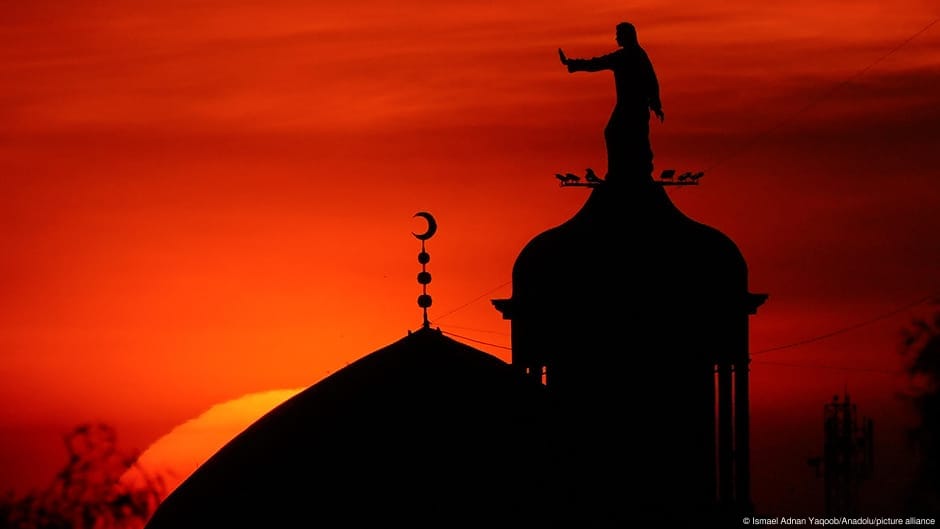
A new Pew Research Center forecast to 2070 says Islam will pass Christianity as the largest religion within about a decade, driven by fertility rates and age profiles.
By Hushread Stories, from 30 outlets · First published 18 Nov 2026
In brief
- Pew Research Center projects Islam will overtake Christianity as the world's largest religion by around 2035.
- Projected figures are 2.57 billion Muslims and 2.52 billion Christians, with both populations still growing.
- Higher fertility in mostly Muslim countries is the main driver, not religious conversion, according to the report.
- The Hindu population is expected to grow in absolute terms while its global share slips, with India's Muslim share rising.
- Britain is the exception, with the non-religious projected to become a majority there by 2070.
Timeline · 5 moments
Hindu, Indian Express and Tayari24 report Pew projections through 2070
The Hindu ↗Indian outlets highlight Hindu share slipping to 14 percent
Times now ↗Washington Post says Christianity's centre shifts to Africa
Washington Post World ↗Deutsche Welle reports 2.57 billion Muslims versus 2.52 billion Christians
Deutsche Welle ↗Pew releases projections on the future of world religions
South China Morning Post ↗Update 19 Nov 2026, 4:55 pm UTC
The new coverage from The Hindu, the Indian Express and Tayari24 Current Affairs reports the same core Pew projection: Islam overtaking Christianity around 2035, driven mainly by fertility rather than conversion. The newer pieces add a 2070 outlook, with Muslims reaching about 35.8 percent of the world population, and note that India's Hindu population will grow in absolute terms while its share of the Muslim-growing world slips. The 2035 crossover and the Britain exception stand unchanged, so the headline and key points need only light updating.
Update 19 Nov 2026, 10:52 am UTC
The new coverage from Dawn, Diken and a further report at News confirms the core projection and adds nothing that contradicts the published piece. The 2035 crossover, the driver of higher fertility rather than conversion, and the continued growth of both populations all stand. The headline and key points already reflect this, so only the key points are refreshed to match how the story now reads.
Update 19 Nov 2026, 3:47 am UTC
Coverage since the original piece has largely confirmed the core projection rather than changing it. [Sky News](https://news.sky.com/story/muslims-projected-to-outnumber-christians-by-2035-with-majority-in-uk-non-religious-by-2070-13613731), [Arab News](https://www.arabnews.com/world/islam-to-become-worlds-largest-religion-by-2035-3012812) and others repeat the 2035 crossover, with Muslims projected at 2.57 billion against 2.52 billion Christians, and The Washington Post frames it as a study finding. The new material adds detail on Britain, where Sky News reports a majority non-religious population by 2070, and on Hindu share falling to about 13.6 percent by 2070, per News18. Nothing in the headline's figures or subject is now wrong, so the headline stands.
How it started
On Wednesday, Pew Research Center published detailed projections on the future of the world's religions, looking ahead from 2020 to 2070. The report is titled "The Future of World Religions" and builds on a quarter century of work by the organisation on religious demography.
The headline finding is that Islam is on course to become the largest religious group on the planet by 2035, ahead of Christianity, which has held that position for a very long time.
How it unfolded
Coverage appeared across outlets on the same day, 18 November. Al Jazeera noted that the report projects steady increases for both Christianity and Islam over the full period, so this is not a story of one faith shrinking while the other grows. NDTV quoted the same point, that both are growing but Islam is growing much faster.
Deutsche Welle gave the most precise numbers: 2.57 billion Muslims and 2.52 billion Christians by 2035. Researchers told the outlet that differences in fertility rates account for the change. nu.nl described the cause in similar terms, saying populations in mostly Muslim countries are expected to grow faster than those in mostly Christian ones.
The Washington Post added a geographic angle, reporting that Christianity's centre of gravity is expected to move to Africa and that the United States will no longer be majority-Christian. Mint reported that by 2070 Muslim populations are forecast to grow substantially.
Indian outlets focused on Hinduism. ThePrint reported that the Hindu population will increase by nearly 200 million, though its share of the global total is expected to slip from 15 percent to 14 percent. The Times of India framed it as Hindu growth falling behind other religions in the coming decades.
In Europe, Die Welt set the findings against the backdrop of emptying churches on the continent, noting that the number of believers worldwide is rising nonetheless. The Times looked at Britain specifically: Islam could overtake Christianity globally by 2035, but not in the UK. By 2070 the country could join a small group of nations where non-religious people are a majority, though Christianity would remain the largest faith there.
Where it stands
The projection is a demographic forecast, not an official policy matter, and the coverage so far shows no government or religious-body response. Outlets agree on the 2035 crossover date and on fertility as the main driver.
The South China Morning Post described Pew as having issued authoritative reports on religious demography for 25 years, which is why the figures are being widely repeated. As with any long-range forecast, the numbers depend on assumptions about birth rates, age structure and religious switching that can change over decades.
More in Culture
All →
Cambridge Dictionary Picks 'Human' as Its 2026 Word of the Year
As AI chatbots blur the line between people and machines, one of the best-known dictionaries has chosen a word that asks what makes us distinct.
24 sources · today
Pope Leo XIV ends 12-day South America tour with huge Mass in Lima
Weeks after lung cancer surgery, the pope finished a gruelling trip through Uruguay, Argentina and Peru, drawing vast crowds and ending in the country where he spent two decades as a missionary.
44 sources · over 3 days
M. John Harrison Wins 2026 Booker Prize at Record Age
Harrison's win for The End of Everything makes the 81-year-old the Booker's oldest winner, bringing an apocalyptic novel and a long, unconventional literary career into the spotlight.
43 sources · over 7 days