
Uber and Wayve Launch London's First Commercial Robotaxi Service With Human Supervisors
Uber has teamed up with Wayve to introduce self-driving robotaxis in London, a milestone for UK autonomous vehicle technology as real passengers begin riding under supervised conditions.
By Hushread Stories, from 20 outlets · First published 3 Sept 2026
In brief
- Uber and Wayve have begun operating 15 autonomous taxis in London, each with a human safety driver present.
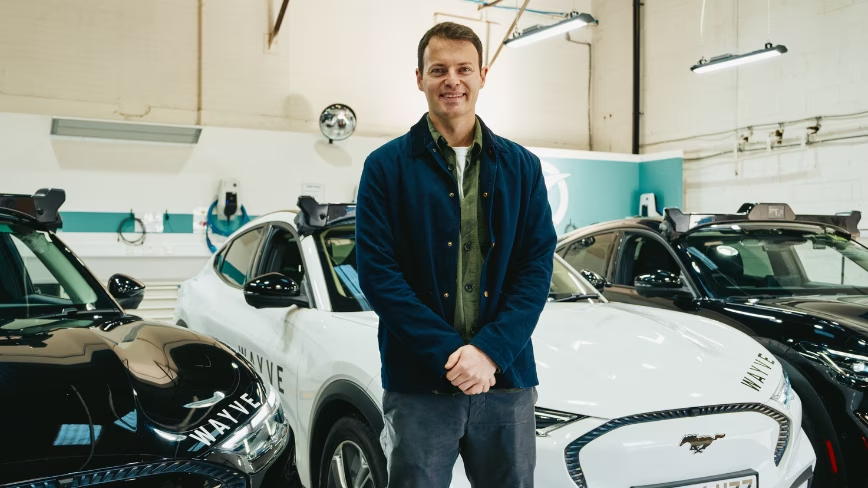
- The service uses Ford Mustang Mach-E vehicles equipped with Wayve's self-driving technology and can be booked via the Uber app.
- Current regulations in London require a licensed driver in every vehicle, so fully driverless rides are not available yet.
- The robotaxi fleet is classified as private hire vehicles and is operating on a limited pilot basis for now.
- Expansion to a fully driverless service in London will need further regulatory approval and is not yet scheduled.
Timeline · 6 moments
London robotaxi service operates with required safety drivers
The Next Web ↗Uber and Wayve launch 15 robotaxis in London
AI - The Guardian ↗London's unique roads test the limits of autonomous driving technology
Bloomberg Technology ↗Initial fleet of 15 autonomous vehicles begins operating with safety drivers
BBC - Home ↗Uber beats Waymo to offer commercial robotaxis in London
The Verge - All Posts Tech ↗Uber and Wayve launch London's first public robotaxi service
CNET News Tech ↗Update 4 Sept 2026, 4:46 pm UTC
Uber and Wayve's robotaxi service has officially started operating in London with 15 vehicles, each still requiring a human safety driver. Despite new UK regulations allowing driverless taxis, the London service is following local rules that mandate a supervisor in every car.
Update 3 Sept 2026, 3:52 pm UTC
Uber and Wayve officially launched their robotaxi service on September 3, 2026, making 15 self-driving Ford Mustang Mach-E vehicles available to Londoners. The cars are classified as private hire vehicles and still require a human safety driver, as full driverless operation is not yet approved. Regulators in Europe remain cautious compared to the US, and further permits are needed before the cars can operate without human supervisors.
Update 3 Sept 2026, 8:05 am UTC
Uber and Wayve's robotaxi service is now live in London with 15 self-driving vehicles available to the public through the Uber app. Each car still has a human safety driver, and the rollout remains limited compared to London's large fleet of traditional taxis, highlighting a careful approach to expansion.
How it started
Uber's ambitions for autonomous vehicles have been years in the making, but the breakthrough in London came through a partnership with Wayve, a UK-based AI startup specializing in self-driving technology. Wayve's approach uses machine learning to help vehicles handle the complex, often unpredictable streets of London.
The collaboration aimed to address both technical and regulatory challenges unique to the UK. London's dense layout, historic roads, and busy traffic patterns presented hurdles that differ from those in US cities where robotaxi trials have already taken place.
How it unfolded
On September 2, 2026, Uber and Wayve publicly launched the first commercial robotaxi service in London. The initial fleet consists of Ford Mustang Mach-E vehicles, each equipped with Wayve's autonomous driving system and a human safety driver in the front seat to oversee operations, according to CNET.
The same day, The Verge noted that Uber became the first company to offer this kind of service in London, beating US rival Waymo to the city's streets. The service is available to regular riders, who can book trips through the familiar Uber app, though only a small number of vehicles are currently licensed to operate.
The BBC reported that there are 15 autonomous vehicles in the initial fleet, each operating under a special licence. This limited rollout allows Uber and Wayve to gather real-world data and refine their technology in live traffic conditions.
According to Bloomberg, London's roads present unique challenges compared to US cities, such as narrow lanes, older infrastructure, and varied weather, providing a real test for the technology's adaptability.
Coverage from Engadget and others confirmed that while the London launch is the headline, Uber and Wayve are also planning international expansions, including a future rollout of Nissan autonomous vehicles in Tokyo.
Where it stands
Londoners can now hail a robotaxi through Uber, but each ride includes a trained safety operator behind the wheel. The fleet is small, and the service is still in its early stages, focusing on safety, reliability, and public acceptance.
Uber's move puts London at the forefront of autonomous vehicle deployment in Europe, offering a glimpse of what future city transport could look like if the trials prove successful.
What to watch
The next steps are likely to involve expanding the number of robotaxis on London's streets and gradually reducing the need for human safety drivers. Regulators will closely monitor the service's performance and safety record, which will determine how quickly fully driverless rides become possible in the UK and beyond.
More in Technology
All →
Anthropic Rolls Out Claude Duet, a Work-Focused AI Agent in Preview
The app is aimed at professionals and small businesses and includes security guardrails for workplace use.
31 sources · over 2 days
Google brings Gemini Personal Intelligence to Android Auto for personalized driving help
Google is connecting its in-car assistant to personal information across its apps, adding tailored driving help as the Android Auto rollout begins and support for built-in systems approaches.
13 sources · over 3 days
eMudhra Exits Global TLS Certificate Business After Eight Keys Compromised
Emergency browser blocks and an Indian government investigation have followed the discovery of weak certificate keys, exposing a failure in the systems that establish trust online.
20 sources · over 3 days