
Cyberattacks send false nuclear warnings through Ukrainian and Russian emergency apps
Both countries reported interference with public warning apps, spreading false alerts about nuclear danger while authorities urged residents to rely on official information.
By Hushread Stories, from 34 outlets · First published 2 Nov 2026 · Chapter 2 of 2
Earlier: Ukraine air raid app sends false nuclear alerts after suspected hack
In brief
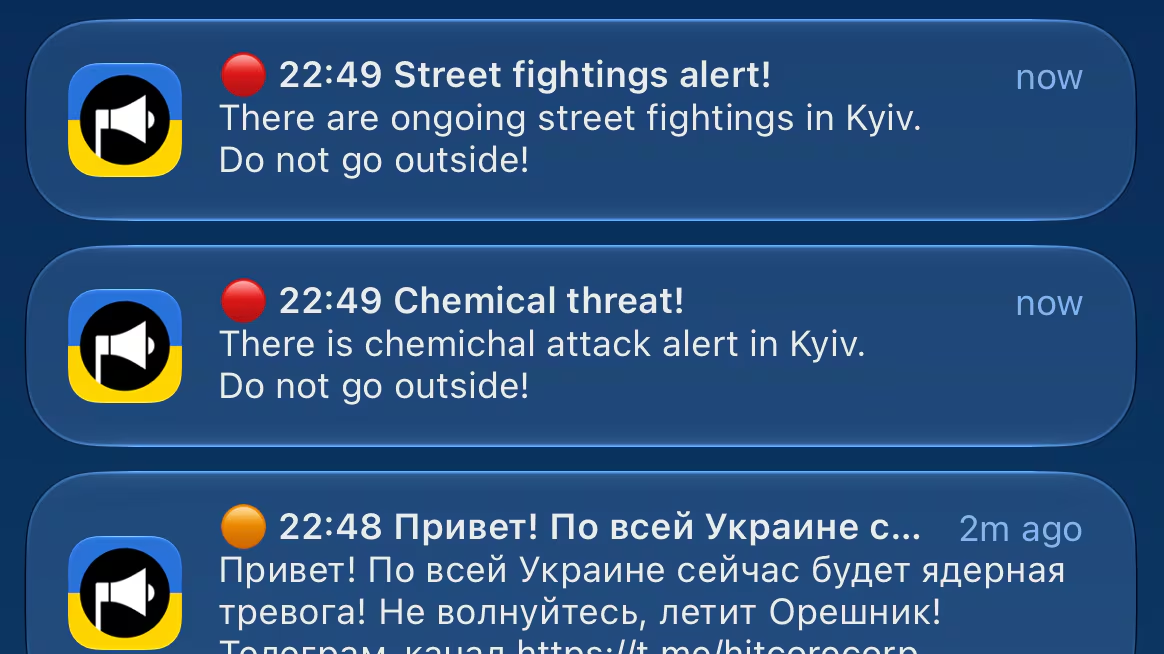
- Ukraine reported that its public air raid warning app sent false nuclear, chemical and street fighting alerts.
- Russia subsequently reported a cyberattack on its emergency warning app, saying hackers had posted false information.
- Ukrainian authorities denied the reported threats and urged people to follow official channels for reliable information.
- Ukraine temporarily suspended the affected service after unauthorized interference, according to a report published on Monday.
- The reports do not establish who carried out the attacks or whether the two incidents were connected.
Timeline · 5 moments
Report describes temporary suspension of Ukrainian alert service
Mint ↗Russia reports cyberattack hours after Ukraine's announcement
Infobae ↗Authorities deny threats and direct users to official channels
BBC News ↗Ukrainian app displays false nuclear and chemical warnings
CNN Brasil ↗Limited Oleshky ceasefire ends without reported violations
Deutsche Welle ↗How it started
Ukraine's public air raid warning app sent users messages about nuclear danger, chemical threats and street fighting on Sunday night, November 1. The warnings were false, NBC News reported.
The incidents came around the end of a limited ceasefire in the Oleshky area of Kherson. Deutsche Welle reported that the ceasefire ended Sunday night without reported violations, while Russian drones and missiles struck other Ukrainian regions. The coverage does not establish a connection between the ceasefire's expiry and the app attacks.
How it unfolded
On November 1, Ukraine's Air Force said its public alert app had been hacked. For a short period, it displayed nuclear and chemical warnings for Kyiv and other areas, according to CNN Brasil.
The false messages also claimed that Russia's hypersonic Oreshnik missile had been deployed, the Sydney Morning Herald reported. These were claims in the erroneous alerts, not confirmed military developments.
Ukrainian authorities said there was no threat and advised the public to follow official channels, BBC News reported. In coverage published November 2, Al Jazeera said authorities reported clearing up the confusion in under an hour.
Russia then reported an attack on its own emergency warning app. Infobae reported on November 2 that Russia described a massive cyberattack, hours after Ukraine's announcement. Moscow said hackers had posted false information, according to Japan Times.
Ukraine's air raid alert channel said unauthorized parties had interfered with the app's operations, prompting authorities to suspend the service temporarily, Mint reported on November 2.
Where it stands
Both countries have reported cyberattacks against apps used to warn the public about danger. The nuclear and radiation warnings described in the coverage were false, not evidence of an actual nuclear emergency. CBC News reported that users in Ukraine received false warnings of dangerously high radiation levels in Kyiv.
The available coverage does not establish whether Ukraine's suspended service has been fully restored. Nor does it establish a common attacker or a technical link between the incidents. CNBC International described them as separate cyberattacks.
What to watch
The immediate questions are whether the affected services are operating normally again and how the false messages reached users. The provided reports do not explain the method of intrusion or establish responsibility. For residents, the guidance reported by BBC News remains to follow official channels for information.
More in Technology
All →
Polymarket Returns $3.9 Million After Hackers Hijack Third-Party Monitoring Script
Polymarket has returned $3.9 million to traders after a compromised monitoring script enabled theft, while its provider says early findings indicate only one customer was targeted.
22 sources · over 6 days
Suspected Freezer Hacks Disrupt Supermarkets in Belgium and Sweden
Sudden refrigeration temperature changes have hit dozens of supermarkets, forcing food disposal in Belgium and raising fears of another cyberattack weeks after similar incidents in France.
9 sources · today
Apple Unveils Touchscreen MacBook Pro Alongside New iPad Mini and iMac
Apple is bringing touch controls and OLED to the MacBook Pro, a reversal of its longstanding position that arrives alongside updates to its tablet and desktop lineup.
69 sources · over 9 days