
Delhi Court Declines to Stop CJP Protest After Leaders Are Jailed
A planned flag gathering in central Delhi faces municipal opposition after two CJP leaders were jailed, while courts consider challenges over protest restrictions and police conduct.
By Hushread Stories, written with AI from 44 outlets · First published 15 Oct 2026 · Chapter 2 of 2
Earlier: Delhi Protest Leaders Jailed as Supreme Court Takes Up Election Dispute
In brief
- Delhi Police removed Jantar Mantar from its designated protest venues on October 12, naming three alternatives.
- CJP leaders Saurav Das and Ashutosh Ranka received five days in custody after entering the barricaded site.
- Petitions before the Supreme Court allege police excesses and seek an independent inquiry into treatment of detainees.
- Delhi High Court declined to stop the October 16 protest, although municipal authorities had denied permission.
- Abhijeet Dipke has urged supporters to join the flag march and announced a nationwide campaign from October 23.
Timeline · 9 moments
CJP announces nationwide campaign starting on October 23
India News ↗High Court refuses to stop Connaught Place protest
NDTV India ↗Municipal council denies permission for Central Park protest
Times now ↗Delhi police chief apologises over CJP protest curbs
India Today ↗Supreme Court petitions seek inquiry into alleged police excesses
The Hindu ↗Two CJP leaders sent to five days in custody
India | The Guardian ↗At least 35 media workers reported detained
Al Jazeera ↗Police file trespassing case against Das and Ranka
NDTV India ↗Delhi Police removes Jantar Mantar as designated protest venue
The Hindu ↗How it started
The protests centre on demands for Chief Election Commissioner Gyanesh Kumar to resign over alleged voter roll irregularities, according to BBC News - India. The coverage describes a campaign seeking his resignation, not an announcement that he has stepped down.
The youth-led Cockroach Janta Party, or CJP, has become a prominent part of the demonstrations. Its confrontation with police intensified around Jantar Mantar, a longstanding protest venue in Delhi that authorities removed from the list of designated demonstration sites on October 12, The Hindu reported.
How it unfolded
On October 12, Delhi Police replaced Jantar Mantar with three alternative protest venues, according to The Hindu. The change disrupted CJP's plans, Times of India India reported.
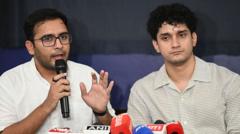
On October 13, CJP leaders Saurav Das and Ashutosh Ranka entered the heavily barricaded site and raised slogans demanding Kumar's resignation. Police subsequently filed a trespassing case against them, according to NDTV India.
The crackdown also affected people covering the demonstrations. Al Jazeera reported on October 13 that police had detained at least 35 media workers in New Delhi over a 48-hour period.
On October 14, Ranka and Das were sent to five days in custody, The Guardian reported. Accounts differ on the number of leaders jailed: Deutsche Welle reported three, while other coverage identified two. Amnesty International News called for the immediate release of Das and Ranka, describing their attempted protest as peaceful.
Legal challenges widened the same day. Petitions before the Supreme Court alleged police excesses and sought an independent inquiry, preservation of CCTV footage and the return of detainees' phones and belongings, according to The Hindu.
By October 15, the dispute had shifted to a proposed gathering at Central Park in Connaught Place. The New Delhi Municipal Council denied permission, Times now reported. Delhi High Court nevertheless refused to stop the following day's protest, with police to regulate it, according to NDTV India.
Where it stands
The October 16 gathering remains the immediate focus. Abhijeet Dipke has called for supporters to assemble with the national flag to protest the police crackdown on demonstrators raising allegations of electoral fraud, according to NDTV India. The municipal refusal and the High Court's decision are separate developments, not a single, unconditional clearance.
Police conduct is also under scrutiny. India Today reported on October 15 that Delhi's top police officer apologised over CJP protest curbs and sought discharge of a contempt notice. Separately, opposition leader Rahul Gandhi and others are seeking an independent audit of voter deletions, according to Deutsche Welle. These are pending challenges, not findings that the alleged electoral irregularities occurred.
What to watch
The first test is how police regulate the October 16 gathering following the High Court's refusal to stop it. Dipke has urged political parties, youth groups, farmer unions and student bodies to join the march, India News reported.
Beyond Delhi, CJP has announced a nationwide campaign against SIR from October 23, according to India News. The other unresolved questions concern the custody of its leaders and what action courts take on allegations of police excesses and demands for an electoral roll audit.
More in World
All →
Albania student protests escalate as demonstrators attack ministries in Tirana
Demands for better education and job prospects have widened into calls for Prime Minister Edi Rama's resignation, with ministries damaged and police using tear gas.
23 sources · over 2 days
Ukraine Resumes Russian Refinery Strikes as Zelenskyy Rejects Trump's Diesel Deal
The collapse of a brief pause in Ukrainian refinery attacks deepens a dispute with Washington as Russian diesel exports restart and Ukraine reports restrictions on vital satellite services.
77 sources · over 5 days
Maduro and Cilia Flores Plead Not Guilty to New Torture Charges
The New York court appearance moves the case beyond a scheduled hearing, with Maduro and Flores formally denying new allegations that torture helped them retain power.
9 sources · today