
France Extends Curfews After Riots and Prepares for Fresh Protests
French authorities are extending targeted curfews and preparing a larger security operation for Saturday, while Prime Minister Sébastien Lecornu plans talks with unions over protecting the right to demonstrate.
By Hushread Stories, written with AI from 41 outlets · First published 21 Oct 2026
In brief
- Protests over living costs and declining public services escalated into rioting, looting and fires across France.
- Targeted curfews brought overnight calm, according to Prime Minister Sébastien Lecornu, with further restrictions announced for Tuesday.
- More than 2,000 people have entered police custody since October 17, and hundreds face immediate trials.
- Authorities plan a larger police deployment for Saturday, with some military forces freeing officers for demonstration duties.
- Lecornu is due to meet representatives from five unions on October 21 before another planned protest day.
Timeline · 8 moments
Lecornu due to meet five unions before further protests
The Hindu ↗Government announces military support for weekend security operation
Euronews ↗Hundreds face immediate trials following nationwide unrest
France24 ↗Police arrest suspect after fire at Limoges town hall
Sky News ↗Lecornu credits targeted curfews with restoring overnight calm
Latest news, sport and opinion from the Guardian ↗Nuñez promises more police for Marseille's next demonstration
Franceinfo ↗Targeted curfews imposed in Paris and other cities
BBC News ↗France hit by some of its worst recent rioting
The Hindu ↗How it started
Protests over rising living costs and declining public services drew hundreds of thousands of people, according to The Independent. The demonstrations escalated into rioting, looting and fires across France.
The unrest on October 17 was among the country's worst in recent years, The Hindu reported. Destruction and looting affected about 20 cities, according to Le Monde, prompting mayors to gather in a show of solidarity.
How it unfolded
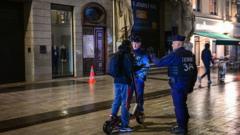
By October 19, curfews had been imposed in parts of central Paris and other cities. BBC News reported that the interior minister acknowledged police had "lost control" in some cities.
That evening, Interior Minister Laurent Nuñez visited Marseille and met Mayor Benoît Payan for 45 minutes. He promised a larger police deployment for the next demonstration planned for Saturday, according to Franceinfo.
On October 20, Prime Minister Sébastien Lecornu said targeted curfews had "contributed to calm overnight", The Guardian reported. Further restrictions were announced for parts of Paris, Lyon, Bordeaux and Nice, according to Le Monde.
The response also moved into the courts. France24 reported on October 20 that more than 2,000 people had been placed in police custody since October 17, nearly 70 percent of them adults, as hundreds faced immediate trials.
Police also arrested a suspect over the fire at Limoges town hall. Reports differed on his age: nu.nl said he was 34, while Der Spiegel reported he was 40.
In parliament on October 20, Lecornu promised a "massive" security operation for the October 24 demonstrations. He said the response would change in its resources, deployment, speed and mobility, according to Franceinfo.
Where it stands
Authorities are extending restrictions after the first quiet night since the unrest. NPR reported that nightly curfews would continue "for as long as necessary", with fresh restrictions imposed in central Paris and Lyon on Tuesday.
The restrictions are targeted rather than nationwide. In Paris, the renewed curfew covers République square from 2100 GMT on October 20 to 0400 GMT on October 21, according to NDTV. Local authorities will coordinate with mayors on whether curfews are needed, Al Jazeera reported.
The planned security reinforcement includes some military forces from Operation Sentinelle. Their deployment will free police and gendarmes for the expected demonstrations, Nuñez said, according to Euronews.
What to watch
Lecornu is due to meet representatives from five unions on the morning of October 21. A letter to the organisations says the talks will address "ways and means to guarantee the essential freedom to demonstrate", according to The Hindu.
The next major test is Saturday, October 24. Student unions and groups from the yellow vest movement have called another day of protests, Express & Star reported. Whether the expanded security operation can prevent renewed violence while allowing demonstrations remains unresolved.
More in World
All →
French military jet crashes near Nancy, leaving at least one dead
Rescuers have found a body after a French military jet crashed between Nancy and Pont-à-Mousson, while reports say the search for a second pilot continues.
8 sources · today
Trump Faces Sanctions Backlash as Ukraine Talks Shift to Oslo
Moves to ease pressure on Russia have drawn bipartisan criticism, while talks in Norway offered signs of progress without resolving disputes over American support for Ukraine.
67 sources · over 5 days
Tiger Shroff Shooting Probe: Salman Khan Was Reportedly the Intended Target
Reports say the shooters had targeted Salman Khan but switched to Tiger Shroff because of tight security.
17 sources · over 3 days