
Tech Stocks Slide Again as AI Doubts, Inflation and New Tariffs Rattle Global Markets
A sell-off in AI-linked shares has pushed the Nasdaq to the edge of a bear market, and a brief rebound around Nvidia's CEO change faded fast, leaving investor confidence in the AI trade fragile.
By Hushread Stories, from 54 outlets · First published 26 Nov 2026 · Chapter 4 of 4
Earlier: Nasdaq Sinks 4% as AI Rout Resumes, Nvidia Falls Again
In brief
- The Nasdaq 100 briefly fell about 20% from its high on November 25 before dip buyers pulled it back from the brink.
- Nvidia shares jumped on Jensen Huang's return as CEO on November 23, then gave back much of that gain within two days.
- Asian markets were hit hard, with Japan's Nikkei closing down 2.78% at 57,012 and chip names in Tokyo and Seoul sliding.
- Fresh 20% US tariffs and a hotter inflation reading added to worries about AI spending and possible higher interest rates.
- Wall Street closed well off its lows on November 25, but traders face the Thanksgiving break with volatility still elevated.
Timeline · 8 moments
S&P puts Nvidia on negative watch after wild session
BigGo Finance — Real-time Stock Quotes, Financial & Business News ↗Nasdaq falls nearly 4% in early trading
BBC News ↗New 20% US tariffs and hot inflation hit stocks
Yahoo Finance ↗Nikkei closes down 2.78% at 57,012
NewsOnJapan.com ↗Asian chip stocks tumble, led by Japan
Techmeme ↗Anthropic falls below its IPO price
Sydney Morning Herald ↗AI stocks reverse, dragging Nasdaq and S&P 500 lower
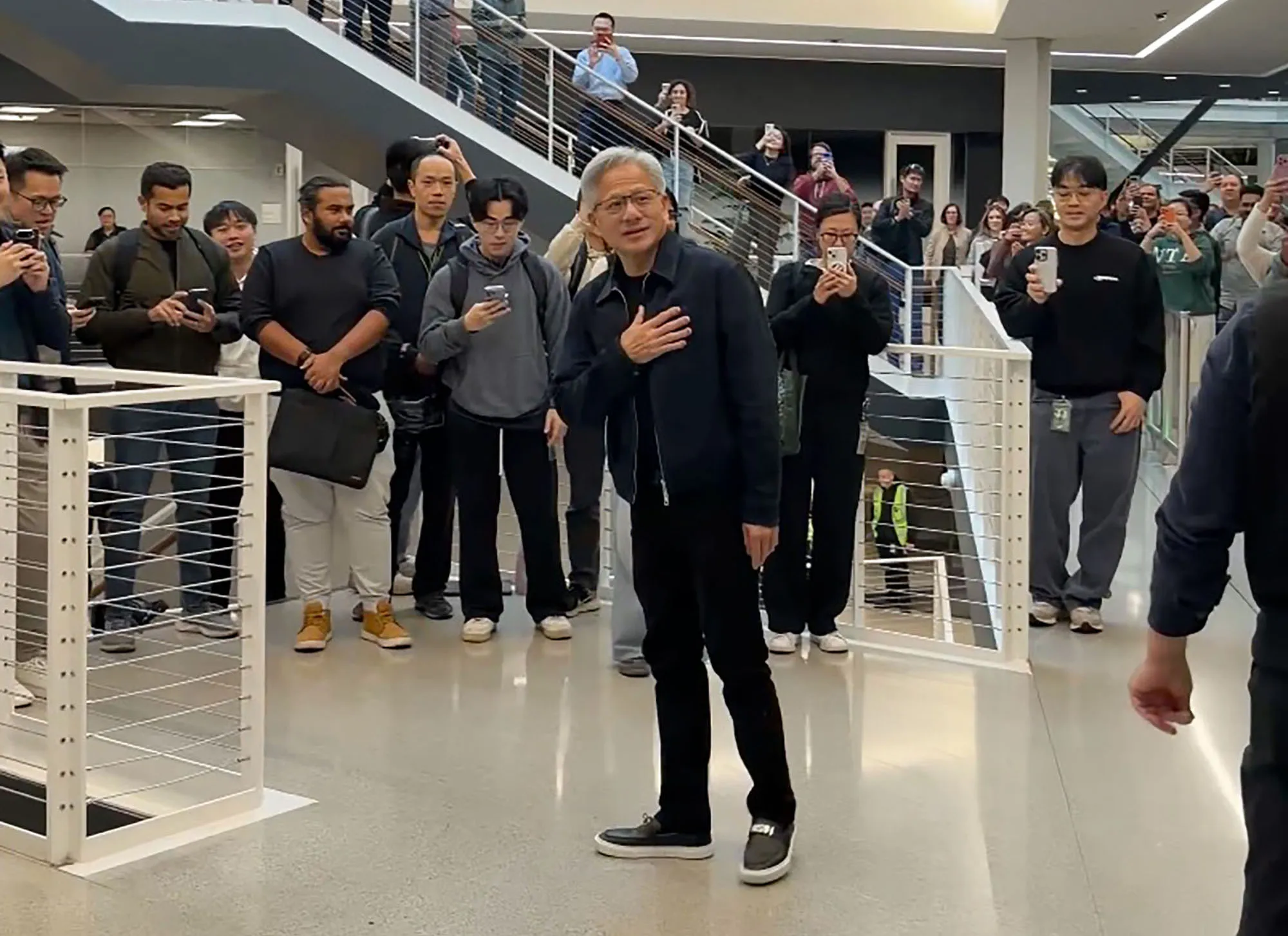
CBC News ↗Nvidia surges on Jensen Huang's return as CEO
CNBC ↗How it started
The sell-off began around November 20, when shares tied to artificial intelligence started falling sharply. Doubts about whether huge spending on AI will ever pay off had been building, and they came to a head.
By the time the damage was tallied, the Nasdaq was heading toward a bear market, the usual label for a fall of 20% from a peak. The S&P 500 and the Dow had slipped into correction territory, meaning a drop of at least 10%.
Taiwan took some of the worst of it. Its stock market had its worst week in decades, which led authorities to curb short-selling and announce government support measures. South Korea readied a market stabilisation fund of its own.
How it unfolded
On Monday, November 23, stocks bounced. The trigger was Nvidia, where Jensen Huang returned as CEO after an abrupt exit. CNBC reported that Nvidia shares surged 31% on the news, and the Dow extended a recovery of nearly 2,000 points over two days.
The relief did not last. On Tuesday, November 24, CBC News reported that AI-linked stocks dragged the US market lower after the previous day's surge quickly fizzled. CNBC said Nvidia and Anthropic each closed about 6.5% lower. The Dow still finished above 50,000, according to The Straits Times, which put it at 50,028.79, up 0.87%, while the Nasdaq and S&P 500 fell. The Sydney Morning Herald noted that Anthropic had dropped below its IPO price.
The selling spread to Asia on Wednesday, November 25. Al Jazeera reported sharp falls in Japan, South Korea and Taiwan. CNBC, via Techmeme, put Advantest down more than 12%, Tokyo Electron more than 7%, and Samsung and SK Hynix more than 6%. NewsOnJapan said the Nikkei closed down 1,633 points, or 2.78%, at 57,012.
New pressure came from outside tech. Yahoo Finance reported that the Trump administration announced new 20% tariffs and that the PCE inflation index showed price increases picked up in October. Reuters carried the same mix of AI rout and tariff worries.
In US trading that day the Nasdaq fell nearly 4% early on, according to the BBC. Wall Street Journal-sourced Dealbreaker described a slide that wiped out most of Monday's gains. The New York Post said Nvidia fell 8.3%, and ABC News Australia put the Philadelphia Semiconductor Index down 7.3% at one point. MarketWatch said Sandisk, Nebius and Micron each dropped more than 10%, and that Oracle was sinking toward a three-year low.
Where it stands
Wednesday ended far better than it began. Bloomberg reported that dip buyers emerged, fading a sell-off that had briefly sent the Nasdaq 100 to the brink of a bear market. MarketWatch said the Dow closed higher after a big comeback, while the S&P 500 and Nasdaq fell but finished well off their lows.
Reports differ on the depth of the intraday plunge. CBC News cited an S&P 500 drop of 2.6% at one point, while the Chinese-language outlet Wallstreetcn said the S&P fell 2.9% and the VIX volatility gauge rose above 33. By the close, the Top Stories wire report said the S&P 500 was down only 0.3%.
The damage to confidence is still visible. The Financial Times noted that tech shares have declined this month over fears about whether the AI boom can be sustained, and BigGo Finance reported that S&P placed Nvidia on negative watch. The BBC's Faisal Islam argued that the fears were legitimate before Huang's exit and that his return does not fix them.
What to watch
US markets close for Thanksgiving, so the next test comes when trading resumes. The question is whether the Wednesday bounce marks a floor or just another swing in an unusually jumpy market.
Three pressures remain unresolved: whether AI spending can be justified by returns, whether higher inflation pushes interest rates up, and how far the new tariffs go. Coverage also points to Asia, where chip-heavy markets in Japan, South Korea and Taiwan have been the most exposed.
More in Business
All →
US Proposes Tariffs of Up to 25 Percent on 14 Trading Partners Including China and India
Country-specific duties follow a Section 301 overcapacity probe, with India's rate dropping to 17 percent if a trade deal is signed.
84 sources · over 2 days
Amazon plans to sell new and used cars online in the UK from early 2027
Amazon is taking its car-selling service outside the US for the first time, starting in Britain with Hyundai on board and reservations from £99, a test of online car retail.
16 sources · over 2 days
Nvidia Reinstates Jensen Huang Eleven Days After His Resignation, Amid Trump Role and Probes
Nvidia's board brought back its co-founder after an affair scandal with espionage questions, and critics say the speed and White House involvement raise doubts about governance while investigations continue.
164 sources · over 11 days