
Trump Backs Netanyahu Before Israeli Election as Vance Withholds Endorsement
Trump's endorsement gives Netanyahu prominent backing before Israel's October 27 vote, but uncertain polling and Vance's refusal to join him complicate the political message.
By Hushread Stories, written with AI from 52 outlets · First published 20 Oct 2026 · Chapter 2 of 2
Earlier: Trump Endorses Netanyahu After Talks on Possible Iran Strike Before Elections
In brief
- President Donald Trump endorsed Israeli Prime Minister Benjamin Netanyahu on October 18, nine days before Israel votes.
- Polls show Netanyahu and his far right partners lack the majority needed to secure another term.
- Netanyahu aired a telephone call in which Trump predicted victory and both hinted at further action against Iran.
- Vice President JD Vance declined to endorse Netanyahu, saying he was not getting involved in Israeli elections.
- Netanyahu has urged stronger partnerships with India and Latin America, warning that a future American president could be hostile.
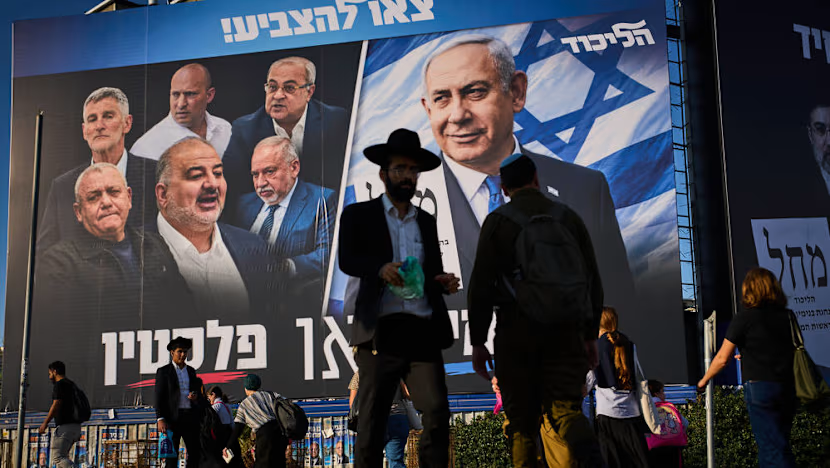
Timeline · 5 moments
Vance declines endorsement and says he remains uninvolved
The Hill ↗Netanyahu speaks with Trump after receiving his endorsement
Infobae ↗Tehran warns of retaliation after renewed strike threats
Iran International (English) ↗Trump endorses Netanyahu nine days before Israeli election
Deutsche Welle ↗Netanyahu warns of hostile future American leadership
Business Line - Home ↗How it started
U.S. President Donald Trump endorsed Israeli Prime Minister Benjamin Netanyahu on October 18, nine days before Israel's parliamentary election. According to NPR, Trump wrote that Netanyahu "has been a Great Warrior Prime Minister, and an even greater Partner for Peace in combatting the Islamic Republic of Iran."
The backing arrived during a difficult campaign. Deutsche Welle reported that polls showed Netanyahu and his far-right partners lacked the majority needed to secure another term. Euronews described the endorsement as breaking months of silence, after the two leaders' strategies on Iran and Gaza had diverged.
How it unfolded
On October 18, before Trump's endorsement, Netanyahu warned that a future U.S. president could be hostile toward Israel. He called for stronger alliances with India and Latin America, according to The Hindu. The remarks framed broader partnerships as preparation for possible changes in Washington.
Trump's endorsement later that day tied his support to the confrontation with Iran. Euronews reported that he also warned the United States might not "do this work" if Israel changed leaders.
On October 19, Iran International reported that Trump and Netanyahu had escalated threats of renewed strikes against Iran on Sunday. Tehran warned of retaliation while diplomatic efforts continued.
Netanyahu spoke with Trump by telephone on October 19, according to Infobae. In the call Netanyahu aired, Trump predicted an election victory and the two hinted at further action against Iran, World News CNA reported.
Also on October 19, Vice President JD Vance declined to follow Trump's endorsement. "I'm not anti-endorsing him. I'm not pro-endorsing him," he said, according to The Hill. CNBC reported that Vance said he was "not getting involved in Israeli elections."
Where it stands
As of October 20, Netanyahu has Trump's explicit support, but not an endorsement from Vance. Vance's stated position is neutrality rather than opposition, according to The Hill.
The electoral benefit remains uncertain. Analysts cited by The New York Times said Trump's standing in Israel was not what it once was. That limits how confidently his intervention can be treated as a boost, particularly with polling reported by Deutsche Welle showing Netanyahu's bloc short of a majority.
What to watch
The immediate test is Israel's October 27 election: whether Netanyahu and his partners can secure the majority that current polls suggest they lack, according to Deutsche Welle.
Further action against Iran is also unresolved. The threats of renewed strikes and Tehran's warning of retaliation, reported by Iran International, leave open whether the campaign's military rhetoric will be followed by action.
More in World
All →
CJP Leaders Seek Delhi High Court Hearing After Custody Extension
Saurav Das and Ashutosh Ranka have challenged their continued detention, while CJP founder Abhijeet Dipke is out on conditional bail following protests over electoral rolls.
23 sources · over 8 days
Trump and Zelensky Clash as Oslo Talks Test Ukraine Support
A dispute over sanctions has widened into accusations about delayed missiles and intelligence, as US envoys prepare for talks with Ukraine and European leaders in Oslo.
65 sources · over 4 days
Two men re-arrested over suspected Iran links near RAF Fairford
Counter-terrorism police have re-arrested two men over an incident near RAF Fairford, saying Iranian state involvement is highly likely as the investigation continues.
10 sources · today