
UK Greens face widening backlash after adopting 'Zionism is racism' policy
The conference vote has led Israel to bar Zack Polanski, drawn criticism from European Greens and prompted senior Labour figures to reject future cooperation.
By Hushread Stories, written with AI from 15 outlets · First published 7 Oct 2026 · Chapter 2 of 2
Earlier: UK Green Party Formally Declares Zionism a Form of Racism at Conference
In brief
- Green Party members adopted the policy at their Brighton conference by 1,022 votes to 813.
- Jewish groups, the Israeli government and Labour condemned the decision, while some Green parliamentarians opposed it.
- Israel barred Green leader Zack Polanski after accusing his party of legitimising the destruction of Israel.
- Nine Labour MPs asked Sussex Police to assess allegations of possible antisemitic offences at the conference.
- Future cooperation with Labour is in doubt, while the party also faces criticism from European Greens.
Timeline · 7 moments
Senior Labour figures reject prospect of Green cooperation
Guardian Politics ↗Nine Labour MPs request police assessment of alleged offences
BBC - Home ↗European Greens express dismay over the adopted policy
Latest news, sport and opinion from the Guardian ↗Israel bars Polanski following Green Party conference vote
Euronews ↗Jewish groups warn policy discriminates against Jewish supporters
Financial Times ↗Brighton conference adopts policy by 1,022 votes to 813
Guardian Politics ↗Members prepare to vote on disputed Zionism motion
Middle East Eye ↗How it started
The dispute began with a proposal to make the Green Party of England and Wales formally define Zionism as a form of racism. On October 2, Middle East Eye reported that members would vote on the motion at their conference.
The debate came at a politically sensitive moment for party leader Zack Polanski. The Financial Times described the conference dispute and the approaching Holborn by-election as a defining week, amid signs that the party's surge in support was faltering.
Polanski had described himself as an anti-Zionist, according to the Guardian. But the proposal also alarmed some Jewish members, the Guardian reported when the vote passed.
How it unfolded
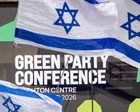
On October 4, members adopted the policy at the annual conference in Brighton, voting 1,022 in favour and 813 against, according to the Guardian. The result made the disputed position formal party policy rather than simply the view of individual members.
Condemnation followed from Jewish groups, Labour and Israel's government. The Financial Times reported that Jewish community leaders warned the motion discriminated against Jewish supporters. The National Post also reported criticism from the ruling Labour Party.
Israel accused the Greens of giving "legitimacy to terrorism", according to Middle East Eye. Al Jazeera reported that Israel's president called the policy an "antisemitic lie" that deliberately endangered Jews and Israelis. These were Israel's characterisations of the motion.
By October 5, Israel had barred Polanski, Euronews reported. Its coverage also highlighted internal opposition: at least three of the party's five MPs had opposed the policy. Separately, the Guardian reported dismay from the group representing European Greens.
Also on October 5, the BBC reported that nine Labour MPs had referred the Greens to Sussex Police, asking whether alleged "possible antisemitic offences" at the conference merited a criminal investigation. A referral is not a finding that an offence occurred.
On October 6, the dispute widened into a question of future political cooperation. The Guardian reported that senior Labour figures considered cooperation with the Greens very unlikely. A minister said they could not see the parties cooperating, while an official wanted a coalition formally ruled out.
Where it stands
The policy remains adopted, but the vote has exposed divisions within the Greens and damaged relations beyond the party. Euronews reported condemnation from both Labour and the Conservatives, alongside opposition among Green MPs.
Polanski has pushed back against the response. "I won't accept exclusion," he said, according to the BBC. Meanwhile, the Financial Times assessed that the motion had narrowed the party's potential base of support.
The latest coverage describes the motion as making the party officially anti-Zionist and backing a single democratic state, according to Middle East Eye. The broader dispute now concerns both that policy and whether other parties will work with the Greens.
What to watch
One unresolved issue is whether Labour turns senior figures' objections into a formal position against a coalition. The Guardian reported a call for that step, not an announcement that it had been taken.
Another is the response to the police referral. The supplied BBC coverage establishes that MPs requested an assessment of alleged offences, but does not establish that a criminal investigation has begun.
More in World
All →
Protests Against Election Chief Gyanesh Kumar Spread Ahead of Delhi Rally
Detentions, police cases and opposition marches have intensified pressure over alleged voter roll irregularities, as the Cockroach Janta Party prepares another Delhi protest on October 10.
17 sources · over 6 days
Flydubai Cockpit Attack Investigation Examines Airport Target and Co-pilot's Past
Investigators are examining reports of a planned crash into Ben Gurion Airport, while new accounts describe the captain's injuries and Israel's preparations to shoot down the aircraft.
80 sources · over 12 days
French School Protests Widen as Clashes Disrupt Nearly 900 Institutions
Students, teachers and parents joined nationwide demonstrations on Tuesday, expanding pressure for better school conditions as police clashes, mass arrests and a teenager's severe injury sharpened tensions.
56 sources · over 3 days