
US Stocks Slide Into Correction as AI Selloff Spreads to Asia
A seven-session losing streak has pushed the S&P 500 and Dow into correction and wiped out the Nasdaq's 2026 gains, while Asian regulators rush to prop up their own markets.
By Hushread Stories, from 36 outlets · First published 23 Nov 2026
In brief
- The S&P 500 fell 3.59% on Friday to 6,918.45, its seventh straight loss and longest losing streak since February 2020.
- The Dow and S&P 500 both closed more than 10% below their records, while the Nasdaq lost 5.28% and erased its 2026 gains.
- Anthropic's market debut reportedly fell flat and added to investor worries about AI valuations and the trade that has driven this year's rally.
- Taiwan's Taiex fell 17.5% in a week, its worst since 1991, prompting a blanket short-selling ban and a rescue fund.
- US futures bounced sharply on Sunday night, but South Korean and Chinese shares kept falling on Monday despite support measures.
Timeline · 10 moments
Dow and Nasdaq futures jump as stocks rebound
Fortune ↗Asian regulators announce margin cuts and rescue measures
CNBC ↗Kospi falls sharply despite policy pledges
Al Jazeera ↗US futures open higher after Friday's selloff
Bloomberg ↗South Korea readies market stabilization fund
MLQ.ai | AI News, Analysis & Data ↗Taiwan bans short selling after worst week since 1991
The Next Web ↗S&P 500 loses $5.6 trillion in a week
cnn.com ↗Anthropic debut falls flat, deepening AI worries
dawn.com ↗Nasdaq falls more than 1,200 points in one session
CBS Top Stories ↗AI stock rout pushes S&P 500 and Dow into correction
The Financial Express ↗How it started
The trigger was a growing unease about the artificial intelligence trade, which has carried much of this year's gains in US stocks. Investors had been asking whether the valuations attached to AI companies, Nvidia chief among them, could be justified.
The Financial Express described a brutal week driven by concerns over AI valuations, with the biggest weekly losses since April 2025. The S&P 500 had set its record high in early October, according to CNN, and has been sliding since.
Anthropic's market debut was meant to be a moment of confidence. Instead, dawn.com reported, the debut fell flat and made the AI worries worse.
How it unfolded
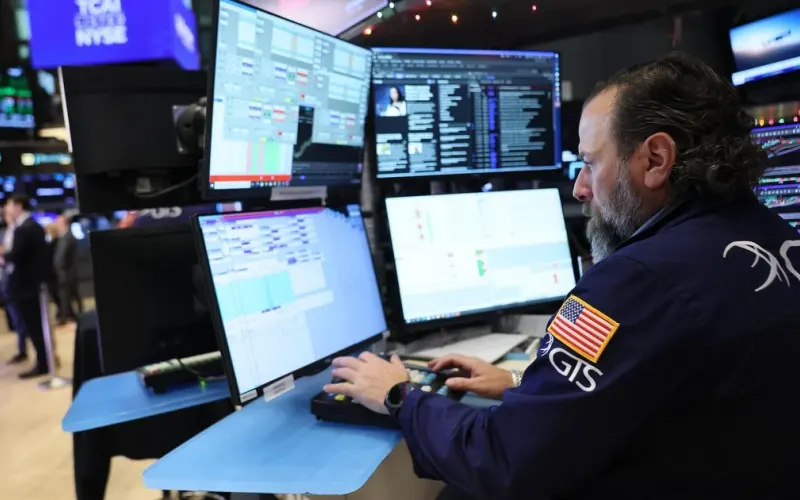
Over several sessions the major indices fell hard, with the Dow, S&P 500, Nasdaq and Russell each dropping more than 2% on some days. By Friday, November 20, the pain had become unmistakable.
CBS reported that the tech-heavy Nasdaq tumbled more than 1,200 points on the day. Fortune put the S&P 500's Friday close at 6,918.45, down 3.59%, for a seventh straight loss. CNN said the index shed $5.6 trillion in market value over the week. Yahoo Finance said Nvidia plunged 14% on Friday and the Nasdaq Composite lost 5.3%, though its headline also cites a 48% figure for Nvidia that the summary does not explain.
Both the Dow and the S&P 500 confirmed corrections, meaning a fall of 10% or more from the peak, while the Nasdaq reversed all its gains for the year, according to CNBC. Some of the day's moves differ slightly between outlets, with The Age and BigGo Finance putting the S&P 500's fall at about 3.7%.
The damage spread overseas. CNBC reported that Taiwan's Taiex plunged 6.2% on Friday and 18% on the week, its worst since 1991. BigGo Finance put the weekly drop at 17.5%. Taiwan's financial regulator banned all short selling of local stocks below the previous day's close, The Next Web said, citing Bloomberg.
On Sunday, November 22, South Korea's finance ministry held an emergency meeting and said it would ready its market stabilization fund, according to MLQ.ai. BigGo Finance reported that the fund was being used for the first time in 18 years, deploying roughly $8.0 billion. CNBC said regulators in China, South Korea and Taiwan all stepped in, with measures including lower margin requirements for leveraged buying.
Where it stands
Early Monday brought a partial rebound in the US and no relief in Asia. Fortune reported that Dow futures jumped 798 points, or 1.66%, and Nasdaq futures rose nearly 3%. Business Line said Nasdaq 100 futures bounced nearly 3% and S&P 500 futures rose 2%.
Asia told a different story. Al Jazeera reported the Kospi fell more than 3 percent, and Business Line said South Korean shares dropped about 4% to a 10-month low before finding support. Bloomberg wrote that sentiment toward the AI trade remains fragile even after support measures and signs of US stabilization.
Taiwan's leveraged investors are part of the problem. Bloomberg Markets reported the biggest unwind of leveraged bets in at least three decades on Friday, which helps explain why official efforts are having limited effect.
What to watch
The first test is whether the futures bounce holds once US trading opens, or whether the "Black Monday" fears The Financial Express raised prove overblown. Analysts are already split. CNBC host Jim Cramer said the selloff is not a repeat of 2000, according to a report on his comments, while Goldman Sachs, via Fortune, has said the AI unwind has become more dangerous and is watching for signs of a bottom.
In Asia, watch whether the stabilization fund and margin cuts steady Seoul and Taipei. Taiwan's premier, Cho Jung-tai, is due to meet finance and tech leaders on November 23, BigGo Finance reported, as officials try to shore up confidence.
More in Business
All →
Anthropic Prices Record IPO at $83 Amid Sell-Off in AI Shares
The listing valued the AI company near $1.5 trillion, but shares slid below their first-day close as the Nasdaq fell.
145 sources · over 7 days
Leaked Deutsche Bank files show $582 million in suspicious Epstein payments
A leak of more than 15 million internal documents has drawn new scrutiny to the bank's dealings with Russian oligarchs, Epstein and Donald Trump.
46 sources · over 6 days
Missouri judge approves Bayer's $7.25 billion Roundup cancer settlement covering current and future claims
The ruling could end tens of thousands of lawsuits over Roundup and non-Hodgkin lymphoma, giving Bayer a way to cap legal costs that have run to billions.
23 sources · over 3 days