
US Tech Stock Rout Spreads Globally Before Modest Friday Rebound
Democrats' midterm victories triggered fears of restrictions on AI data centres, wiping trillions from stocks before a partial recovery that left major indexes down for the week.
By Hushread Stories, from 57 outlets · First published 7 Nov 2026 · Chapter 2 of 2
Earlier: Nasdaq tumbles 5% as chip stocks slide after US midterms
In brief
- Investors sold technology shares after Democratic midterm victories raised fears of tighter rules for AI and data centres.
- The Nasdaq lost about $2.5 trillion in market value on Thursday as investors rushed to sell technology stocks.
- Selling spread to Asia and Europe on Friday, with South Korea briefly halting trading after steep losses.
- US stocks rebounded on Friday, including major chipmakers, but the recovery left major indexes lower for the week.
- The outlook hinges partly on whether political opposition translates into restrictions that delay planned US data centre expansion.

Timeline · 5 moments
Investors turn to bonds amid global stock losses
Global News ↗European shares fall as global AI selloff spreads
Deutsche Welle ↗Japan's Nikkei records fifth consecutive daily decline
産経ニュース ↗South Korean plunge triggers temporary stock trading halt
DIE ZEIT | Nachrichten, News, Hintergründe und Debatten ↗Nasdaq loses $2.5 trillion as AI construction fears intensify
cnn.com ↗How it started
The selloff began with a political shock to the AI investment boom. Democrats' sweeping US midterm victories prompted investors to fear that Washington and state governments would impose tougher restrictions on artificial intelligence and data centres, according to NPR News.
The immediate concern was infrastructure spending. Investors questioned whether political opposition could slow the construction of data centres that support AI development, Business Line reported. The coverage describes a market reaction to possible policy changes, rather than an announced nationwide crackdown.
The exposure extended beyond technology companies. Chipmakers, cloud providers and power companies had helped drive much of the year's stock market gains before investors pulled back, according to The Next Web.
How it unfolded
On November 5, investors wiped about $2.5 trillion from the value of the tech-heavy Nasdaq as fears about the AI buildout intensified, CNN reported. NPR News put the Nasdaq's decline at more than 5%.
It was not an isolated day of weakness. The selloff marked the second consecutive day of selling in AI stocks and the Nasdaq Composite's fifth decline of more than 500 points since mid-October, according to The Japan Times.
By November 6, the losses had spread across Asia. South Korea's benchmark fell more than 8%, and trading in Seoul was halted for 20 minutes, DIE ZEIT reported. Japan's Nikkei closed at 57,434.77, down 3,643.13 points, recording its fifth consecutive daily decline, according to 産経ニュース.
European shares also fell on November 6 as investors reassessed AI spending prospects after the Democratic election victory, Deutsche Welle reported. Investors sought safety in bonds while stocks continued falling in Europe and Asia, according to Global News.
Later on November 6, US technology shares began recovering. The Nasdaq opened higher, the BBC reported, while Nvidia, AMD and other chip stocks rebounded, according to MarketWatch.
Where it stands
Friday's recovery did not erase the damage. The Nasdaq and S&P 500 rose on November 6, but major indexes still recorded weekly losses, according to Investopedia. The Financial Times described the rebound as tepid compared with historic recoveries after severe selloffs.
Reported loss estimates differ in scope. CNN reported about $2.5 trillion erased from the Nasdaq on Thursday, while Euronews reported a record $2.9 trillion loss among S&P 500 companies that day. Those figures cover different groups of stocks and should not be added together.
Company executives were more upbeat than the market reaction suggested. Executives at OpenAI, Arm and Qualcomm largely projected optimism about continued AI growth, according to CNBC Technology. Analysts nevertheless warned of further volatility, MarketWatch reported.
What to watch
The central question is whether election results produce restrictions that materially delay data centre construction. UBS analysts estimated that around 30% of expected US data centre capacity additions in 2028 could be at risk, according to NDTV. That is a risk estimate, not a tally of cancelled projects.
The next test for markets is whether the recovery holds as investors reassess those expansion plans. Friday's gains left weekly losses intact, according to Investopedia, while MarketWatch reported warnings that volatility could continue.
More in Business
All →
Berkshire Hathaway Raises Buybacks to Record $9.6 Billion as Earnings Fall
Berkshire's third-quarter results pair weaker operating earnings with record share repurchases, showing how new chief executive Greg Abel is deploying some of the conglomerate's enormous cash reserves.
8 sources · today
Karnataka Reports Ethanol Above E20 Limit in Petrol, Seeks Centre's Explanation
Karnataka says petrol samples contained up to 31.2% ethanol, above the 20% limit, prompting demands for a Union government explanation and relief for consumers.
13 sources · over 2 days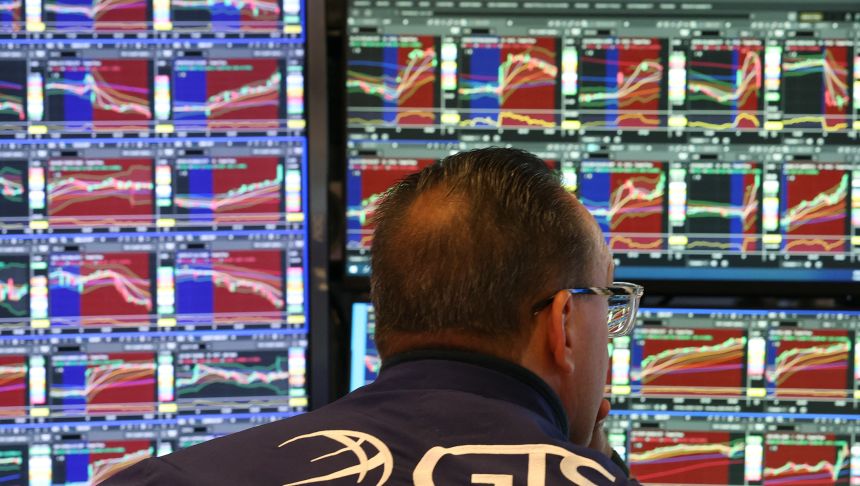
Anthropic Pushes Ahead With IPO as Investors Challenge $1.5 Trillion Valuation
Anthropic intends to list before Thanksgiving, but a sharp technology selloff and investor concerns about AI are putting pressure on its valuation and timetable.
21 sources · over 4 days