
Disclosure: Hushread is my app. I’ve tried to be fair, and I say where the others are the better choice.
Full text RSS feeds from major news sites are rare: seven of the 40 feeds I measured on October 17, 2026 carry the whole article, from Fox News, Politico, The Atlantic, Vox, Axios, ProPublica and MIT Technology Review. Five more give you the first few paragraphs (The Guardian, Ars Technica, The Verge, 404 Media, Semafor). The other 24 working feeds, including BBC, The New York Times, NBC, CBS, Al Jazeera, Wired and TechCrunch, send a headline and one sentence, so your reader shows a stub and you tap through to the website for every story. Three feeds people still recommend are dead or blocked: CNN’s main feed stopped in April 2023, The Washington Post’s feeds answered with a server error on every try, and The Economist refuses feed readers outright.
That gap matters more than any reader feature. A feed that carries the article lets you read offline, search old items, listen to them, and skip the site’s cookie wall and ads. A feed that carries one line is a list of links. Below is what each outlet actually sends, measured, and what to do when the feed you want is a stub.
How I measured it
I fetched each feed once, took every item in it (10 to 255 items depending on the outlet) and measured the text left in description and content:encoded after stripping HTML. The table shows the median per item, so one long piece does not flatter a feed of stubs. I counted a feed as full text when the median body is over 1,500 characters (about 250 words, which in practice meant whole articles of 4,000 to 12,000 characters), partial when it is between 400 and 1,500, and a stub below that. I also checked whether items carry an image (a media:content, media:thumbnail or enclosure tag), since a reader can only show a picture the feed includes.
The numbers are from one fetch on one day. Feeds change, and some outlets vary the body by section, so treat the groups as the finding and the exact character counts as a snapshot.
The feeds that carry the full article
Measured on October 17, 2026. “Body” is the median characters of article text per item.
| Outlet | Feed | Body | Images |
|---|---|---|---|
| ProPublica | propublica.org/feeds/propublica/main | 11,700 | yes |
| Vox | vox.com/rss/index.xml | 9,200 | yes |
| The Atlantic | theatlantic.com/feed/all | 7,000 | yes |
| MIT Technology Review | technologyreview.com/feed | 6,300 | some |
| Fox News | moxie.foxnews.com/google-publisher/latest.xml | 4,900 | yes |
| Politico | rss.politico.com/politics-news.xml | 4,200 | yes |
| Axios | api.axios.com/feed | 3,200 | yes |
The Atlantic’s feed is a good example of what full text looks like. Open it in a browser and the article is there, paragraph by paragraph, with the author and the time:
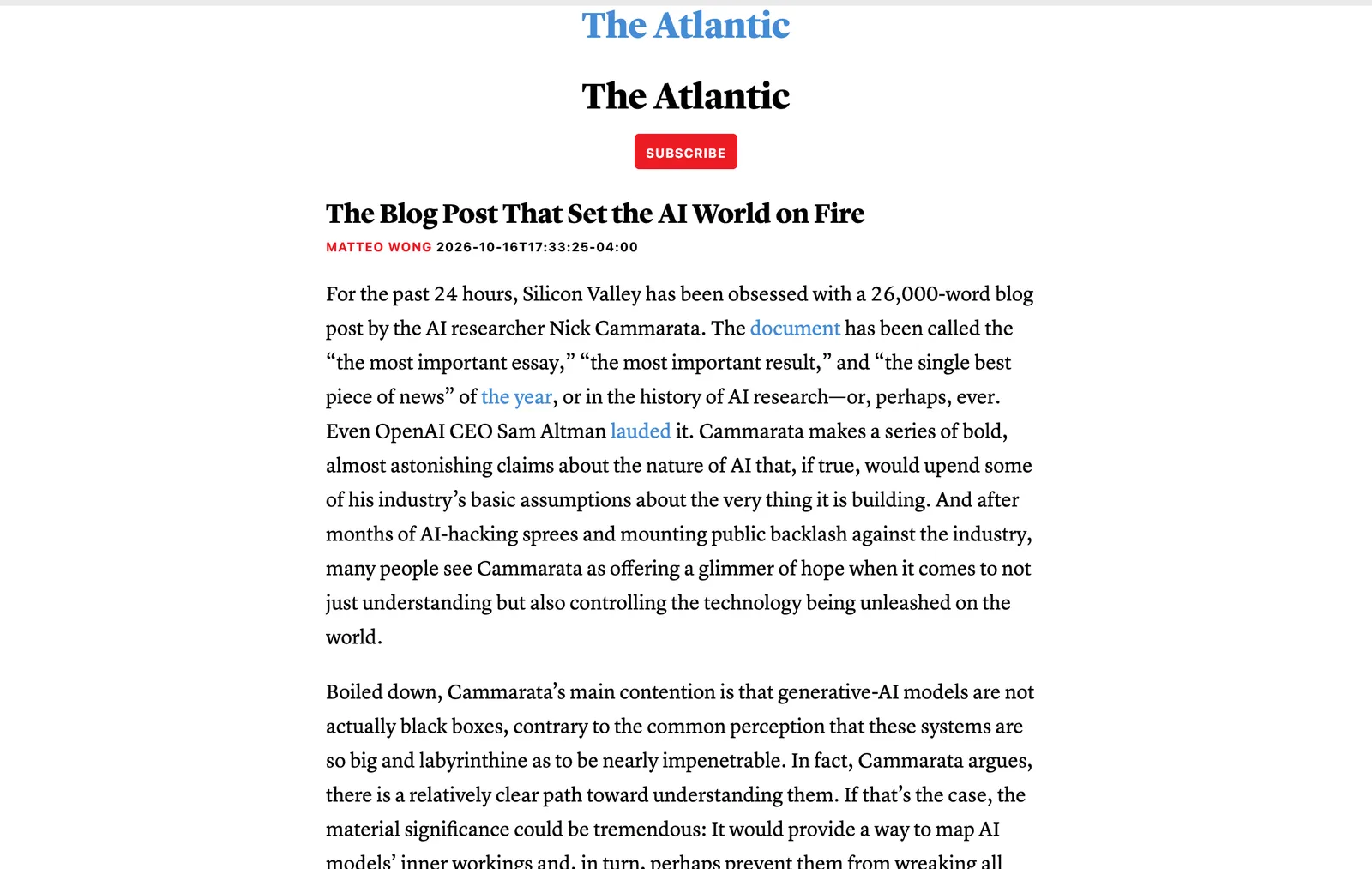 The Atlantic’s main feed rendered in Chrome, 17 October 2026. Source: theatlantic.com
Fox News is the odd one out in the group. The feeds listed on its RSS page send stubs; the feeds under moxie.foxnews.com/google-publisher/ carry the whole article, and they work in any reader. ProPublica’s feed is the longest of the lot, because its stories are long and it sends every word. Axios puts the full item in description as well as content:encoded, so it reads fully even in readers that ignore the second field.
The feeds that give you the first few paragraphs
| Outlet | Feed | Body | Images |
|---|---|---|---|
| 404 Media | 404media.co/rss | 1,400 | yes |
| Ars Technica | feeds.arstechnica.com/arstechnica/index | 1,200 | yes |
| Semafor | semafor.com/rss.xml | 900 | yes |
| The Guardian | theguardian.com/world/rss | 900 | yes |
| The Verge | theverge.com/rss/index.xml | 700 | yes |
Ars Technica sends the opening of each story and then a “Read full article” line. The Guardian sends two to four paragraphs in description, enough to know whether a story is worth opening. The Verge’s items vary a lot: short posts arrive whole, long features arrive cut. 404 Media sends the first few paragraphs.
The feeds that send a headline and one line
These feeds work and update, but every item is a title plus a sentence of 80 to 370 characters. You read the story on the website or not at all.
BBC’s feed is typical of the group. Each item is a title, one sentence and a link, plus a 240-pixel thumbnail:
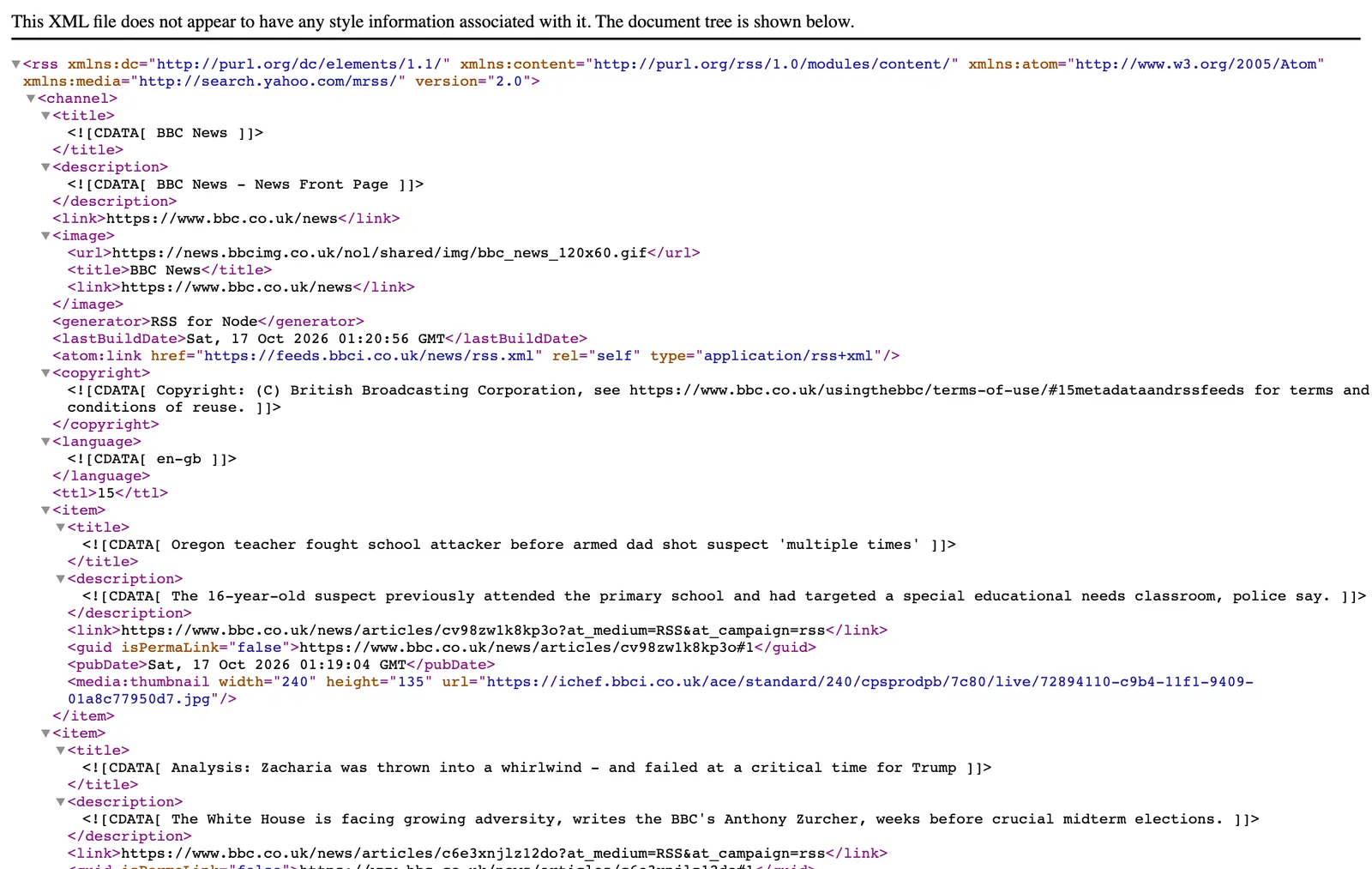 The BBC News front page feed as a browser shows it, 17 October 2026. Source: feeds.bbci.co.uk
Indian Express sends no description at all, just titles, 200 of them. Hacker News’s feed is links to other sites by design. Reuters and the Associated Press have no public feeds of their own; the usual workaround is a Google News search feed for site:reuters.com or site:apnews.com, which gives you Google’s one-line snippet and nothing else. Both still update every few minutes and are the only free way to follow either wire in a reader. More feed URLs for these outlets, by section, are in the best RSS feeds for news.
Dead, frozen or blocked
CNN. rss.cnn.com/rss/edition.rss still answers with 50 items, which is why it survives on every list of news feeds. The newest of those items is dated April 5, 2023. The feed has not changed in two and a half years, and cnn.com/services/rss, the page that used to list CNN’s feeds, now redirects to the home page.
The Washington Post. feeds.washingtonpost.com/rss/world and /rss/politics returned a 502 error on every try on October 17, with a browser’s user agent and a feed reader’s. The feeds may come back; if your reader shows them as failing, that is why.
The Economist. Its feed URLs at economist.com return a 403 page to any feed reader. Subscribers have a feed through their account; there is no public one.
What to do when the feed is a stub
Most of the big names are in the stub group, so this is the normal case, and there are three ways round it.
Let the reader fetch the article. Some readers follow the link in each item, pull the page and extract the article text, so a stub feed reads like a full-text one. Hushread does this for every source on every plan: when the feed carries one line, it fetches the page, keeps the article body and the images, and shows that in the app without the ads or page clutter, so BBC or The New York Times read the same as ProPublica. Inoreader lists the same thing as a feature, “read the whole article when a feed sends only a snippet”, on its features page. Where a site blocks automated fetching, as Bloomberg does, no reader can get past that and you get the stub either way.
Use a full-text proxy. FiveFilters Full-Text RSS takes a feed URL and returns the same feed with the article bodies filled in, from a hosted service or your own server. It works with any reader, including ones with no fetching of their own. The site’s own terms decide whether that is allowed; some publishers block it.
Pick the outlet’s fuller feed. A few publishers run more than one feed with different bodies. Fox News is the clear case above, and Axios fills both fields. Checking the outlet’s own feeds page before settling for the main feed takes a minute: how to find the RSS feed of a website covers where to look.
Why so many outlets send stubs
A feed with the whole article is a page view the site never gets. Ads, subscriptions and analytics all live on the article page, so most newsrooms send enough to make you click and no more. That logic is not changing, so a reader that fetches the page for you is the practical answer for the stub group, and the list above tells you which feeds need it.
FAQ
Which RSS feeds have the full article?
Of the 40 news feeds measured here, seven: ProPublica, Vox, The Atlantic, MIT Technology Review, Fox News (the google-publisher feeds), Politico and Axios. Their items run from about 3,000 to 12,000 characters of article text. Five more send the first few paragraphs: 404 Media, Ars Technica, Semafor, The Guardian and The Verge.
Why does my RSS feed only show a summary?
Because that is all the publisher put in the feed. BBC, The New York Times, NBC, CBS, Al Jazeera, Wired, TechCrunch and most other big outlets send a title and one sentence per item, so every reader shows the same stub. The fix is a reader that fetches the article page itself, or a full-text proxy such as FiveFilters.
How do I get full text from an RSS feed that only sends a snippet?
Use a reader that pulls the article from the link, or run the feed through a full-text proxy that returns the same feed with the bodies filled in. Hushread fetches the page for every source on every plan, and Inoreader lists the same feature. Sites that block automated fetching, Bloomberg for one, stay stubs in any reader.
Is the CNN RSS feed still working?
No. rss.cnn.com/rss/edition.rss still answers with 50 items, but the newest is from April 5, 2023, and CNN’s RSS page now redirects to its home page.
If you want the big outlets in one place without the tapping through, Hushread fetches the article for every source you add, free for up to 5 sources.