
Disclosure: Hushread is my app. I’ve tried to be fair, and I say where the others are the better choice.
The news aggregator meaning is simple: an app or website that collects stories from many news outlets and shows them in one place, without reporting the news itself. Google News, Apple News, MSN, Techmeme, Hacker News and every RSS reader fit that definition. What separates them, and what decides whether one suits you, comes down to two questions: who picks the stories you see, and where you end up reading them.
Dictionary entries stop at the first sentence. The useful part is that each company says, on its own pages, how its aggregator chooses. Google is the bluntest about it: “Computer algorithms determine which stories show up on Google News and in what order” (Google News Help).
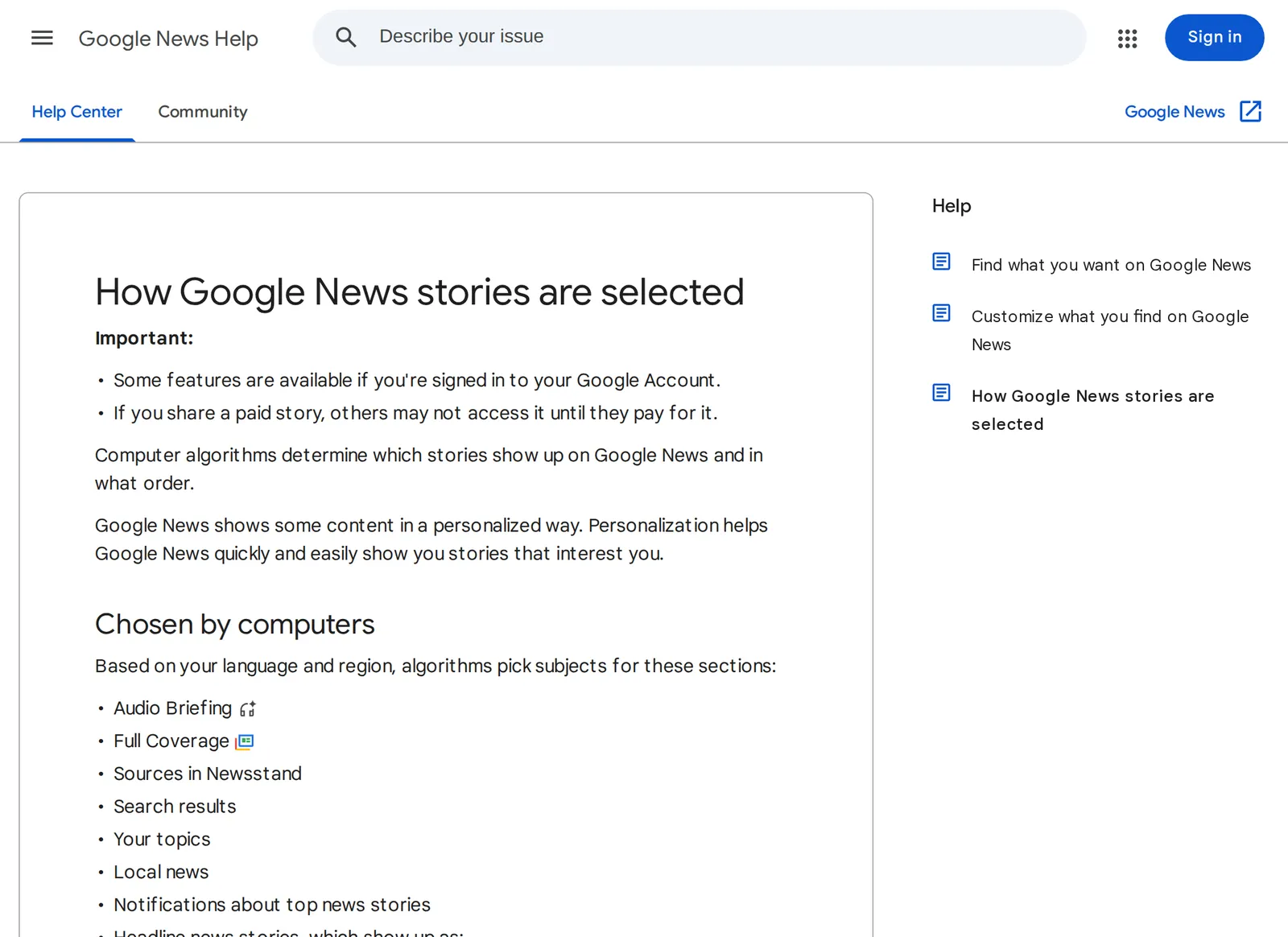 Google’s own explanation of how Google News picks stories, 15 November 2026. Source: support.google.com
Who picks the stories: four answers
Almost every news aggregator uses one of four selectors, or a mix of them.
Algorithms
Google News is the clearest case. Under the heading “Chosen by computers”, its help page lists sections such as Headlines, Full Coverage, Local news and search results, where algorithms pick subjects from your language and region, so “people who use the same language and region get news for the same subjects.” Other sections, including “For you” and Following, are personalised, drawing partly on your activity on Google services and YouTube. A second help page adds that Full Coverage “has no personalization other than your language, region, and subscriptions” (Google News Help).
No person at Google is choosing your top story. That’s the point of the design and its weak spot: you see what the system predicts you’ll click.
Editors
Apple News is a hybrid that leads with people. Apple’s page says “Experienced Apple News editors curate the day’s top stories from trusted sources, and advanced algorithms help you discover stories you’ll find interesting”, and its plan table describes Top Stories as “chosen by editors, personalized for you” (Apple).
Techmeme, the tech news site, describes the same mix more precisely. It calls its setup an editorial pyramid: “At the top, editors make final calls on what we feature, and write descriptive, straightforward headlines for that news.” Below them sit filtering tools that “automatically re-sort our front page”, and under both its crawling technology (Techmeme).
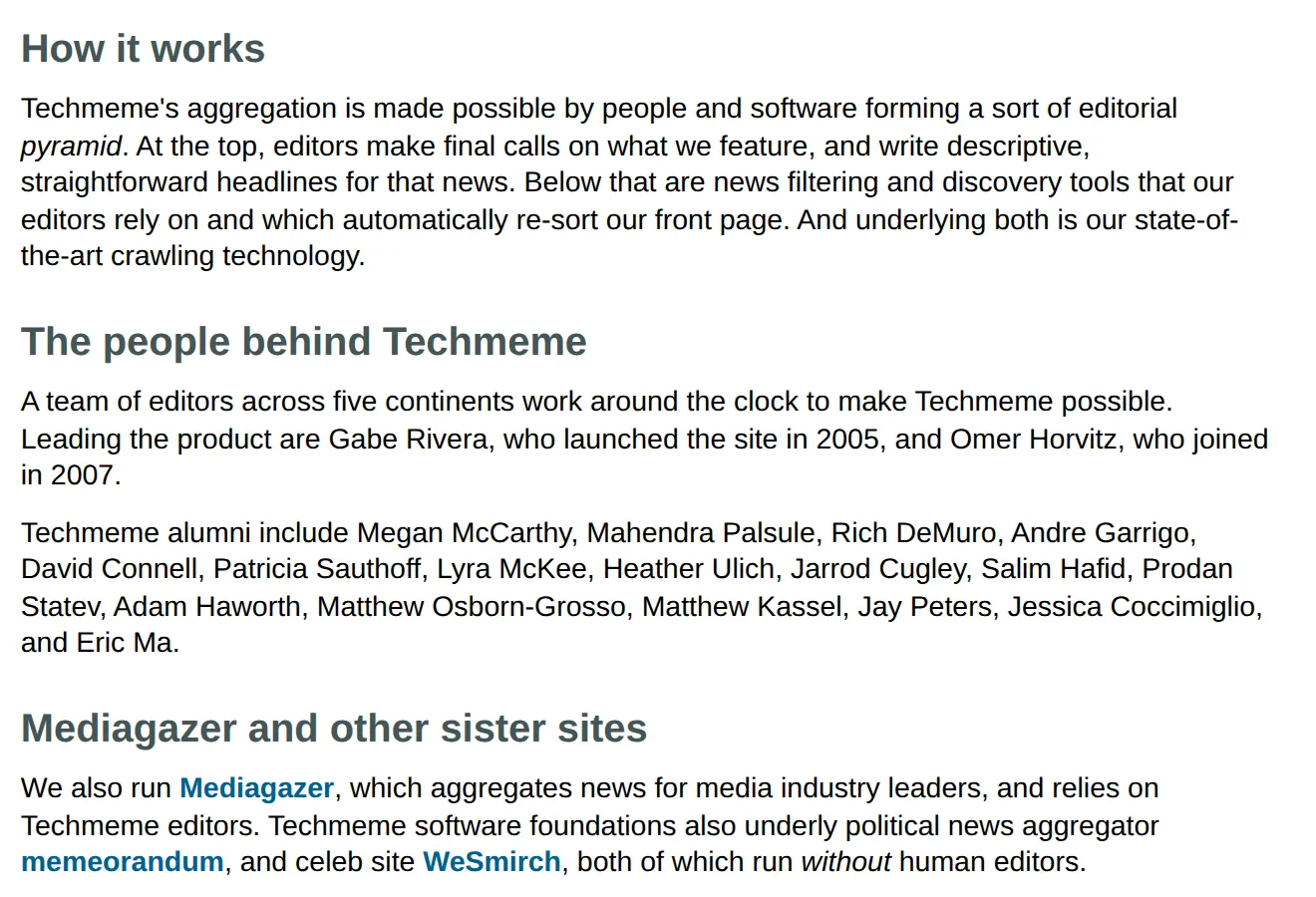 Techmeme’s description of how it picks stories, 15 November 2026. Source: techmeme.com
The same page shows how thin the line is. Techmeme’s software also underpins memeorandum, a political news aggregator, and WeSmirch, a celebrity site, “both of which run without human editors”. Same machinery, with or without a person on top.
Votes
Hacker News lets readers decide. Its FAQ says “The basic algorithm divides points by a power of the time since a story was submitted”, and lists user flags, anti-abuse software, software that demotes overheated discussions, account or site weighting and moderator action as the other factors (Hacker News FAQ). Upvotes push a story up, age pulls it down.
You
An RSS reader is an aggregator where you name every source. It reads the feeds that sites publish (the guide to RSS covers how) and shows what arrives. NetNewsWire, a free and open source reader for Mac, iPhone and iPad, pitches itself as the way to get news from your favourite sites instead of “relying on big tech social media and their algorithms” (NetNewsWire).
Hushread works the same way, with one difference that matters for news. You add the outlets, and the feed shows every article from them newest first, nothing ranked or injected (Hushread docs). When several of your outlets cover one event, the copies fold into a single card with an Also mentioned in line, so you get the breadth of a big aggregator without reading the same headline five times (Hushread docs).
The catch with this kind is plain: it shows nothing you didn’t ask for. If you want to be surprised by stories outside your sources, one of the other three suits you better.
Where you read the article: link out or hosted copy
The second question is what happens when you tap, and it decides whose page, ads and paywall you meet.
Google News sends you away. Google told publishers it “will no longer directly render article text provided in RSS and Atom feeds in the Google News app. Instead, we’ll send readers directly to publishers’ web pages” (Google Publisher Center Help). You land on the outlet’s own site, with its ads and its paywall.
MSN keeps you. Its partner help says “MSN Partners receive a share of advertising revenue from ads that appear alongside their full-length content” (Microsoft support). In practice a partner’s story usually opens as an msn.com page with MSN’s ads beside it, and the Google News vs MSN comparison shows both kinds of page side by side.
Apple News works more like MSN. Publishers can send articles in Apple News Format, which Apple lays out for iPhone, iPad and Mac, and its publisher page says they keep “100% of the revenue generated from ads you sell, and 70% from ads sold by Apple” (Apple Developer).
Neither model is better in itself. A hosted copy loads fast and looks consistent; a link out gives the publisher its own page and you the full site, paywall included.
News aggregator examples
Who picks the stories at each well-known aggregator, in its own words (pages read on 15 November 2026):
| Aggregator | Who picks the stories | Kind |
|---|---|---|
| Google News | Algorithms, some sections personalised | Algorithmic |
| Apple News | Editors for top stories, algorithms for discovery | Editors plus algorithm |
| MSN | Editors for important news, personalised by usage | Editors plus algorithm |
| Techmeme | Editors on top of filtering software | Editors plus algorithm |
| Hacker News | Reader votes, decayed by age, plus moderators | Community votes |
| Ground News | Merges each event’s coverage, shows the outlet split | Coverage comparison |
| RSS readers (NetNewsWire, Hushread) | You, by choosing sources | Your own feeds |
MSN is the hybrid people tend to miss. Its FAQ says “news deemed important by our editors will still display prominently”, uses “usage frequency and articles viewed” to tailor the rest, and says a partner’s work “usually is not changed or altered in any way by our content teams or algorithms” (Microsoft support).
Ground News is a fifth kind worth knowing. It says “Articles from different outlets covering the same event are merged into a single story” and that it processes “nearly 60,000 news articles from over 50,000 different news sources” a day (Ground News).
How to tell which kind an app is
Four checks answer it in a minute, for any news app:
- Can you add a source by its web address? If yes, you’re the one choosing, at least in part. If you can only follow topics or “see more like this”, an algorithm decides.
- Is the order newest first? A feed sorted strictly by time isn’t ranking you. A “For you” or “Top stories” section always is.
- Does the help page name editors? Apple, Techmeme and MSN all do. If the company’s own explanation says algorithms and nothing else, take it at its word.
- Where does a tap land? The publisher’s address in the browser bar means a link-out aggregator. A page inside the app, with the aggregator’s ads around it, means a hosted copy.
If the answers are “no, no, no and inside the app”, the app decides almost everything you read. That suits plenty of people. If it doesn’t suit you, the list of news apps without an algorithm is the next stop.
FAQ
What is a news aggregator?
A news aggregator is an app or website that gathers stories from many news outlets into one feed, without producing the reporting itself. Google News, Apple News, MSN, Techmeme and RSS readers are all news aggregators.
How do news aggregators work?
They collect articles from publishers, usually through feeds or crawlers, then decide what to show using algorithms, editors, reader votes or the sources you picked. Some send you to the publisher’s site when you tap, and others, like MSN and Apple News, show a hosted copy of the article.
What are some news aggregator examples?
Google News (algorithmic), Apple News (editors plus algorithms), MSN (editors plus personalisation), Techmeme (editors on top of software), Hacker News (reader votes), Ground News (coverage comparison) and RSS readers such as NetNewsWire or Hushread (you choose the sources).
Is an RSS reader a news aggregator?
Yes. An RSS reader is a news aggregator where you choose every source yourself, so nothing reaches your list unless you subscribed to the site it came from.
Is Google News a news aggregator?
Yes. Google says computer algorithms decide which stories appear on Google News and in what order, and tapping a story sends you to the publisher’s own web page.
If you’re happy letting an editor or an algorithm decide, Google News and Apple News do that job well, and there’s no reason to switch. If you want to choose every outlet and see their stories in order, an RSS reader is the kind to try, and Hushread is one that groups repeated coverage of the same event as it goes.