
AI stock rout drives US correction as Taiwan and South Korea step in
A sharp sell-off in AI and tech shares pushed US indexes into correction and sent Asian regulators scrambling, before a one-day rebound faded on Tuesday.
By Hushread Stories, from 42 outlets · First published 24 Nov 2026 · Chapter 2 of 4
Earlier: US Stocks Rebound Sharply as Chinese Shares Hit 16-Month Low on Chip Curbs
In brief
- The Dow and S&P 500 joined the Nasdaq in correction territory as AI stocks fell, with the Dow down about 8% on the week.
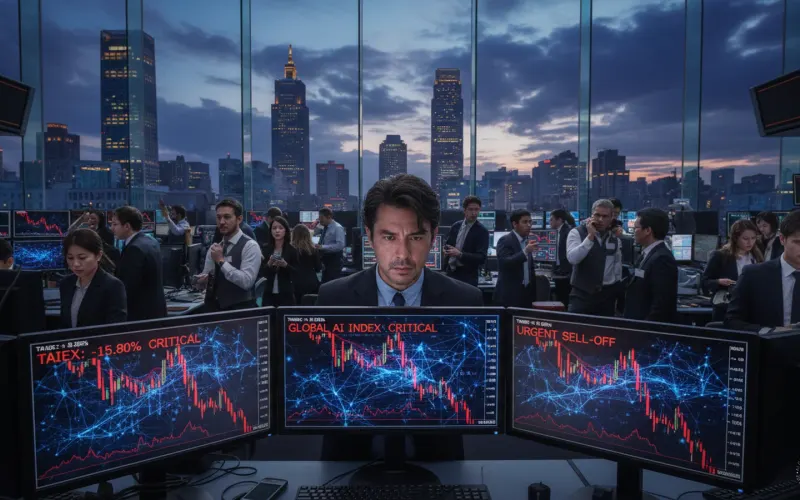
- Taiwan's Taiex lost 17.5% in a week, its worst since 1991, prompting a short-selling ban and a stock-lending freeze.
- South Korea readied a market stabilization fund unused since the Lehman crisis, while China and Taiwan eased margin requirements.
- Stocks rebounded sharply on Monday, November 23, led by Nvidia after Jensen Huang's return to the company.
- US stocks reversed lower on Tuesday as Nvidia gave back its jump and Anthropic slipped below its IPO price, though the Dow closed back above 50,000.
Timeline · 12 moments
Asian stocks slide as AI trade doubts resurface again
Bloomberg ↗Dow closes above 50,000 as Nvidia and Nasdaq retreat
MarketWatch.com - MarketWatch Breaking News Bulletins ↗Nvidia reverses 31% jump; Anthropic slips below IPO price
The Financial Express ↗Nasdaq 100 tumbles as Nvidia rally fades
Bloomberg ↗Stocks post best Monday since 2020 on Nvidia surge
Yahoo Finance Business & Economy ↗Chinese stocks hit 16-month low on chip curbs
All Articles ↗Kospi falls to 10-month low before finding support
Business Line - Home ↗China, Korea, Taiwan regulators announce rescue measures
CNBC ↗US futures bounce as Asia scrambles to slow rout
Reuters ↗South Korea readies stabilization fund after emergency meeting
MLQ.ai | AI News, Analysis & Data ↗Update 25 Nov 2026, 2:09 am UTC
Wall Street reversed course on Tuesday, November 24, after Monday's rebound. Bloomberg reported that Asian stocks slid as doubts about the AI trade returned, and Economic Times said the Nasdaq and S&P 500 closed lower as investors weighed Jensen Huang's return to Nvidia and possible new tariffs. MarketWatch noted the Dow closed back above 50,000 even as the Nasdaq and S&P 500 retreated, so the rout has narrowed rather than ended.
How it started
The trigger was a growing doubt about whether the AI boom can pay for itself. The Financial Express described investors questioning whether massive infrastructure spending can generate adequate returns, and Bloomberg pointed to an unwinding of the AI trade.
By Friday, November 20, the damage had reached the broad US market. The Age reported that the S&P 500 fell 3.7 per cent, its worst weekly loss in more than 18 months, and pushed the Nasdaq composite into the red for the year.
The weight of a few giant stocks made it worse. Bloomberg Markets said the unwind wiped more than $5 trillion from the S&P 500 in a week, exposing how much of the market rests on its biggest names.
How it unfolded
Fortune reported that the Dow Jones Industrial Average and the S&P 500 joined the Nasdaq in correction territory as AI stocks plunged further. Fast Company put the weekly losses at 8% for the Dow and 8.6% for the S&P 500.
Asia took the hardest hit. CNBC reported that Taiwan's Taiex plunged 6.2% on Friday, taking its weekly loss to 18%, the worst since 1991. BigGo Finance gave the weekly figure as 17.5%, a fall of more than 7,000 points. Over the weekend, The Next Web said Taiwan's financial regulator banned all short selling of local stocks below the previous day's closing price, citing Bloomberg. ZeroHedge added a stock-lending freeze and a $15 billion rescue fund, and Bloomberg said Taiwan was also weighing lower margin requirements.
South Korea held an emergency meeting on Sunday, November 22. According to MLQ.ai, its finance ministry said the securities market stabilization fund would be ready to activate immediately depending on market conditions. CNBC reported that China, Korea and Taiwan regulators all stepped in, with measures including lower margins for leveraged stock purchases and the reintroduction of a stabilization fund.
Monday brought a swing the other way. Business Line reported that Nasdaq 100 futures bounced nearly 3% early, while South Korean shares fell about 4% to a 10-month low before finding support. By the close, Yahoo Finance said stocks had their best Monday since 2020, and Fast Company said Nvidia led the rebound.
Not every market followed. All Articles reported that Chinese stocks hit a 16-month low on Monday after the US announced new restrictions on advanced AI chips.
Where it stands
The relief did not last. The Financial Express reported that US stocks opened lower on Tuesday, November 24, as Nvidia reversed its 31% jump and Anthropic slipped below its IPO price. Bloomberg said the Nasdaq 100 plunged, led by chipmakers, and that plans for new US tariffs also weighed on sentiment.
The New York Times said markets have veered wildly for days, pushed and pulled by the drama at Nvidia and the record-breaking trading debut of Anthropic.
Analysts are split. Faisal Islam at the BBC argued that fears over the AI boom had not gone away and that Huang's return would not fix them. BigGo Finance described Wall Street as divided between calling this a correction and worrying about a bubble.
What to watch
Economic Times noted that investors are awaiting key inflation data later this week for clues on the Federal Reserve's next move.
The other open questions are whether the Asian support measures hold if selling resumes, and how earnings estimates for AI-linked companies are revised. BigGo Finance said investors see stabilizing downward revisions as the signal of a bottom.
More in Business
All →
US Proposes Tariffs of Up to 25 Percent on 14 Trading Partners Including China and India
Country-specific duties follow a Section 301 overcapacity probe, with India's rate dropping to 17 percent if a trade deal is signed.
84 sources · over 2 days
Amazon plans to sell new and used cars online in the UK from early 2027
Amazon is taking its car-selling service outside the US for the first time, starting in Britain with Hyundai on board and reservations from £99, a test of online car retail.
16 sources · over 2 days
Nvidia Reinstates Jensen Huang Eleven Days After His Resignation, Amid Trump Role and Probes
Nvidia's board brought back its co-founder after an affair scandal with espionage questions, and critics say the speed and White House involvement raise doubts about governance while investigations continue.
164 sources · over 11 days