
Hera spacecraft reveals stadium-sized crater left by NASA's DART asteroid impact
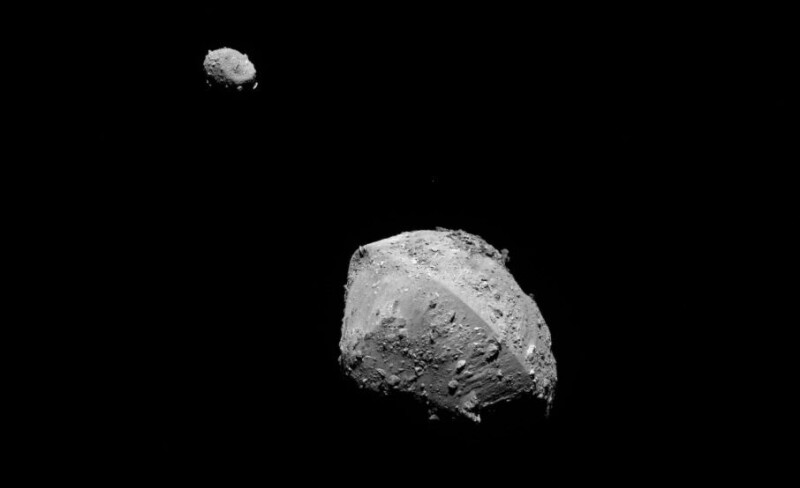
Four years after NASA rammed a probe into Dimorphos, Europe's Hera spacecraft has sent back the first close-up images of the damage, data that could shape future planetary defence designs.
By Hushread Stories, from 27 outlets · First published 25 Nov 2026
In brief
- The European Space Agency's Hera probe has released its first close-up images of Dimorphos, the asteroid NASA struck with DART in 2022.
- The images show a stadium-sized crater on the roughly 150-metre-wide asteroid, part of the Didymos double asteroid system.
- Hera reached the Didymos system earlier this month after a journey of about two years.
- Coverage describes hundreds of rocks drifting near the surface, pointing to a chaotic impact zone around the crater.
- Hera will approach to within 13 kilometres of Dimorphos next month to collect increasingly detailed images.
Timeline · 6 moments
CNET reports DART did far more damage than anticipated
CNET News Tech ↗Hundreds of rocks seen drifting near the impact zone
Euronews ↗Images show stadium-sized crater on Dimorphos
The Register ↗ESA unveils first close-up images of Dimorphos in live event
Space.com Space ↗BBC flags release of pictures of the impact damage
BBC ↗Hera arrives at the Didymos double asteroid system
Microsiervos ↗Update 26 Nov 2026, 4:03 am UTC
New coverage from 25 and 26 November confirms the core story and adds detail. The Hera images show a crater the size of a stadium on Dimorphos, and Ars Technica describes a chaotic scene with loose rocks around the impact zone. CNET says DART did far more damage than anyone expected. Nothing in the published headline or key points is wrong, so only the timeline and points are updated.
How it started
In 2022, NASA deliberately crashed its DART spacecraft into Dimorphos, a small asteroid orbiting a larger companion called Didymos. The Double Asteroid Redirection Test was a first real-world trial of planetary defence: could a human-made object nudge a space rock off its usual path?
The answer, Euronews noted, was already known in outline. The mission had shifted the orbit of Dimorphos. What nobody had seen up close was the physical damage the impact left behind.
That is the job of Hera, a spacecraft from the European Space Agency. It was built to return to the scene and study what the collision actually did to the asteroid.
How it unfolded
Space.com reported that Hera spent about two years travelling to the Didymos system after launch. According to Microsiervos, the probe reached the binary system formed by Didymos and Dimorphos earlier this month, on the 4th.
On 25 November 2026, ESA released the first close-up views. The BBC had flagged in advance that pictures of the damage would be released later in the day, and Gizmodo and Space.com both ran live-viewing pieces as the unveiling approached.
The headline finding, repeated across outlets, is a stadium-sized crater. The Register and UPI both describe it that way, and Stuff said the mission had left one face of the asteroid flattened. Science Magazine put it as humans having walloped the asteroid and left a stadium-sized crater.
Euronews went further, saying the images show a huge impact zone with hundreds of rocks drifting near the surface, and used the phrase "complete chaos" in its headline. The BBC noted that the target is the 150m-wide (490ft) Dimorphos.
The Guardian framed the pictures as a source of clues for designing a potential planetary defence system, a theme echoed by other outlets that tied the images to the practical question of how to protect Earth.
Where it stands
Hera is in place at the Didymos system and the first images are public. Scientists are now analysing the crater area to learn how the collision reshaped the asteroid and what the debris tells them about its structure.
The images released so far are only a start. ABC News Australia reported that the spacecraft will approach within 13km of the asteroid next month, obtaining increasingly higher-resolution images.
What to watch
The main thing to watch is the closer approach next month. At 13km, Hera should return sharper views of the crater and the surrounding rubble, which may help settle how the impact affected the asteroid's surface and loose debris.
The larger question is what the findings mean for defence. The coverage links the data to the design of any future system for deflecting a dangerous asteroid, but it does not yet say what specific lessons scientists have drawn.
More in Science
All →
China launches Shenzhou-24 with Pakistan's Zeeshan Ali, first foreign astronaut at Tiangong
A Pakistani payload specialist is now in orbit aboard a Chinese spacecraft, the first time a foreign astronaut has flown to China's Tiangong station, marking a new step in China's human spaceflight programme.
39 sources · over 3 days
Anthropic mathematician says Claude helped him prove the Riemann Hypothesis, and Lean groups certify it
A 167-year-old problem may have fallen to an AI-assisted proof that no human can read in full, leaving mathematicians to work out what it means and whether it holds.
68 sources · over 6 days
Voyager 1 Reaches One Light-Day From Earth, a First for Any Human-Made Object
Nearly 49 years after launch, the 1977 probe is now so far away that a radio signal takes a full day to reach it, a distance no spacecraft has matched.
59 sources · over 7 days