
Japan prepares to launch first mission to return Martian moon samples
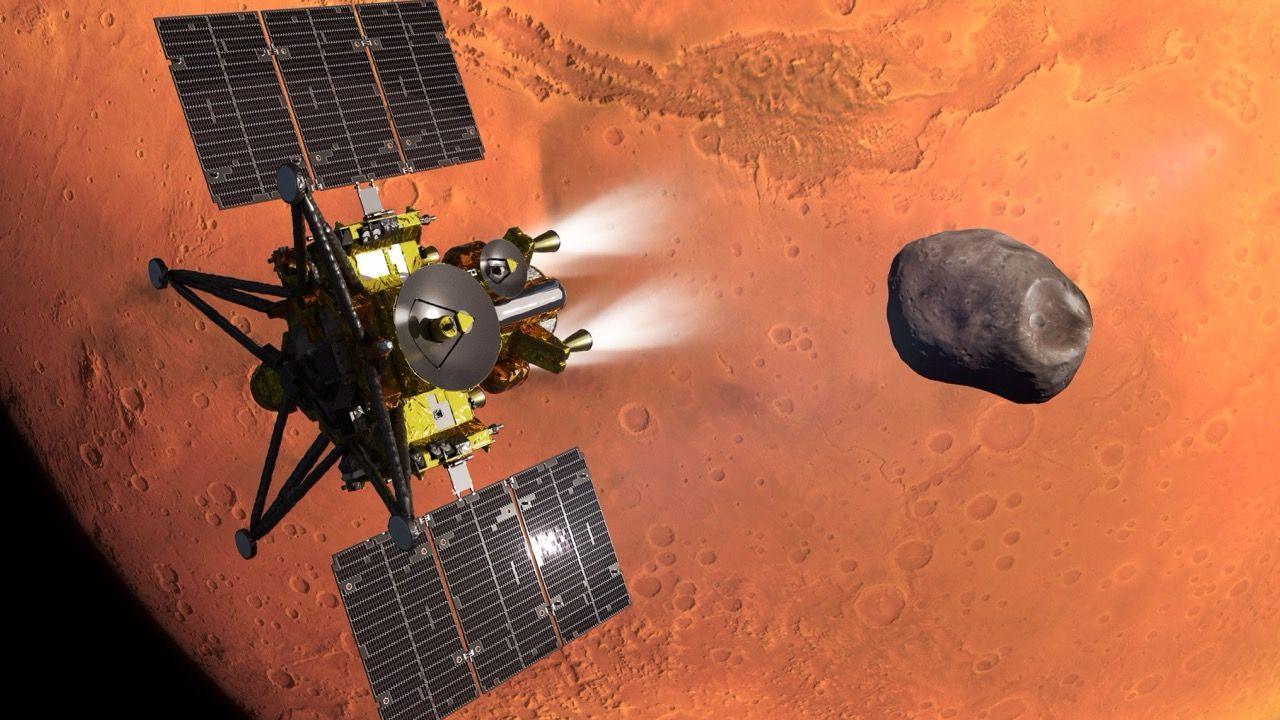
Japan's MMX spacecraft is scheduled to launch on October 20, beginning a planned five-year mission to bring Phobos samples home and investigate how Mars's moons formed.
By Hushread Stories, written with AI from 23 outlets · First published 19 Oct 2026
In brief
- Japan is preparing to launch MMX, the first mission designed to return samples from a Martian moon.
- An H3 rocket is scheduled to carry the spacecraft from Tanegashima Space Center on October 20.
- The spacecraft will enter Martian orbit before attempting to collect soil samples from Phobos, Mars's larger moon.
- The mission aims to return samples to Earth by 2031, roughly five years after launch.
- Scientists hope the samples will help explain how Phobos and the smaller Martian moon Deimos formed.
Timeline · 5 moments
Sample return target remains set for 2031
Times of India ↗Idefix rover highlighted ahead of planned Phobos landing
Franceinfo ↗H3 launch scheduled from Tanegashima for October 20
World News CNA ↗Mission plan puts Martian orbit before Phobos sampling
The Conversation ↗NASA outlines its role in Japan's MMX mission
NASA Breaking News Space ↗How it started
Japan's Martian Moons eXploration mission, known as MMX, is headed for Mars, but its sampling target is not the planet. The spacecraft will focus on Phobos, the larger of Mars's two small moons, according to Phys.org.
The scientific goal is to understand where those moons came from. The Hindu reported that scientists hope the planned five-year mission will provide clues to the formation of both Phobos and its smaller sibling, Deimos. They also hope it could shed light on the origins of life in the solar system.
How preparations unfolded
On October 15, NASA Breaking News Space outlined NASA's involvement in the mission led by the Japan Aerospace Exploration Agency. Its report described the partnership as part of an effort to advance understanding of Mars's moons.
On October 16, The Conversation explained the planned sequence: MMX will enter Martian orbit before attempting to collect samples from Phobos. New Scientist reported the same day that launch was set for October 20.
By October 18, launch reporting had become more specific. World News CNA said an H3 rocket carrying MMX was scheduled to lift off from Tanegashima Space Center on Tuesday, October 20, at 4.41am.
On October 19, Franceinfo highlighted another part of the mission: Idefix, a French-German rover intended to land on Phobos. Meanwhile, Times of India reported that the mission aimed to bring its samples back by 2031.
Where it stands
The supplied coverage describes a mission awaiting launch, not one that has already lifted off. The October 20 launch date and 2031 return target remain the timetable reported by Times of India.
Some headlines describe a Monday launch, while others say Tuesday. The published schedules place the launch on Monday evening in Europe and early Tuesday in Japan: Deutschlandfunk gives October 19 at 21.41 Central European Summer Time, while World News CNA gives October 20 at 4.41am.
What to watch
The immediate milestone is whether the H3 rocket lifts off as scheduled from Tanegashima. Beyond launch, MMX must reach Martian orbit and attempt the Phobos sampling operation described by The Conversation.
The longer test is returning those samples to Earth by 2031. If successful, the material could help answer the questions about the moons' formation outlined by The Hindu, rather than leaving scientists to study them only from afar.
More in Science
All →
Amelia Earhart expedition ends after suspected plane wreckage proves to be trees
Researchers have left Nikumaroro without finding Amelia Earhart's plane, after investigating a satellite image anomaly that raised hopes of solving her 1937 disappearance.
17 sources · over 8 days
Neanderthal Shoulder Wound Points to Possible Wooden Spear Killing in Iraq
A hole in a 75,000-year-old shoulder blade could be early evidence of lethal spear violence, while other injuries suggest the same Neanderthal also experienced care.
8 sources · today
Colossal Announces AI Tool to Advance Efforts to Revive the Dodo
The US biotechnology company says AI has identified genetic targets linked to dodo traits, advancing its research without yet demonstrating that the extinct bird can be recreated.
8 sources · today