
Poland's Court Crisis Deepens as Tusk and Nawrocki Clash Over Judges
A confrontation over Poland's Constitutional Tribunal has brought riot police, presidential intervention and European Commission scrutiny, with rival claims to judicial authority still unresolved.
By Hushread Stories, from 45 outlets · First published 1 Nov 2026 · Chapter 4 of 4
Earlier: Poland's Court Standoff Deepens as Swieczkowski Is Barred From Tribunal
In brief
- The suspension of senior Constitutional Tribunal judges triggered protests and a confrontation over control of the court.
- President Karol Nawrocki accused Prime Minister Donald Tusk's government of forcibly taking over the tribunal.
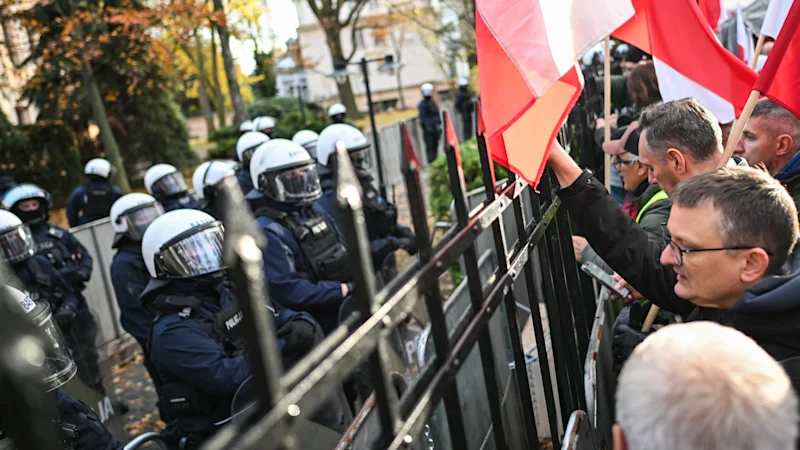
- Riot police guarded the court as several hundred protesters demanded the reinstatement of its suspended president.
- Tusk pledged support for newly elected judges and ruled out compromise over the rule of law.
- The European Commission backed Parliament's right to appoint judges, while the dispute over their installation remained unresolved.
Timeline · 8 moments
Four former court presidents support Tusk's government
DIE ZEIT | Nachrichten, News, Hintergründe und Debatten ↗European Commission backs Parliament's right to appoint judges
Euronews ↗Acting tribunal president reportedly bars suspended leaders
RT en Español - Noticias ↗Tusk pledges no compromise in televised national address
Euronews ↗Nawrocki convenes political parties for crisis consultations
La Nacion ↗Nawrocki enters tribunal during confrontation with a judge
DER SPIEGEL - Schlagzeilen – Tops ↗Riot police guard court as protesters demand reinstatement
Sydney Morning Herald ↗Two senior tribunal judges suspended by fellow judge
NDTV Top Stories ↗How it started
The immediate trigger was the suspension of the Constitutional Tribunal's leadership on October 30. NDTV Top Stories reported that a fellow judge suspended two senior judges. NYT World News described judges backed by the current government suspending the chief justice after years of legal wrangling.
Accounts differ over who formally carried out the suspension. TGcom24 attributed it directly to Prime Minister Donald Tusk. The distinction matters because the dispute concerns not just who should lead the tribunal, but who has authority to change its leadership.
The broader conflict concerns the court's independence and membership. According to Al Jazeera, the centrist government says it is restoring judicial independence after years of far-right political interference. Il Post described the opposing camp as the right-wing PiS party, supported by President Karol Nawrocki.
How it unfolded
On October 30, protesters gathered outside the tribunal to oppose its president's suspension, which they considered unlawful, according to France24. Riot police began guarding the building that afternoon, Sydney Morning Herald reported, with several hundred demonstrators demanding reinstatement.
That evening, Nawrocki entered the tribunal in a physical confrontation. DER SPIEGEL reported that he pushed his way inside and pressed a female judge down. In the early hours of October 31, he accused the government of violating the constitutional order, according to CNN Brasil.
On October 31, Nawrocki convened representatives of the centrist majority and nationalist opposition for consultations aimed at finding a way out of the crisis, La Nacion reported. His accusation was that Tusk's government had taken the court by force.
Tusk responded with a televised address on October 31. According to Euronews, he accused PiS and Nawrocki of undermining the rule of law, pledged support for newly elected judges and vowed there would be no compromise on that principle.
A report published on November 1 added another practical barrier to resolving the standoff. RT en Español reported that Anna Korwin-Piotrowska, who presented herself as acting president of the tribunal, had barred its president and vice president from entering the building on October 31.
Where it stands
Neither side appeared ready to retreat after the crisis talks, Al Jazeera reported on November 1. Tusk has defended the overhaul, while Nawrocki and the opposition continue to challenge the changes as an unlawful takeover. The coup allegation is their accusation, not an established finding.
The dispute has also drawn a response from Brussels. Euronews reported on November 1 that the European Commission said Poland's Parliament has the right to appoint Constitutional Court judges. Le Monde reported that Brussels called on Nawrocki to validate the new appointments.
Four former court presidents have backed the government and criticised Nawrocki's conduct, according to DIE ZEIT. That support adds to the political pressure, but the supplied coverage does not report a settlement over the tribunal's leadership or membership.
What to watch
The immediate test is whether the newly appointed judges can take their places and whether Nawrocki validates their appointments, as Brussels has urged, according to Le Monde. Access to the building also remains a concrete point of conflict following the reported exclusion of the suspended leadership.
Any outcome from the party consultations will need to address those competing claims to authority. Al Jazeera reported no apparent retreat by either side, while Tusk's pledge of no compromise leaves little sign of an imminent political agreement.
More in Politics
All →
Canada and EU Keep Associate Membership Talks Alive After Summit
Mark Carney set June 2027 as a target for concluding talks on Canada becoming the EU's first associate member, while the sides launched a new alliance.
33 sources · over 4 days
AAP names 40 Punjab candidates as two MLAs quit party
Chief Minister Bhagwant Mann will contest from Dhuri again, but two MLA resignations a day after the list have brought internal dissent into focus.
9 sources · over 3 days
Norway Answers Trump's Nobel Peace Prize Insults With Toilet Humour
Norwegian officials say they have no influence over the Nobel decision, while tourism promoters have turned President Donald Trump's vulgar attack into a showcase for public toilets.
22 sources · over 6 days