
Poland's Court Crisis Deepens as Tusk and Nawrocki Clash Over Judges
The suspension of Constitutional Tribunal leaders has brought police, protesters and European Commission pressure into a dispute over who can take their seats on Poland's court.
By Hushread Stories, from 46 outlets · First published 3 Nov 2026 · Chapter 5 of 5
Earlier: Poland's Court Crisis Deepens as Tusk and Nawrocki Clash Over Judges
In brief
- The suspension of Constitutional Tribunal chief judge Bogdan Swieczkowski triggered a confrontation over control of the court.
- President Karol Nawrocki accuses Prime Minister Donald Tusk's government of forcibly taking over the judiciary.
- Tusk says Nawrocki must recognise judges elected by parliament and accuses him of seeking confrontation.
- The European Commission backed parliament's right to appoint judges, while four former court presidents supported Tusk's government.
- Crisis talks produced no breakthrough, and judges plan to meet despite the continuing dispute over court membership.
Timeline · 8 moments
Constitutional judges plan meeting despite disputed court membership
DIE WELT ↗Tusk urges Nawrocki to recognise parliament's elected judges
Euronews ↗Four former court presidents back Tusk's government
DIE ZEIT | Nachrichten, News, Hintergründe und Debatten ↗European Commission backs parliament's right to appoint judges
Euronews ↗Acting court president bars suspended leaders from building
RT en Español - Noticias ↗Tusk pledges support for newly elected tribunal judges
Euronews ↗Nawrocki convenes parties for talks on court crisis
La Nacion ↗Tusk defends suspension as opposition alleges institutional coup
Financial Times ↗How it started
Poland's immediate crisis concerns who is entitled to sit on the Constitutional Tribunal, but the dispute has been building for years. Il Post described a prolonged struggle between government and opposition over the court's membership and influence over its work.
Since returning to power in 2023, Prime Minister Donald Tusk has promised to resolve the crisis around a tribunal controlled by the nationalist opposition, according to Le Monde. His efforts have stalled over the recognition of new judges.
The latest confrontation followed President Karol Nawrocki's refusal to accept new judicial appointments. TGcom24 reported that Tusk then suspended the Constitutional Tribunal's president. The two sides present these steps in sharply different terms: the government calls its intervention a repair of the court, while opponents describe an institutional coup, according to the Financial Times.
How it unfolded
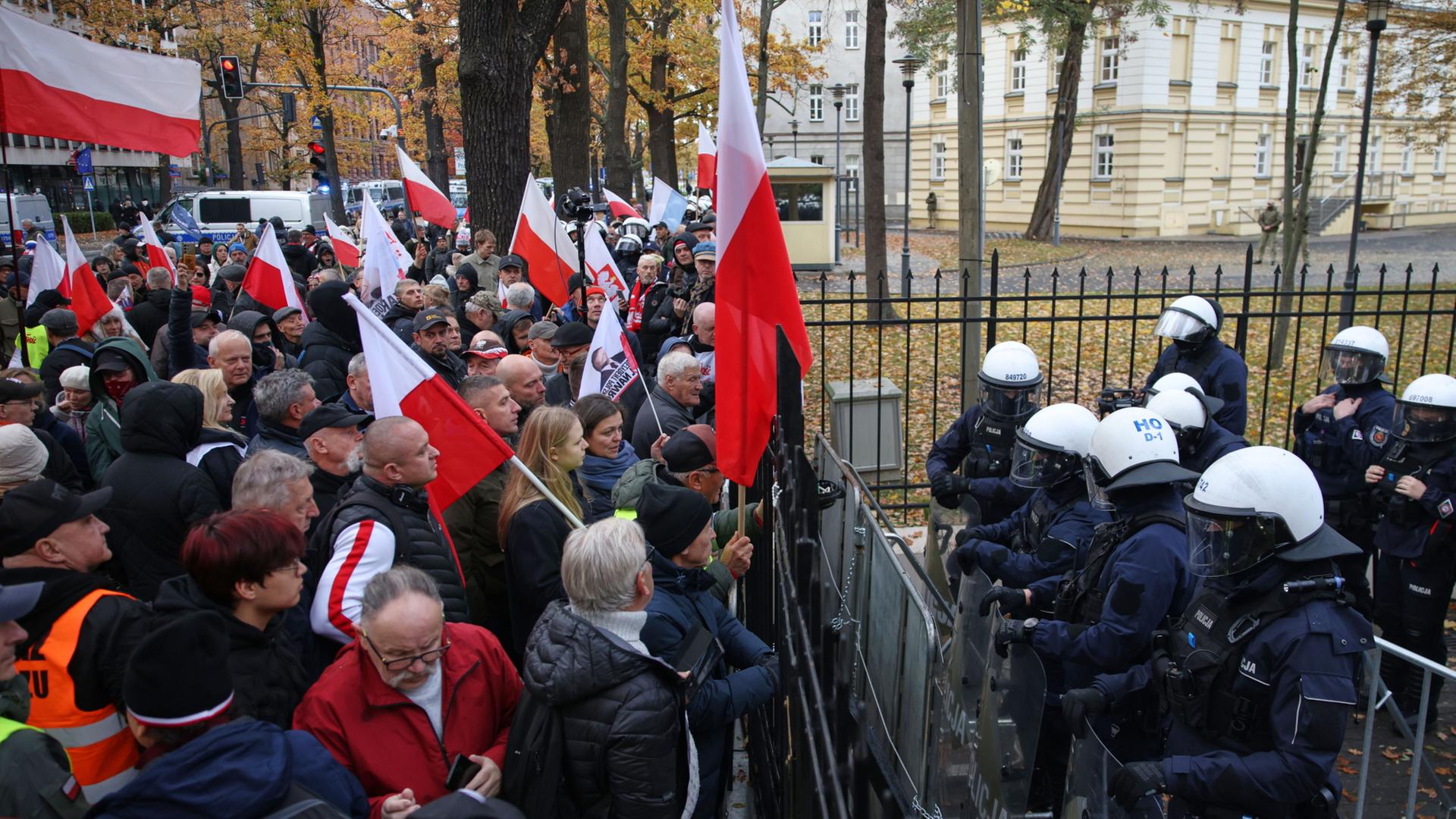
On October 30, the dispute moved into a physical confrontation at the tribunal. Le Monde reported police intervention inside the institution, while the Sydney Morning Herald said riot police had guarded the court since Friday afternoon. Several hundred protesters gathered to demand the reinstatement of its president.
Nawrocki entered the court on Friday evening and pushed a female judge down, according to DER SPIEGEL. He accused Tusk's government of a forced takeover of the court, Times now reported on October 31.
On October 31, Nawrocki held consultations with political parties after the suspension of Constitutional Tribunal chief judge Bogdan Swieczkowski. The talks produced no breakthrough by Saturday afternoon, according to Al Jazeera.
Tusk addressed the nation that day, accusing PiS and Nawrocki of undermining the rule of law and pledging support for newly elected judges, Euronews reported. In a further sign of the struggle over authority inside the court, Anna Korwin-Piotrowska, presenting herself as acting tribunal president, barred its president and vice president from entering, according to RT en Español.
By November 1, the European Commission had publicly backed parliament's right to appoint Constitutional Tribunal judges, Euronews reported. Four former court presidents also supported Tusk's government and criticised Nawrocki's conduct, according to DIE ZEIT.
On November 2, Tusk called on Nawrocki to recognise the judges elected by parliament and accused him of choosing a forceful confrontation, Euronews reported. DIE ZEIT reported his argument that the crisis could be resolved if the president swore in the new judges.
Where it stands
There was no sign of compromise in the November 3 account from ARD Tagesschau. It reported that both the tribunal's president and his deputy had been suspended, and that Nawrocki had cut short a foreign trip amid the weekend turmoil.
The central disagreement remains unresolved: Tusk wants recognition of the new judges, while Nawrocki alleges a government takeover. European Commission support for parliament's appointment powers has added pressure, but has not produced a settlement in the coverage provided.
What to watch
The immediate test is whether Nawrocki agrees to swear in or recognise the disputed judges. Tusk has presented that step as the route out of the crisis, according to DIE ZEIT, but the latest reporting offers no indication of an agreement.
The court's ability to conduct business is another concrete issue. DIE WELT reported on November 2 that constitutional judges intended to meet despite the membership dispute. Whether that proceeds, and whose authority is accepted inside the tribunal, remains unsettled.
More in Politics
All →
Trump says US will end $4 billion Israel aid after 2026
Trump says he has agreed with Benjamin Netanyahu to end annual US military aid to Israel, but the coverage provides no details on how the cutoff would work.
9 sources · today
Israeli Opposition Pursues Government Without Netanyahu as Arab Coalition Offers Support
An inconclusive election has left Arab lawmakers central to Israel's coalition talks, but opposition divisions over working with them could obstruct efforts to replace Benjamin Netanyahu.
15 sources · over 2 days
US to Mediate Ukraine-Russia Talks in Abu Dhabi on November 10-11
The planned meeting will bring American, Ukrainian and Russian officials together for renewed peace negotiations, with working-level discussions scheduled as the conflict heads toward winter.
26 sources · today