
Disclosure: Hushread is my app. I’ve tried to be fair, and I say where the others are the better choice.
To follow a topic in RSS, you subscribe to a search instead of a site. Google News, Bing News, Hacker News (through hnrss), Reddit, Mastodon hashtags and many publishers’ tag pages all turn a word into a feed URL you can paste into any reader. I ran the same topic, “heat pump”, through seven of them on 21 October 2026: Google News gave the most (100 items, all from the past week), Bing gave fewer but fuller items (a summary on each, a picture on some), and the rest are narrow but useful in their own corner.
Keyword RSS feeds compared
Fetched on 21 October 2026, all for “heat pump”:
| Feed | URL pattern | Items | Span | What each item has |
|---|---|---|---|---|
| Google News search | news.google.com/rss/search?q=TERM | 100 | 14 to 20 Oct | Headline, outlet, Google redirect link |
| Bing News search | bing.com/news/search?q=TERM&format=rss | 12 | Mostly 9 to 20 Oct | Headline, summary, outlet, some pictures |
| Guardian tag page | theguardian.com/environment/heat-pumps/rss | 20 | Jan to 21 Oct | Headline, summary, pictures |
| Hacker News (hnrss) | hnrss.org/newest?q=TERM | 20 | Dec 2025 to 25 Sep | HN post and link |
| Reddit search (ends 13 Nov 2026) | reddit.com/search.rss?q=TERM&sort=new | 25 | Mostly past hours | 3 subreddits, then 22 posts |
| Mastodon hashtag | mastodon.social/tags/heatpump.rss | 20 | 24 Sep to 19 Oct | Post text and media |
| WordPress site search | electrek.co/?s=TERM&feed=rss2 | 500 | 2015 to Oct 2026 | Post, in no date order |
Search feeds trade depth for reach: Google News sees every outlet but gives you a bare headline, while a single publisher’s tag feed is slow but carries a summary and pictures. For news coverage of a subject, start with the first three. For what people are saying about it, add Hacker News, Reddit and Mastodon.
Publisher tag feeds: the cleanest topic feed
Before any search engine, check whether a publisher you trust already has a page for the topic. Editors tag their own articles, so a tag feed has no false matches. The Guardian says so directly: “you can find the feed for any index page simply by adding /rss to the url. This works for sections, keywords and profiles” (The Guardian).
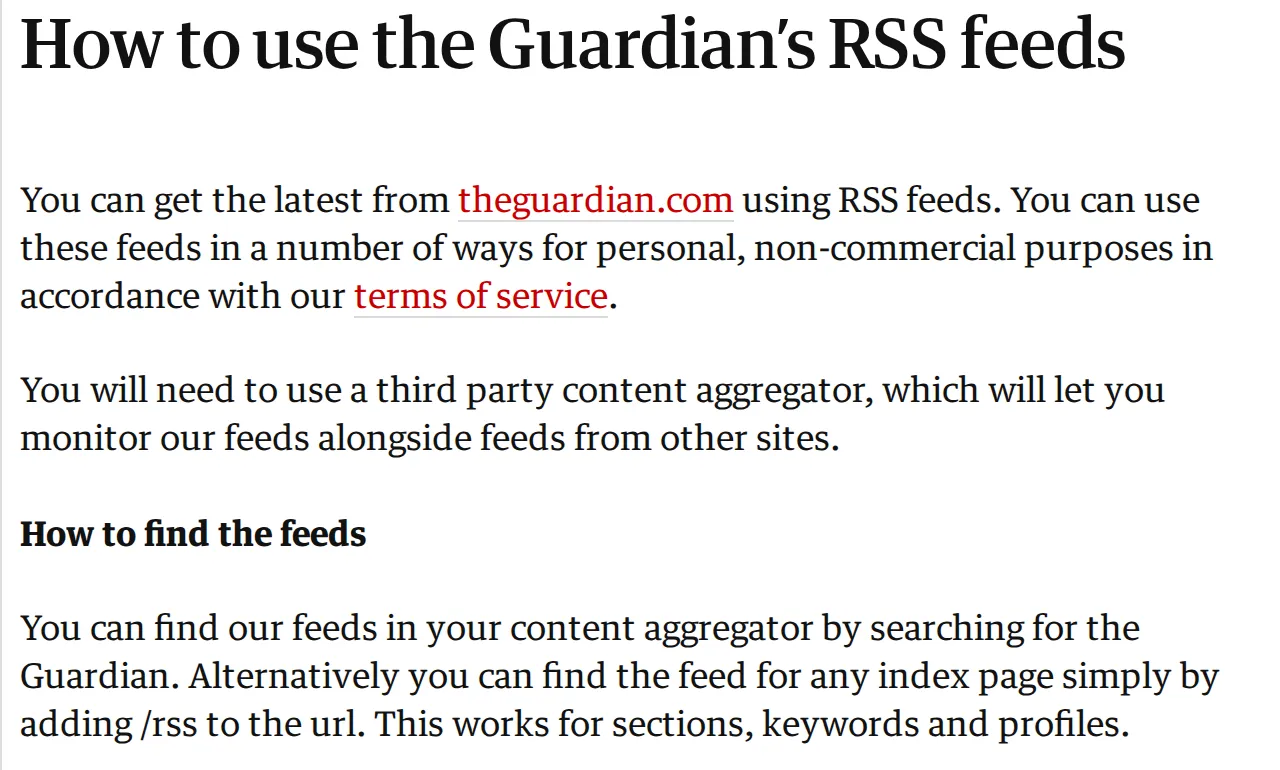 The Guardian’s RSS help page, 21 October 2026. Source: theguardian.com
To find a tag page, open any article on the subject and click its topic label, then add /rss to that page’s address. The Guardian’s heat pumps page with /rss added returned 20 articles going back to January, all ones the Guardian’s editors had filed under heat pumps: subsidies, sales across Europe, energy bills, the warm homes plan. That is the trade-off: one outlet and slow, but nothing that only matched a word by accident. If you aren’t sure whether a site has topic feeds, finding the RSS feed of any website walks through the checks.
Site search feeds are the noisy cousin. Many WordPress sites will return their search results as a feed if you add &feed=rss2 to a search URL. Electrek’s search for “heat pump” came back with 500 items reaching back to 2015, in no date order, and the first four headlines were about Tesla’s energy plans, EV chargers and wind power. Fine for a one-off dig, not for a daily feed.
Google News search feeds: the widest net for news
Put your words after q= and set the edition, and you have a feed of every outlet Google News indexes:
https://news.google.com/rss/search?q=%22heat+pump%22+when:7d&hl=en-US&gl=US&ceid=US:enThat returned exactly 100 items, all from 14 to 20 October, which is the cap: a busy topic hits it in days. Items come in relevance order, not by date, and each is a headline, the outlet’s name and a link through a Google redirect. The when:7d, intitle: and site: operators narrow it, and Feedly’s help page documents the hl, gl and ceid edition parameters (Feedly). The full set of URL formats, and why the redirect links break “load full article” buttons, is in the Google News RSS guide.
The free Google News RSS feed generator builds the URL for you. If you’d rather skip URLs altogether, in Hushread you type the words into Add source and tap Track ”…” on the internet. It runs the same Google News search, opens the publisher’s article instead of the Google redirect, and puts new matches in your feed newest first (Hushread docs). Topics are on the free plan, which has no limit on sources.
Bing News RSS: fewer items, fuller ones
Add &format=rss to a Bing News search:
https://www.bing.com/news/search?q=%22heat+pump%22&format=rss&setmkt=en-USMicrosoft described the parameter back in 2010 and warned that “Bing limits you to 10 items in the RSS feed at a time” (Microsoft). The cap is a little looser now: I got 10 to 12 items per request. But each carried a short summary and the outlet’s name, and some had a thumbnail (5 of the 12 in the US version), none of which Google’s feed gives you. Most were from the past two weeks, with the odd older story mixed in, one from May 2025. The link goes through bing.com/news/apiclick.aspx, with the publisher’s address in its url= parameter.
Bing picks the market from where the request comes from, so add setmkt=en-US (or your own market) to fix the edition. With it, my feed’s sources became the Detroit Free Press, CBC and Yahoo Finance. Microsoft doesn’t document format=rss today, so treat it as unofficial.
A dozen items is too few for a busy topic, but for a narrow one (a small company, a local issue) Bing’s summaries make it the nicer read.
Hacker News, Reddit and Mastodon: what people say about it
News feeds tell you what was published. These three tell you what people are discussing.
Hacker News. hnrss.org builds feeds from HN, and its docs say “You can get a feed of new posts and/or comments containing keywords by using the q=KEYWORD parameter” (hnrss). Feeds return 20 items by default, count= raises that to a hard limit of 100, and points=N keeps only posts above N points. “Heat pump” is a rare HN subject: my 20 items stretched back about nine months, to December 2025.
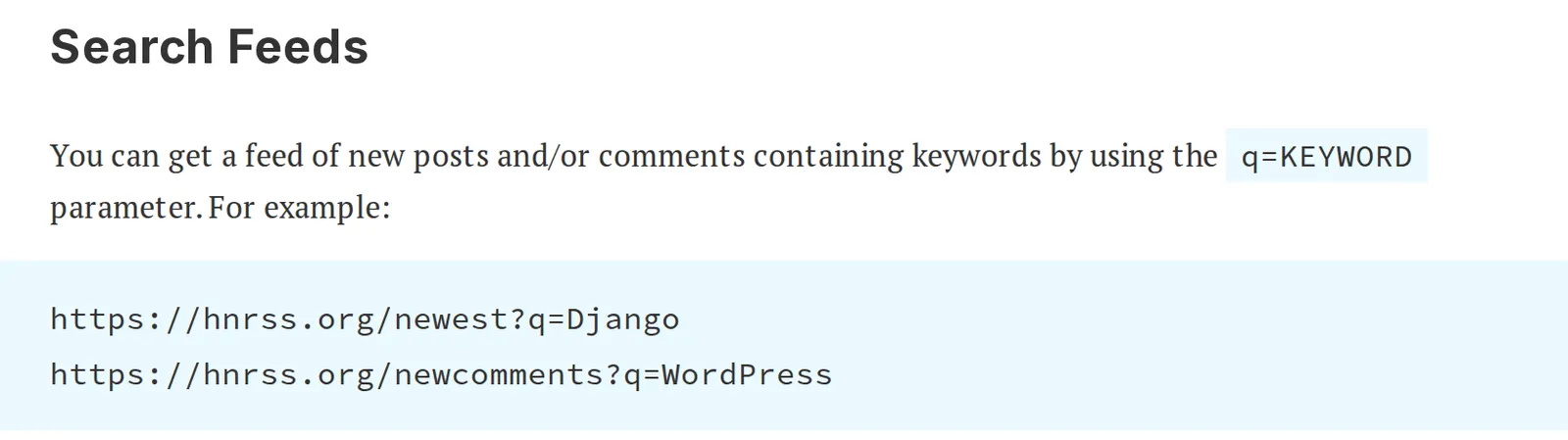 The Search Feeds section of the hnrss docs, 21 October 2026. Source: hnrss.github.io
Reddit. reddit.com/search.rss?q=TERM&sort=new returned 25 entries: three matching subreddits first, then 22 posts, most from the past few hours. It has a short life. Reddit is shutting down its RSS feeds on November 13, 2026 (heise); what ends and what replaces it is in the Reddit RSS shutdown post.
Mastodon. Every hashtag has a feed at SERVER/tags/TAG.rss; Mastodon’s docs say “Every account and tag page provide an RSS feed” (Mastodon docs). #heatpump on mastodon.social gave 20 posts from the past four weeks. A hashtag feed shows only the posts that one server knows about, and only posts that use the tag, not every post that mentions the words.
Google Alerts vs RSS
Google Alerts is the other common way to follow a topic, but Google’s own help page describes it as email: “You’ll get emails whenever we find matching search results” (Google). Feedly’s help says an alert can be “delivered as RSS feed” (Feedly), so you can read alerts in a reader too. Alerts search Google Search results, not only news; a Google News feed covers news only but needs no account.
Keeping a topic feed clean
Every method above matches words, so every one picks up noise. A few habits help:
- Quote phrases.
"heat pump"instead ofheat pumpstops matches on “heat” and “pump” in separate sentences. - Exclude the words that keep slipping in. Google’s search help says to “Enter
-in front of a word that you want to leave out” (Google Search Help), and it works in news feeds: my week of “heat pump” news had five or six headlines about boilers, and adding-boilerto the search left none. - Filter in the reader. If your reader has keyword rules, mute the words that keep slipping in. In Hushread a Mute rule hides matches from a topic, and a Notify rule sends a push alert when a matching article mentions a word you care about (Hushread rules).
FAQ
How do I make an RSS feed for a keyword?
Put the keyword into a search that has a feed: https://news.google.com/rss/search?q=KEYWORD for news, https://www.bing.com/news/search?q=KEYWORD&format=rss for Bing, https://hnrss.org/newest?q=KEYWORD for Hacker News. Wrap phrases in quotes, encoded as %22.
Is Google Alerts or RSS better for tracking a topic?
Google Alerts suits an occasional email about new pages anywhere on the web. A Google News or Bing News feed suits reading a topic every day next to your other sources, needs no Google account, and shows up in whatever reader you already use.
Can I follow a hashtag in an RSS reader?
On Mastodon, yes: add .rss to the hashtag’s page, as in https://mastodon.social/tags/heatpump.rss. The feed shows the last 20 public posts with that tag that the server knows about.
How do I track a topic online without Google Alerts?
Make a Google News search feed for it and add it to any RSS reader; it needs no Google account. For brand-monitoring tools that also cover social networks, see Google Alerts alternatives.
Why does my keyword RSS feed show old articles?
Search feeds are often ordered by relevance, not date. Add a time limit such as when:7d to a Google News search, or use a publisher’s tag feed, which lists articles newest first.
If one outlet covers your subject well, its tag feed beats every search here. If you want the whole web’s coverage and are happy to build URLs, a Google News feed in the reader you already have does the job for free. If you’d rather type the words and get the publisher’s links, get Hushread.