
Disclosure: Hushread is our app. We’ve tried to be fair, and we say where the others are the better choice.
No. RSS is not dead: on 9 October 2026 we fetched working, freshly updated feeds from the BBC, The New York Times, The Guardian, NPR, NASA, YouTube and GitHub, and podcasting still runs on it. What did die is the support around it. Google closed its reader in 2013, Firefox removed its feed features in 2018, and some sites have dropped their feeds or announced that they will. The format is in daily use; the big companies stopped putting it in front of you.
Where the “RSS is dead” idea comes from
Mostly from one announcement. On 13 March 2013, Google software engineer Alan Green wrote on the official Google Reader blog that Reader would be retired on 1 July 2013, and gave the reasons in one sentence: “There are two simple reasons for this: usage of Google Reader has declined, and as a company we’re pouring all of our energy into fewer products” (Google Reader blog).
The company-wide post that day, by Urs Hölzle, SVP Technical Infrastructure and Google Fellow, said the same: “While the product has a loyal following, over the years usage has declined.” Reader was one item in a list of closures that brought the total to “70 features or services closed since our spring cleaning began in 2011” (Google).
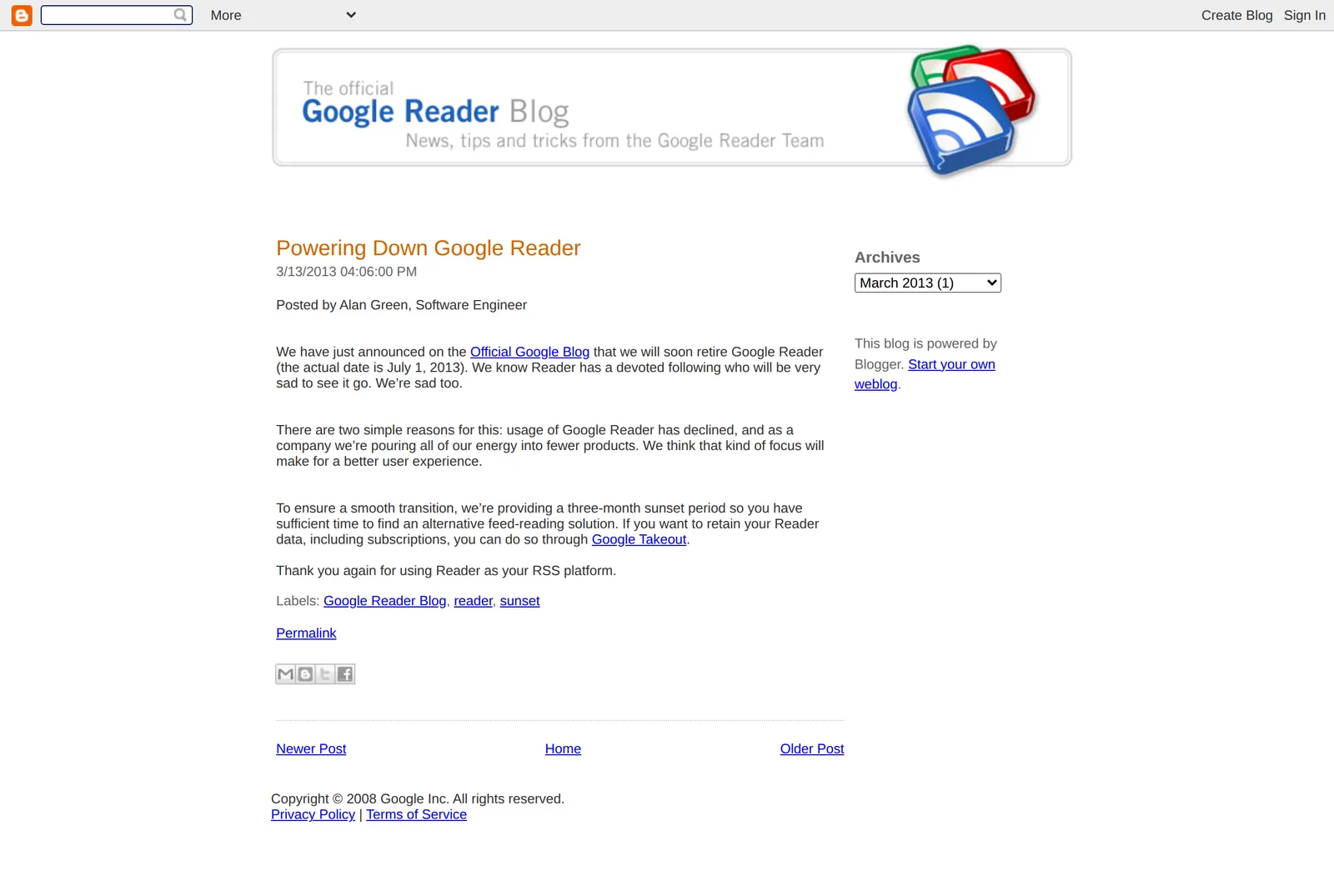 Google’s own announcement that Reader would close, still online on 9 October 2026. Source: googlereader.blogspot.com
Read it closely and it says less than people remember. Google said one product’s usage had fallen and that it wanted fewer products. It did not say feeds were going away, and the same post told users to export their subscriptions and “find an alternative feed-reading solution”.
Is RSS still used? What we fetched on 9 October 2026
A claim that something is alive should be checkable, so we requested each of these with curl on 9 October 2026. Every one returned HTTP 200 and a valid RSS or Atom file.
| Publisher | Feed URL | Newest item published |
|---|---|---|
| BBC News | https://feeds.bbci.co.uk/news/rss.xml | 9 October 2026 |
| The New York Times | https://rss.nytimes.com/services/xml/rss/nyt/HomePage.xml | 9 October 2026 |
| The Guardian | https://www.theguardian.com/world/rss | 9 October 2026 |
| NPR | https://feeds.npr.org/1001/rss.xml | 8 October 2026 |
| NASA | https://www.nasa.gov/feed/ | 8 October 2026 |
| YouTube (one channel) | https://www.youtube.com/feeds/videos.xml?channel_id=UCBJycsmduvYEL83R_U4JriQ | 8 October 2026 |
| GitHub (Linux kernel commits) | https://github.com/torvalds/linux/commits/master.atom | 8 October 2026 |
Newer platforms answered too. Mastodon’s own account has a feed at https://mastodon.social/@Mastodon.rss, and Bluesky’s at https://bsky.app/profile/bsky.app/rss; both returned RSS with posts from 2026.
Much of this happens without anyone deciding to “support RSS”. WordPress’s documentation says “By default, WordPress comes with various feeds” (WordPress), and W3Techs counted WordPress on 40.1% of all websites on 8 October 2026 (W3Techs). A site owner can switch a feed off, so that is a ceiling, not a count of live feeds. Our guide to finding the RSS feed of any website lists the fixed feed addresses other publishing platforms use.
Podcasts are RSS
If you listened to a podcast this week, you used RSS. Apple’s requirements say a show’s feed “must adhere to RSS 2.0 specifications” and that “Each episode must have a unique <enclosure> tag” (Apple Podcasts for Creators). Spotify describes a podcast’s RSS feed to creators as “a file that contains everything about your podcast” (Spotify). YouTube takes podcasts in the same way: “When a new episode is added to your RSS feed, it will automatically upload to your channel” (YouTube Help).
We checked one. The feed for The Daily, at https://feeds.simplecast.com/54nAGcIl, has a root tag that begins <rss version="2.0", was a 20.3 MB file holding 3,000 audio enclosures, and its newest episode was dated 8 October 2026.
For scale, the Podcast Index, an open directory of podcast feeds, listed 4,737,429 podcasts when we opened it on 9 October 2026. Of those, 108,253 had published in the last 3 days, 237,612 in the last 10, 340,353 in the last 30, 413,126 in the last 60 and 465,909 in the last 90 (Podcast Index). The counts move by the hour.
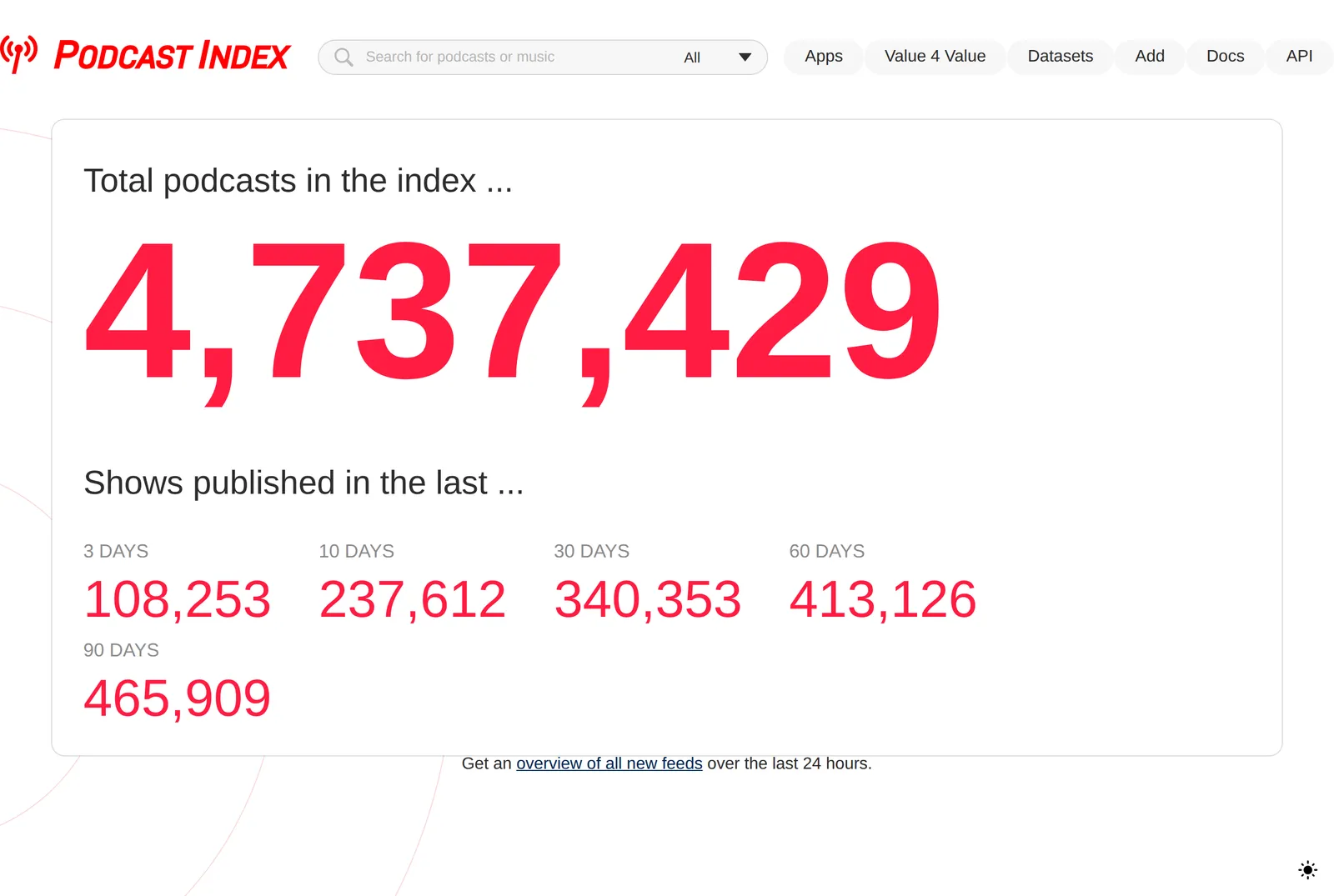 The Podcast Index’s live count of podcast feeds, 9 October 2026. Source: podcastindex.org
What really did die
The pessimists have evidence too, and it is worth being exact about it.
Browser support
Firefox used to preview feeds and keep “live bookmarks” that updated from them. The release notes for Firefox 64, first offered on 11 December 2018, list the change in one line: “RSS feed preview and live bookmarks are available only via add-ons” (Firefox 64 release notes).
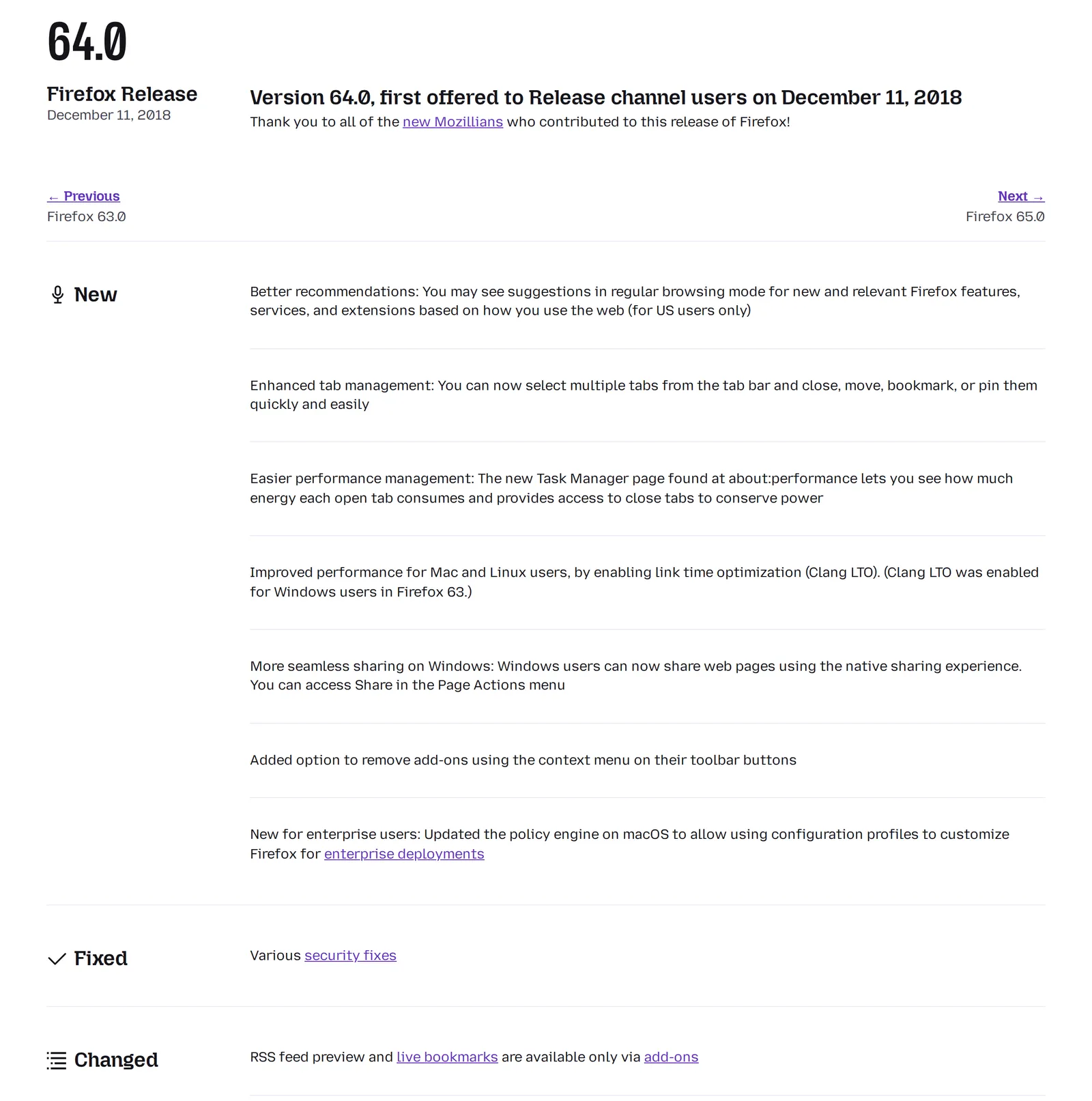 The Firefox release that moved feed support out of the browser, 9 October 2026. Source: firefox.com
Not every browser went that way. Vivaldi’s help pages describe a built-in feed reader that “supports RSS and Atom newsfeed formats”, and say that when a site offers feeds “you’ll see the Feeds button on the right side of the Address field” (Vivaldi Help).
Google has been in between. On 19 May 2021, Chrome product manager Janice Wong wrote that in the coming weeks some Android users in the US on Chrome Canary might see an experimental Follow feature, described as “building on the open RSS web standard” (Chromium Blog). We could not find a current Google help page for the feature, so we can’t tell you whether it is in your copy of Chrome today.
Feeds that were switched off
- Reddit. On 30 September 2026 a Reddit announcement to moderators said “we’ll stop supporting RSS feeds on November 13, 2026”, citing scraping and automated abuse, and added: “If you use RSS for feeds outside of a community you moderate, there is no replacement” (r/modnews, reported by heise). The feeds still answered when we fetched one on 9 October 2026. Our subreddit RSS feed guide covers what works until then.
- Google News. Google told publishers that with its move to automatically generated publication pages in late March 2025, “Google News will no longer use RSS feeds or web locations that were submitted in Publisher Center” (Google Publisher Center).
- CNN. Its old feed at
http://rss.cnn.com/rss/edition.rssstill loads, but when we fetched it on 9 October 2026 nearly every item was dated March or April 2023, the newest was dated 9 April 2024, and the file said it was last built on 22 August 2024. A feed that answers is not always a feed that is maintained.
So the honest picture is mixed. Feeds from publishers, blogs, video channels, code hosts and podcasts are plentiful. Feeds from platforms that want you inside their own app are the ones that disappear.
RSS in 2026: unchanged on purpose
One reason RSS looks dead is that nothing happens to it. The specification says of itself that it “is, for all practical purposes, frozen at version 2.0.1”, and its current text, version 2.0.11, was published on 30 March 2009 (RSS Advisory Board). There are no launches and no version announcements to report.
For a file format that is a strength. The feed The Daily published this week declares version="2.0", the version the frozen specification describes, so a reader written years ago can still open it. If you want to see what is inside one, what is RSS walks through a real feed line by line.
What we could not find is a trustworthy number for how many people use a feed reader today. No primary source we opened gives one, so this post does not quote one. Be wary of articles that do without saying where it came from.
FAQ
Is RSS still used?
Yes. On 9 October 2026 the BBC, The New York Times, The Guardian, NPR, NASA, YouTube and GitHub all served feeds with items from that day or the day before, and Apple Podcasts requires shows submitted by feed to follow the RSS 2.0 specification.
Why did Google kill Reader?
Google gave two reasons on 13 March 2013: “usage of Google Reader has declined, and as a company we’re pouring all of our energy into fewer products.” The retirement date it set was 1 July 2013, as part of a round of closures that Google called spring cleaning.
Is RSS worth using in 2026?
It is if you follow more sites than you can remember to visit, because a reader collects their new posts in one list in the order they were published. It is less useful for sources that have removed their feeds, such as Reddit after 13 November 2026.
Do browsers still support RSS?
Some do. Firefox moved feed preview and live bookmarks to add-ons in version 64 in December 2018, while Vivaldi has a built-in feed reader for RSS and Atom. In other browsers you need an extension or a separate reader app.
Will RSS go away?
Individual feeds do go away when a company decides to remove them, as Reddit has announced. The format itself has no owner who can switch it off: the specification is frozen, its current text dates from 2009, and any site can publish a file that follows it.
If you only check two or three sites, you don’t need RSS, and if most of what you read lives on Reddit or other platforms without feeds, it will not reach them. Otherwise, test it on your own reading: paste the address of a site you visit often into any feed reader and see whether a feed turns up. Hushread, our reader, is free for up to 5 sources and can follow a page that has no feed (docs); NetNewsWire, Feedly and Inoreader are compared in our best RSS reader guide. Try Hushread.